

17 Conducting Polymers as Cost Effective Counter Electrode …
353
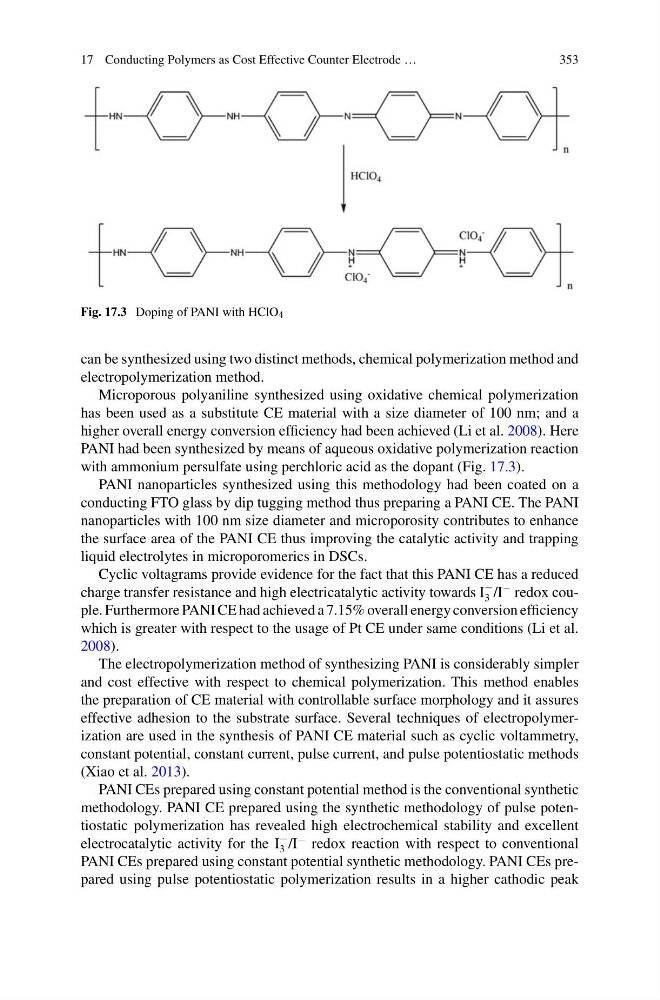
Fig. 17.3 Doping of PANI with HClO 4
can be synthesized using two distinct methods, chemical polymerization method and
electropolymerization method.
Microporous polyaniline synthesized using oxidative chemical polymerization
has been used as a substitute CE material with a size diameter of 100 nm; and a
higher overall energy conversion efficiency had been achieved (Li et al. 2008). Here
PANI had been synthesized by means of aqueous oxidative polymerization reaction
with ammonium persulfate using perchloric acid as the dopant (Fig. 17.3).
PANI nanoparticles synthesized using this methodology had been coated on a
conducting FTO glass by dip tugging method thus preparing a PANI CE. The PANI
nanoparticles with 100 nm size diameter and microporosity contributes to enhance
the surface area of the PANI CE thus improving the catalytic activity and trapping
liquid electrolytes in microporomerics in DSCs.
Cyclic voltagrams provide evidence for the fact that this PANI CE has a reduced
charge transfer resistance and high electricatalytic activity towards I
−
3 /I
− redox couple. Furthermore PANI CE had achieved a 7.15% overall energy conversion efficiency
which is greater with respect to the usage of Pt CE under same conditions (Li et al.
2008).
The electropolymerization method of synthesizing PANI is considerably simpler
and cost effective with respect to chemical polymerization. This method enables
the preparation of CE material with controllable surface morphology and it assures
effective adhesion to the substrate surface. Several techniques of electropolymerization are used in the synthesis of PANI CE material such as cyclic voltammetry,
constant potential, constant current, pulse current, and pulse potentiostatic methods
(Xiao et al. 2013).
PANI CEs prepared using constant potential method is the conventional synthetic
methodology. PANI CE prepared using the synthetic methodology of pulse potentiostatic polymerization has revealed high electrochemical stability and excellent
electrocatalytic activity for the I
−
3 /I
− redox reaction with respect to conventional
PANI CEs prepared using constant potential synthetic methodology. PANI CEs prepared using pulse potentiostatic polymerization results in a higher cathodic peak
353
Fig. 17.3 Doping of PANI with HClO 4
can be synthesized using two distinct methods, chemical polymerization method and
electropolymerization method.
Microporous polyaniline synthesized using oxidative chemical polymerization
has been used as a substitute CE material with a size diameter of 100 nm; and a
higher overall energy conversion efficiency had been achieved (Li et al. 2008). Here
PANI had been synthesized by means of aqueous oxidative polymerization reaction
with ammonium persulfate using perchloric acid as the dopant (Fig. 17.3).
PANI nanoparticles synthesized using this methodology had been coated on a
conducting FTO glass by dip tugging method thus preparing a PANI CE. The PANI
nanoparticles with 100 nm size diameter and microporosity contributes to enhance
the surface area of the PANI CE thus improving the catalytic activity and trapping
liquid electrolytes in microporomerics in DSCs.
Cyclic voltagrams provide evidence for the fact that this PANI CE has a reduced
charge transfer resistance and high electricatalytic activity towards I
−
3 /I
− redox couple. Furthermore PANI CE had achieved a 7.15% overall energy conversion efficiency
which is greater with respect to the usage of Pt CE under same conditions (Li et al.
2008).
The electropolymerization method of synthesizing PANI is considerably simpler
and cost effective with respect to chemical polymerization. This method enables
the preparation of CE material with controllable surface morphology and it assures
effective adhesion to the substrate surface. Several techniques of electropolymerization are used in the synthesis of PANI CE material such as cyclic voltammetry,
constant potential, constant current, pulse current, and pulse potentiostatic methods
(Xiao et al. 2013).
PANI CEs prepared using constant potential method is the conventional synthetic
methodology. PANI CE prepared using the synthetic methodology of pulse potentiostatic polymerization has revealed high electrochemical stability and excellent
electrocatalytic activity for the I
−
3 /I
− redox reaction with respect to conventional
PANI CEs prepared using constant potential synthetic methodology. PANI CEs prepared using pulse potentiostatic polymerization results in a higher cathodic peak