

352
S. S. B. Gunasekera et al.
poly(styrene sulfonate) doped poly(3,4-ethylenedioxythiophene) have been investigated as cost effective Pt-free CEs (Thomas et al. 2014; Hou et al. 2012; Tang
et al. 2013). They have revealed promising electrocatalytic activities and low charge
transfer resistance. However conducting polymers associates a major challenge in
their applicability due to been insoluble and mechanically weak. Due to this reason
nanomaterials are been added such as carbon nanotubes, boron nanotubes, graphene,
fullerene in order to improve and enhance their mechanical, electrical properties (Lee
et al. 2008). The use of nanographite/polyaniline composites as CE in DSCs has
yielded an efficiency of 7.07% (Huang et al. 2011). The favourable properties and
appreciable efficiencies of conducting polymer based CEs have inspired extensive
investigation of them as promising CE materials in Pt free DSCs.
17.2.1 Polyaniline (PANI) as a CE in DSCs
PANI is a conducting polymer consisting of a reactive NH group with two phenyl
rings on either sides of it. The reactive NH group can undergo protonation and
deprotonation. Hence conductivity of PANI depends not only on the oxidation state
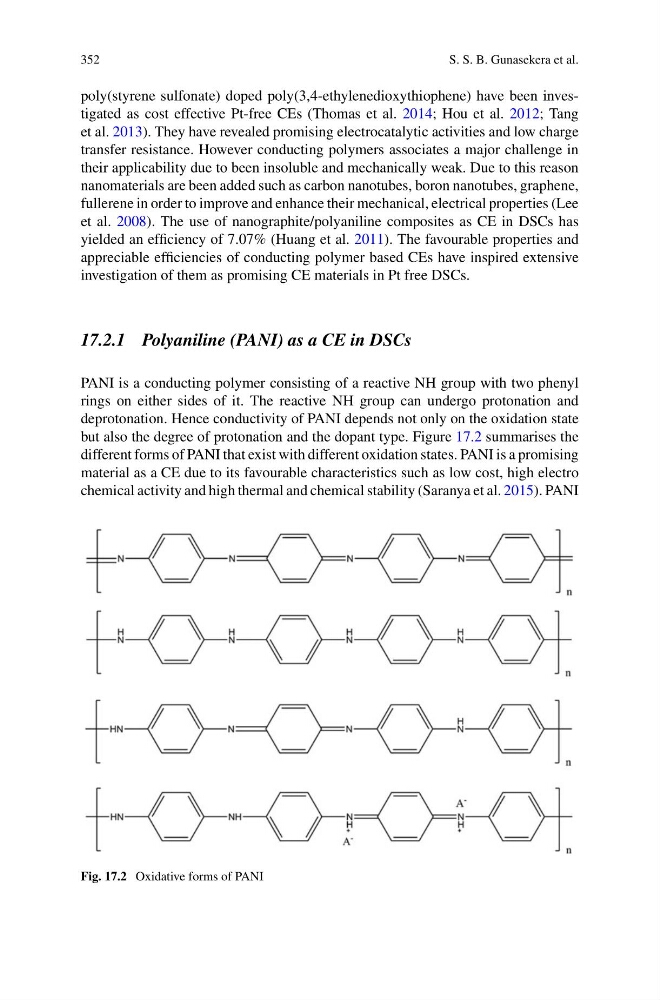
but also the degree of protonation and the dopant type. Figure 17.2 summarises the
different forms of PANI that exist with different oxidation states. PANI is a promising
material as a CE due to its favourable characteristics such as low cost, high electro
chemical activity and high thermal and chemical stability (Saranya et al. 2015). PANI
Fig. 17.2 Oxidative forms of PANI
S. S. B. Gunasekera et al.
poly(styrene sulfonate) doped poly(3,4-ethylenedioxythiophene) have been investigated as cost effective Pt-free CEs (Thomas et al. 2014; Hou et al. 2012; Tang
et al. 2013). They have revealed promising electrocatalytic activities and low charge
transfer resistance. However conducting polymers associates a major challenge in
their applicability due to been insoluble and mechanically weak. Due to this reason
nanomaterials are been added such as carbon nanotubes, boron nanotubes, graphene,
fullerene in order to improve and enhance their mechanical, electrical properties (Lee
et al. 2008). The use of nanographite/polyaniline composites as CE in DSCs has
yielded an efficiency of 7.07% (Huang et al. 2011). The favourable properties and
appreciable efficiencies of conducting polymer based CEs have inspired extensive
investigation of them as promising CE materials in Pt free DSCs.
17.2.1 Polyaniline (PANI) as a CE in DSCs
PANI is a conducting polymer consisting of a reactive NH group with two phenyl
rings on either sides of it. The reactive NH group can undergo protonation and
deprotonation. Hence conductivity of PANI depends not only on the oxidation state
but also the degree of protonation and the dopant type. Figure 17.2 summarises the
different forms of PANI that exist with different oxidation states. PANI is a promising
material as a CE due to its favourable characteristics such as low cost, high electro
chemical activity and high thermal and chemical stability (Saranya et al. 2015). PANI
Fig. 17.2 Oxidative forms of PANI