

348
S. S. B. Gunasekera et al.
as a preferred CE material due to its favourable characteristics such as high catalytic activity and good electrical conductivity (Yun et al. 2015). A liquid electrolyte
is present between the WE and the CE. This electrolyte contains a redox mediator and typically iodide/triiodide redox couple is used in liquid electrolyte (Chiba
et al. 2006) whereas organic hole transport materials such as spiro-OMeTAD (Bach
et al. 1998) and polymer materials such as polyethyleneglycol, polyacrylonitrile and
poly(vinylidine) fluoride-co-hexauoropropylene (Upadhyaya et al. 2006; Cao et al.
1995; Wang et al. 2003) are the common mediators in solid state and quasi-solid state
electrolytes respectively. The function of the electrolyte is the regeneration of the
oxidized dye via electrochemical redox reaction thus completing the cycle. The dye
molecules subjected to oxidation are been reduced by the reduced species migrating
through the electrolyte medium and meanwhile the redox couple regeneration occurs
by means of reduction at the CE (Hagfelt and Grätzel 2000).
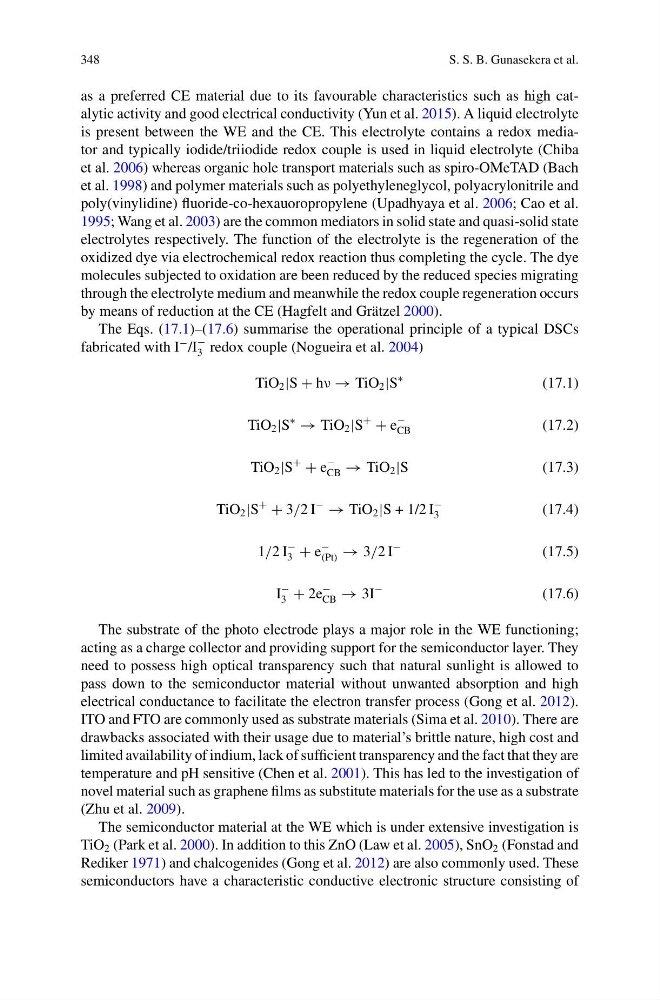
The Eqs. (17.1)–(17.6) summarise the operational principle of a typical DSCs
fabricated with I
− /I
−
3 redox couple (Nogueira et al. 2004)
TiO 2 |S + hν → TiO 2 |S
∗
(17.1)
TiO 2 |S
∗
→ TiO 2 |S
+
+ e
−
CB
(17.2)
TiO 2 |S
+
+ e
−
CB → TiO 2 |S
(17.3)
TiO 2 |S
+
+ 3/2 I
−
→ TiO 2 |S + 1/2 I
−
3
(17.4)
1/2 I
−
3 + e
−
(Pt) → 3/2 I
−
(17.5)
I
−
3 + 2e
−
CB → 3I
−
(17.6)
The substrate of the photo electrode plays a major role in the WE functioning;
acting as a charge collector and providing support for the semiconductor layer. They
need to possess high optical transparency such that natural sunlight is allowed to
pass down to the semiconductor material without unwanted absorption and high
electrical conductance to facilitate the electron transfer process (Gong et al. 2012).
ITO and FTO are commonly used as substrate materials (Sima et al. 2010). There are
drawbacks associated with their usage due to material’s brittle nature, high cost and
limited availability of indium, lack of sufficient transparency and the fact that they are
temperature and pH sensitive (Chen et al. 2001). This has led to the investigation of
novel material such as graphene films as substitute materials for the use as a substrate
(Zhu et al. 2009).
The semiconductor material at the WE which is under extensive investigation is
TiO 2 (Park et al. 2000). In addition to this ZnO (Law et al. 2005), SnO 2 (Fonstad and
Rediker 1971) and chalcogenides (Gong et al. 2012) are also commonly used. These
semiconductors have a characteristic conductive electronic structure consisting of
S. S. B. Gunasekera et al.
as a preferred CE material due to its favourable characteristics such as high catalytic activity and good electrical conductivity (Yun et al. 2015). A liquid electrolyte
is present between the WE and the CE. This electrolyte contains a redox mediator and typically iodide/triiodide redox couple is used in liquid electrolyte (Chiba
et al. 2006) whereas organic hole transport materials such as spiro-OMeTAD (Bach
et al. 1998) and polymer materials such as polyethyleneglycol, polyacrylonitrile and
poly(vinylidine) fluoride-co-hexauoropropylene (Upadhyaya et al. 2006; Cao et al.
1995; Wang et al. 2003) are the common mediators in solid state and quasi-solid state
electrolytes respectively. The function of the electrolyte is the regeneration of the
oxidized dye via electrochemical redox reaction thus completing the cycle. The dye
molecules subjected to oxidation are been reduced by the reduced species migrating
through the electrolyte medium and meanwhile the redox couple regeneration occurs
by means of reduction at the CE (Hagfelt and Grätzel 2000).
The Eqs. (17.1)–(17.6) summarise the operational principle of a typical DSCs
fabricated with I
− /I
−
3 redox couple (Nogueira et al. 2004)
TiO 2 |S + hν → TiO 2 |S
∗
(17.1)
TiO 2 |S
∗
→ TiO 2 |S
+
+ e
−
CB
(17.2)
TiO 2 |S
+
+ e
−
CB → TiO 2 |S
(17.3)
TiO 2 |S
+
+ 3/2 I
−
→ TiO 2 |S + 1/2 I
−
3
(17.4)
1/2 I
−
3 + e
−
(Pt) → 3/2 I
−
(17.5)
I
−
3 + 2e
−
CB → 3I
−
(17.6)
The substrate of the photo electrode plays a major role in the WE functioning;
acting as a charge collector and providing support for the semiconductor layer. They
need to possess high optical transparency such that natural sunlight is allowed to
pass down to the semiconductor material without unwanted absorption and high
electrical conductance to facilitate the electron transfer process (Gong et al. 2012).
ITO and FTO are commonly used as substrate materials (Sima et al. 2010). There are
drawbacks associated with their usage due to material’s brittle nature, high cost and
limited availability of indium, lack of sufficient transparency and the fact that they are
temperature and pH sensitive (Chen et al. 2001). This has led to the investigation of
novel material such as graphene films as substitute materials for the use as a substrate
(Zhu et al. 2009).
The semiconductor material at the WE which is under extensive investigation is
TiO 2 (Park et al. 2000). In addition to this ZnO (Law et al. 2005), SnO 2 (Fonstad and
Rediker 1971) and chalcogenides (Gong et al. 2012) are also commonly used. These
semiconductors have a characteristic conductive electronic structure consisting of