

17 Conducting Polymers as Cost Effective Counter Electrode …
347
17.1.1 Operational Principle of Dye-Sensitized Solar Cells
A dye-sensitized solar cell (DSC) typically consists of three main components; the
dye sensitized semiconductor oxide photoanode/working electrode (WE), redox electrolyte and a counter electrode (CE)/cathode (Grätzel 2001; Hagfelt and Grätzel
2000). The photoanode is a transparent electrode made out of transparent conductive
oxide (TCO) coated on a glass substrate, generally indium doped tin oxide (ITO)
(Tahar et al. 1998) or fluorine doped tin oxide (FTO) (Yang 2009) are used that
facilitate electrical conductivity and light transmittance. A mesoporous semiconductor layer (typically TiO 2 ) is deposited on the TCO in order to enhance and activate
electronic conduction. Additionally the surface of the mesoporous oxide layer is
covalently bonded to a monolayer charge transfer dye which contributes to enhance
light absorption and eventually generate charge carriers. The porous nature and the
morphology of the TiO 2 layer is selected such that it assures a greater degree of
absorption of the dye at the surface thus accommodating a greater area of reaction
sites (Gong et al. 2012).
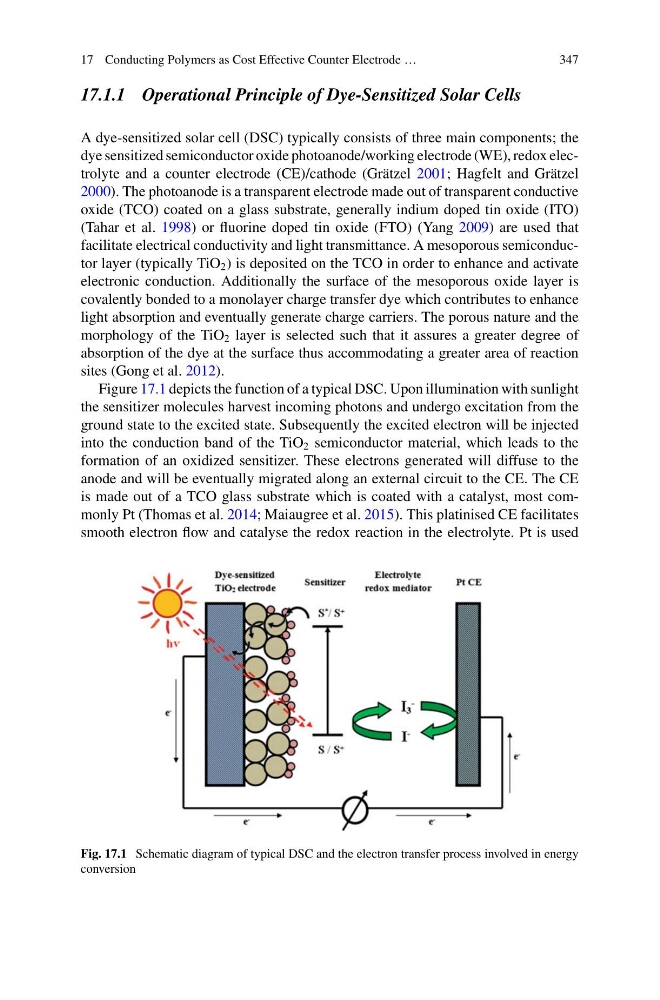
Figure 17.1 depicts the function of a typical DSC. Upon illumination with sunlight
the sensitizer molecules harvest incoming photons and undergo excitation from the
ground state to the excited state. Subsequently the excited electron will be injected
into the conduction band of the TiO 2 semiconductor material, which leads to the
formation of an oxidized sensitizer. These electrons generated will diffuse to the
anode and will be eventually migrated along an external circuit to the CE. The CE
is made out of a TCO glass substrate which is coated with a catalyst, most commonly Pt (Thomas et al. 2014; Maiaugree et al. 2015). This platinised CE facilitates
smooth electron flow and catalyse the redox reaction in the electrolyte. Pt is used
Fig. 17.1 Schematic diagram of typical DSC and the electron transfer process involved in energy
conversion
347
17.1.1 Operational Principle of Dye-Sensitized Solar Cells
A dye-sensitized solar cell (DSC) typically consists of three main components; the
dye sensitized semiconductor oxide photoanode/working electrode (WE), redox electrolyte and a counter electrode (CE)/cathode (Grätzel 2001; Hagfelt and Grätzel
2000). The photoanode is a transparent electrode made out of transparent conductive
oxide (TCO) coated on a glass substrate, generally indium doped tin oxide (ITO)
(Tahar et al. 1998) or fluorine doped tin oxide (FTO) (Yang 2009) are used that
facilitate electrical conductivity and light transmittance. A mesoporous semiconductor layer (typically TiO 2 ) is deposited on the TCO in order to enhance and activate
electronic conduction. Additionally the surface of the mesoporous oxide layer is
covalently bonded to a monolayer charge transfer dye which contributes to enhance
light absorption and eventually generate charge carriers. The porous nature and the
morphology of the TiO 2 layer is selected such that it assures a greater degree of
absorption of the dye at the surface thus accommodating a greater area of reaction
sites (Gong et al. 2012).
Figure 17.1 depicts the function of a typical DSC. Upon illumination with sunlight
the sensitizer molecules harvest incoming photons and undergo excitation from the
ground state to the excited state. Subsequently the excited electron will be injected
into the conduction band of the TiO 2 semiconductor material, which leads to the
formation of an oxidized sensitizer. These electrons generated will diffuse to the
anode and will be eventually migrated along an external circuit to the CE. The CE
is made out of a TCO glass substrate which is coated with a catalyst, most commonly Pt (Thomas et al. 2014; Maiaugree et al. 2015). This platinised CE facilitates
smooth electron flow and catalyse the redox reaction in the electrolyte. Pt is used
Fig. 17.1 Schematic diagram of typical DSC and the electron transfer process involved in energy
conversion