

16 p-Type Dye Sensitized Solar Cells …
317
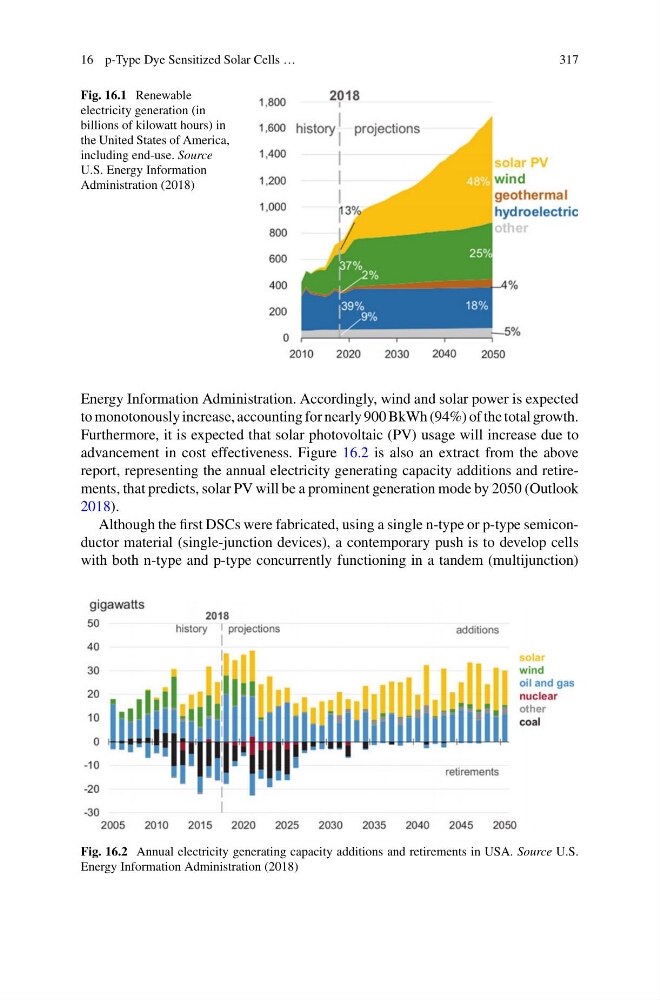
Fig. 16.1 Renewable
electricity generation (in
billions of kilowatt hours) in
the United States of America,
including end-use. Source
U.S. Energy Information
Administration (2018)
Energy Information Administration. Accordingly, wind and solar power is expected
to monotonously increase, accounting for nearly 900 BkWh (94%) of the total growth.
Furthermore, it is expected that solar photovoltaic (PV) usage will increase due to
advancement in cost effectiveness. Figure 16.2 is also an extract from the above
report, representing the annual electricity generating capacity additions and retirements, that predicts, solar PV will be a prominent generation mode by 2050 (Outlook
2018).
Although the first DSCs were fabricated, using a single n-type or p-type semiconductor material (single-junction devices), a contemporary push is to develop cells
with both n-type and p-type concurrently functioning in a tandem (multijunction)
Fig. 16.2 Annual electricity generating capacity additions and retirements in USA. Source U.S.
Energy Information Administration (2018)
317
Fig. 16.1 Renewable
electricity generation (in
billions of kilowatt hours) in
the United States of America,
including end-use. Source
U.S. Energy Information
Administration (2018)
Energy Information Administration. Accordingly, wind and solar power is expected
to monotonously increase, accounting for nearly 900 BkWh (94%) of the total growth.
Furthermore, it is expected that solar photovoltaic (PV) usage will increase due to
advancement in cost effectiveness. Figure 16.2 is also an extract from the above
report, representing the annual electricity generating capacity additions and retirements, that predicts, solar PV will be a prominent generation mode by 2050 (Outlook
2018).
Although the first DSCs were fabricated, using a single n-type or p-type semiconductor material (single-junction devices), a contemporary push is to develop cells
with both n-type and p-type concurrently functioning in a tandem (multijunction)
Fig. 16.2 Annual electricity generating capacity additions and retirements in USA. Source U.S.
Energy Information Administration (2018)