

306
J. B. Liyanage et al.
Another upcoming class of competitors for TiO 2 , are metal-organic frameworks
(MOFs), which are porous crystalline material made up of inorganic nodes, which
are mostly metal cations or clusters; and organic linkers, which are organic ligands
(Li et al. 2014). The light harvesting properties of MOFs were found to depend on the
properties of the linker. Since the linkers are organic molecules having p-electrons,
they absorb energy from the UV and blue regions in the electromagnetic spectrum for
electronic transitions. As result, metal-to-ligand or ligand-to-metal energy transfer
processors are possible, depending on the selection of the linker and metal type. Apart
from this, the controllable architecture, adjustable pore size and high surface area
of MOFs encouraged the application of them in DSCs. Most MOFs are insulators.
However, MOF-5 has exhibited semiconductor behavior due to the geometric type
of metal clusters containing ZnO units in the network which can act as quantum dots
(Llabrés i Xamena et al. 2007). Various studies have been done by incorporating
MOFs into either the working electrode, counter electrode, dye or the electrolyte
medium, that is, any component of a DSC. The highest efficiency of 8.49%, has so
far been attained by the Al-MOG MOF used in the electrolyte medium by Fan et al.
(Fan et al. 2014). So far MOFs have only been incorporated into n-type DSCs and
studies are yet to be done for p-type DSCs.
15.6 Conclusion
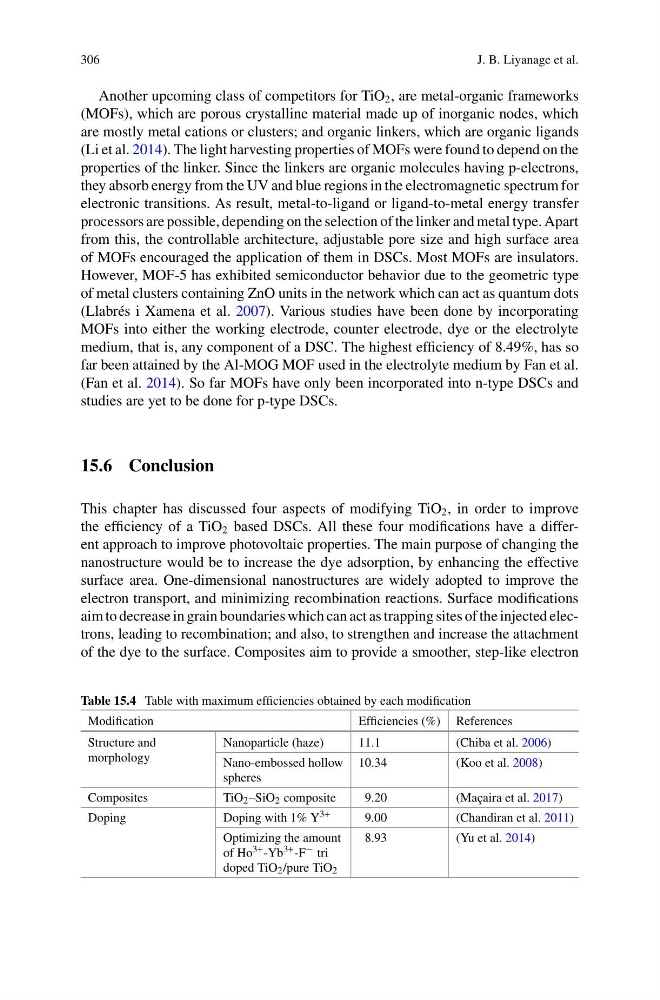
This chapter has discussed four aspects of modifying TiO 2 , in order to improve
the efficiency of a TiO 2 based DSCs. All these four modifications have a different approach to improve photovoltaic properties. The main purpose of changing the
nanostructure would be to increase the dye adsorption, by enhancing the effective
surface area. One-dimensional nanostructures are widely adopted to improve the
electron transport, and minimizing recombination reactions. Surface modifications
aim to decrease in grain boundaries which can act as trapping sites of the injected electrons, leading to recombination; and also, to strengthen and increase the attachment
of the dye to the surface. Composites aim to provide a smoother, step-like electron
Table 15.4 Table with maximum efficiencies obtained by each modification
Modification
Efficiencies (%) References
Structure and
morphology
Nanoparticle (haze)
11.1
(Chiba et al. 2006)
Nano-embossed hollow
spheres
10.34
(Koo et al. 2008)
Composites
TiO 2 –SiO 2 composite
9.20
(Maçaira et al. 2017)
Doping
Doping with 1% Y 3+
9.00
(Chandiran et al. 2011)
Optimizing the amount
of Ho 3+ -Yb 3+ -F − tri
doped TiO 2 /pure TiO 2
8.93
(Yu et al. 2014)
J. B. Liyanage et al.
Another upcoming class of competitors for TiO 2 , are metal-organic frameworks
(MOFs), which are porous crystalline material made up of inorganic nodes, which
are mostly metal cations or clusters; and organic linkers, which are organic ligands
(Li et al. 2014). The light harvesting properties of MOFs were found to depend on the
properties of the linker. Since the linkers are organic molecules having p-electrons,
they absorb energy from the UV and blue regions in the electromagnetic spectrum for
electronic transitions. As result, metal-to-ligand or ligand-to-metal energy transfer
processors are possible, depending on the selection of the linker and metal type. Apart
from this, the controllable architecture, adjustable pore size and high surface area
of MOFs encouraged the application of them in DSCs. Most MOFs are insulators.
However, MOF-5 has exhibited semiconductor behavior due to the geometric type
of metal clusters containing ZnO units in the network which can act as quantum dots
(Llabrés i Xamena et al. 2007). Various studies have been done by incorporating
MOFs into either the working electrode, counter electrode, dye or the electrolyte
medium, that is, any component of a DSC. The highest efficiency of 8.49%, has so
far been attained by the Al-MOG MOF used in the electrolyte medium by Fan et al.
(Fan et al. 2014). So far MOFs have only been incorporated into n-type DSCs and
studies are yet to be done for p-type DSCs.
15.6 Conclusion
This chapter has discussed four aspects of modifying TiO 2 , in order to improve
the efficiency of a TiO 2 based DSCs. All these four modifications have a different approach to improve photovoltaic properties. The main purpose of changing the
nanostructure would be to increase the dye adsorption, by enhancing the effective
surface area. One-dimensional nanostructures are widely adopted to improve the
electron transport, and minimizing recombination reactions. Surface modifications
aim to decrease in grain boundaries which can act as trapping sites of the injected electrons, leading to recombination; and also, to strengthen and increase the attachment
of the dye to the surface. Composites aim to provide a smoother, step-like electron
Table 15.4 Table with maximum efficiencies obtained by each modification
Modification
Efficiencies (%) References
Structure and
morphology
Nanoparticle (haze)
11.1
(Chiba et al. 2006)
Nano-embossed hollow
spheres
10.34
(Koo et al. 2008)
Composites
TiO 2 –SiO 2 composite
9.20
(Maçaira et al. 2017)
Doping
Doping with 1% Y 3+
9.00
(Chandiran et al. 2011)
Optimizing the amount
of Ho 3+ -Yb 3+ -F − tri
doped TiO 2 /pure TiO 2
8.93
(Yu et al. 2014)