

300
J. B. Liyanage et al.
in the host material with impurities, usually of similar atomic radius to the ion to
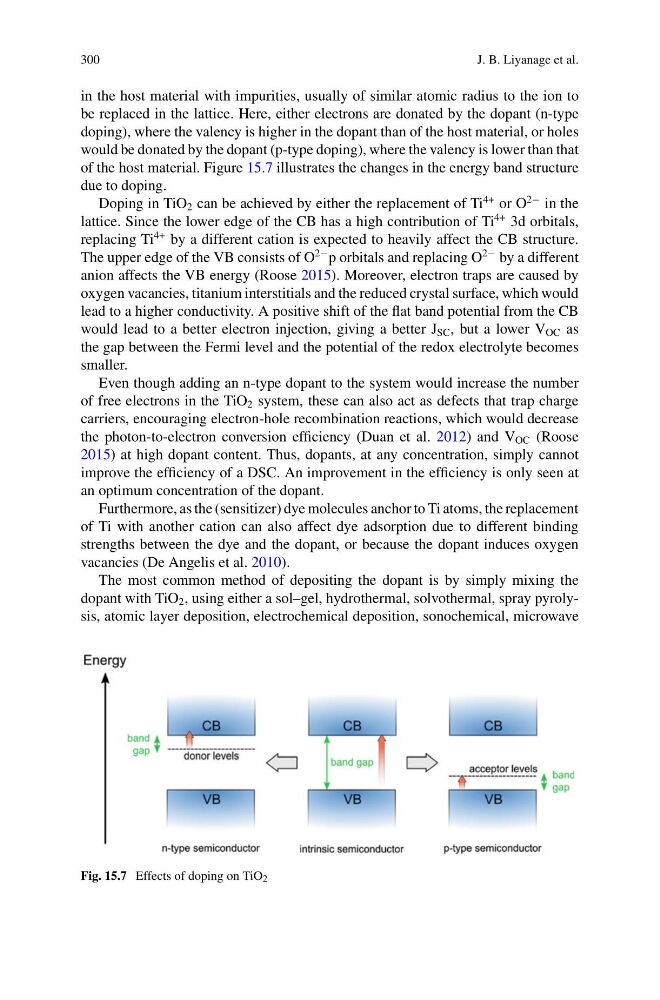
be replaced in the lattice. Here, either electrons are donated by the dopant (n-type
doping), where the valency is higher in the dopant than of the host material, or holes
would be donated by the dopant (p-type doping), where the valency is lower than that
of the host material. Figure 15.7 illustrates the changes in the energy band structure
due to doping.
Doping in TiO 2 can be achieved by either the replacement of Ti
4+ or O
2− in the
lattice. Since the lower edge of the CB has a high contribution of Ti
4+ 3d orbitals,
replacing Ti
4+ by a different cation is expected to heavily affect the CB structure.
The upper edge of the VB consists of O
2− p orbitals and replacing O
2− by a different
anion affects the VB energy (Roose 2015). Moreover, electron traps are caused by
oxygen vacancies, titanium interstitials and the reduced crystal surface, which would
lead to a higher conductivity. A positive shift of the flat band potential from the CB
would lead to a better electron injection, giving a better J SC , but a lower V OC as
the gap between the Fermi level and the potential of the redox electrolyte becomes
smaller.
Even though adding an n-type dopant to the system would increase the number
of free electrons in the TiO 2 system, these can also act as defects that trap charge
carriers, encouraging electron-hole recombination reactions, which would decrease
the photon-to-electron conversion efficiency (Duan et al. 2012) and V OC (Roose
2015) at high dopant content. Thus, dopants, at any concentration, simply cannot
improve the efficiency of a DSC. An improvement in the efficiency is only seen at
an optimum concentration of the dopant.
Furthermore, as the (sensitizer) dye molecules anchor to Ti atoms, the replacement
of Ti with another cation can also affect dye adsorption due to different binding
strengths between the dye and the dopant, or because the dopant induces oxygen
vacancies (De Angelis et al. 2010).
The most common method of depositing the dopant is by simply mixing the
dopant with TiO 2 , using either a sol–gel, hydrothermal, solvothermal, spray pyrolysis, atomic layer deposition, electrochemical deposition, sonochemical, microwave
Fig. 15.7 Effects of doping on TiO 2
J. B. Liyanage et al.
in the host material with impurities, usually of similar atomic radius to the ion to
be replaced in the lattice. Here, either electrons are donated by the dopant (n-type
doping), where the valency is higher in the dopant than of the host material, or holes
would be donated by the dopant (p-type doping), where the valency is lower than that
of the host material. Figure 15.7 illustrates the changes in the energy band structure
due to doping.
Doping in TiO 2 can be achieved by either the replacement of Ti
4+ or O
2− in the
lattice. Since the lower edge of the CB has a high contribution of Ti
4+ 3d orbitals,
replacing Ti
4+ by a different cation is expected to heavily affect the CB structure.
The upper edge of the VB consists of O
2− p orbitals and replacing O
2− by a different
anion affects the VB energy (Roose 2015). Moreover, electron traps are caused by
oxygen vacancies, titanium interstitials and the reduced crystal surface, which would
lead to a higher conductivity. A positive shift of the flat band potential from the CB
would lead to a better electron injection, giving a better J SC , but a lower V OC as
the gap between the Fermi level and the potential of the redox electrolyte becomes
smaller.
Even though adding an n-type dopant to the system would increase the number
of free electrons in the TiO 2 system, these can also act as defects that trap charge
carriers, encouraging electron-hole recombination reactions, which would decrease
the photon-to-electron conversion efficiency (Duan et al. 2012) and V OC (Roose
2015) at high dopant content. Thus, dopants, at any concentration, simply cannot
improve the efficiency of a DSC. An improvement in the efficiency is only seen at
an optimum concentration of the dopant.
Furthermore, as the (sensitizer) dye molecules anchor to Ti atoms, the replacement
of Ti with another cation can also affect dye adsorption due to different binding
strengths between the dye and the dopant, or because the dopant induces oxygen
vacancies (De Angelis et al. 2010).
The most common method of depositing the dopant is by simply mixing the
dopant with TiO 2 , using either a sol–gel, hydrothermal, solvothermal, spray pyrolysis, atomic layer deposition, electrochemical deposition, sonochemical, microwave
Fig. 15.7 Effects of doping on TiO 2