

15 Yet to Be Challenged: TiO 2 as the Photo-Anode Material …
299
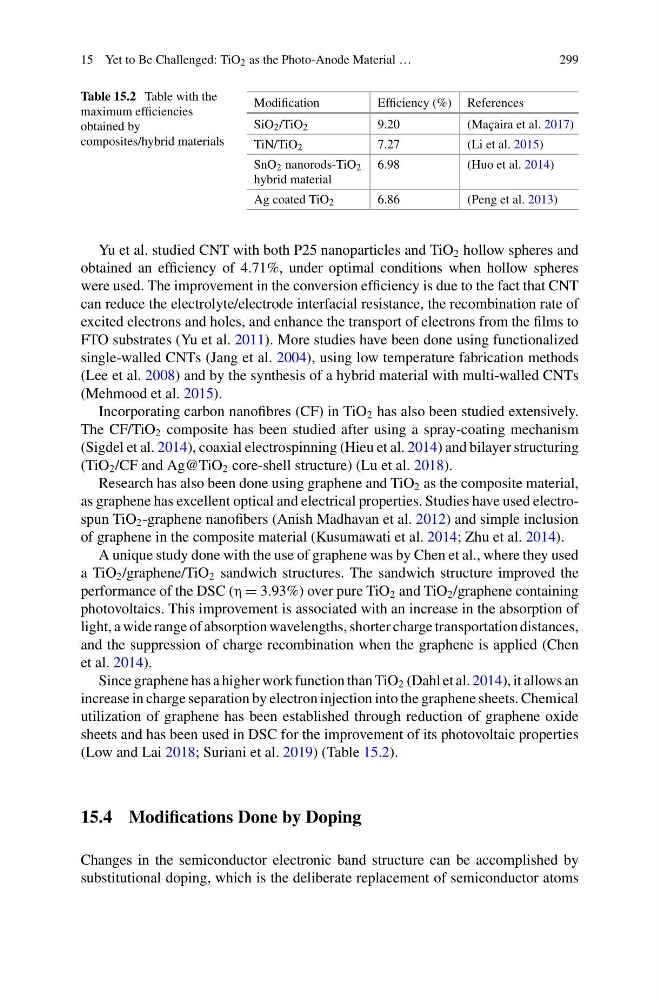
Table 15.2 Table with the
maximum efficiencies
obtained by
composites/hybrid materials
Modification
Efficiency (%) References
SiO 2 /TiO 2
9.20
(Maçaira et al. 2017)
TiN/TiO 2
7.27
(Li et al. 2015)
SnO 2 nanorods-TiO 2
hybrid material
6.98
(Huo et al. 2014)
Ag coated TiO 2
6.86
(Peng et al. 2013)
Yu et al. studied CNT with both P25 nanoparticles and TiO 2 hollow spheres and
obtained an efficiency of 4.71%, under optimal conditions when hollow spheres
were used. The improvement in the conversion efficiency is due to the fact that CNT
can reduce the electrolyte/electrode interfacial resistance, the recombination rate of
excited electrons and holes, and enhance the transport of electrons from the films to
FTO substrates (Yu et al. 2011). More studies have been done using functionalized
single-walled CNTs (Jang et al. 2004), using low temperature fabrication methods
(Lee et al. 2008) and by the synthesis of a hybrid material with multi-walled CNTs
(Mehmood et al. 2015).
Incorporating carbon nanofibres (CF) in TiO 2 has also been studied extensively.
The CF/TiO 2 composite has been studied after using a spray-coating mechanism
(Sigdel et al. 2014), coaxial electrospinning (Hieu et al. 2014) and bilayer structuring
(TiO 2 /CF and Ag@TiO 2 core-shell structure) (Lu et al. 2018).
Research has also been done using graphene and TiO 2 as the composite material,
as graphene has excellent optical and electrical properties. Studies have used electrospun TiO 2 -graphene nanofibers (Anish Madhavan et al. 2012) and simple inclusion
of graphene in the composite material (Kusumawati et al. 2014; Zhu et al. 2014).
A unique study done with the use of graphene was by Chen et al., where they used
a TiO 2 /graphene/TiO 2 sandwich structures. The sandwich structure improved the
performance of the DSC (η = 3.93%) over pure TiO 2 and TiO 2 /graphene containing
photovoltaics. This improvement is associated with an increase in the absorption of
light, a wide range of absorption wavelengths, shorter charge transportation distances,
and the suppression of charge recombination when the graphene is applied (Chen
et al. 2014).
Since graphene has a higher work function than TiO 2 (Dahl et al. 2014), it allows an
increase in charge separation by electron injection into the graphene sheets. Chemical
utilization of graphene has been established through reduction of graphene oxide
sheets and has been used in DSC for the improvement of its photovoltaic properties
(Low and Lai 2018; Suriani et al. 2019) (Table 15.2).
15.4 Modifications Done by Doping
Changes in the semiconductor electronic band structure can be accomplished by
substitutional doping, which is the deliberate replacement of semiconductor atoms
299
Table 15.2 Table with the
maximum efficiencies
obtained by
composites/hybrid materials
Modification
Efficiency (%) References
SiO 2 /TiO 2
9.20
(Maçaira et al. 2017)
TiN/TiO 2
7.27
(Li et al. 2015)
SnO 2 nanorods-TiO 2
hybrid material
6.98
(Huo et al. 2014)
Ag coated TiO 2
6.86
(Peng et al. 2013)
Yu et al. studied CNT with both P25 nanoparticles and TiO 2 hollow spheres and
obtained an efficiency of 4.71%, under optimal conditions when hollow spheres
were used. The improvement in the conversion efficiency is due to the fact that CNT
can reduce the electrolyte/electrode interfacial resistance, the recombination rate of
excited electrons and holes, and enhance the transport of electrons from the films to
FTO substrates (Yu et al. 2011). More studies have been done using functionalized
single-walled CNTs (Jang et al. 2004), using low temperature fabrication methods
(Lee et al. 2008) and by the synthesis of a hybrid material with multi-walled CNTs
(Mehmood et al. 2015).
Incorporating carbon nanofibres (CF) in TiO 2 has also been studied extensively.
The CF/TiO 2 composite has been studied after using a spray-coating mechanism
(Sigdel et al. 2014), coaxial electrospinning (Hieu et al. 2014) and bilayer structuring
(TiO 2 /CF and Ag@TiO 2 core-shell structure) (Lu et al. 2018).
Research has also been done using graphene and TiO 2 as the composite material,
as graphene has excellent optical and electrical properties. Studies have used electrospun TiO 2 -graphene nanofibers (Anish Madhavan et al. 2012) and simple inclusion
of graphene in the composite material (Kusumawati et al. 2014; Zhu et al. 2014).
A unique study done with the use of graphene was by Chen et al., where they used
a TiO 2 /graphene/TiO 2 sandwich structures. The sandwich structure improved the
performance of the DSC (η = 3.93%) over pure TiO 2 and TiO 2 /graphene containing
photovoltaics. This improvement is associated with an increase in the absorption of
light, a wide range of absorption wavelengths, shorter charge transportation distances,
and the suppression of charge recombination when the graphene is applied (Chen
et al. 2014).
Since graphene has a higher work function than TiO 2 (Dahl et al. 2014), it allows an
increase in charge separation by electron injection into the graphene sheets. Chemical
utilization of graphene has been established through reduction of graphene oxide
sheets and has been used in DSC for the improvement of its photovoltaic properties
(Low and Lai 2018; Suriani et al. 2019) (Table 15.2).
15.4 Modifications Done by Doping
Changes in the semiconductor electronic band structure can be accomplished by
substitutional doping, which is the deliberate replacement of semiconductor atoms