

268
R. Saxena et al.
0
2
4
6
8
10
12
14
New Delhi
Jaipur
Chennai
Capric Acid
Na2SO4. 10H2O
Concrete
kWh/day of savings
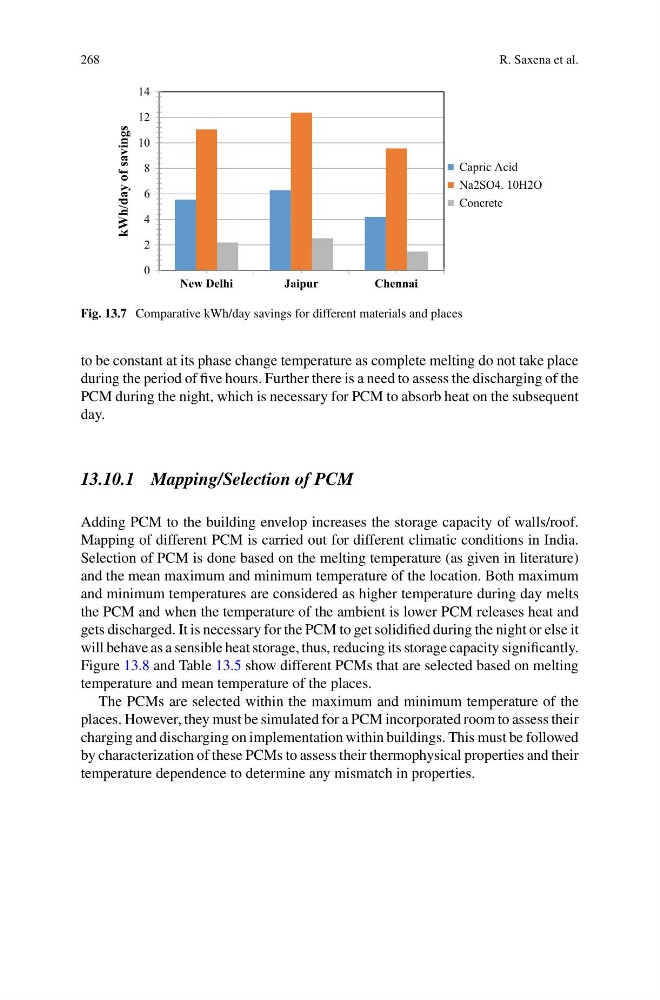
Fig. 13.7 Comparative kWh/day savings for different materials and places
to be constant at its phase change temperature as complete melting do not take place
during the period of five hours. Further there is a need to assess the discharging of the
PCM during the night, which is necessary for PCM to absorb heat on the subsequent
day.
13.10.1 Mapping/Selection of PCM
Adding PCM to the building envelop increases the storage capacity of walls/roof.
Mapping of different PCM is carried out for different climatic conditions in India.
Selection of PCM is done based on the melting temperature (as given in literature)
and the mean maximum and minimum temperature of the location. Both maximum
and minimum temperatures are considered as higher temperature during day melts
the PCM and when the temperature of the ambient is lower PCM releases heat and
gets discharged. It is necessary for the PCM to get solidified during the night or else it
will behave as a sensible heat storage, thus, reducing its storage capacity significantly.
Figure 13.8 and Table 13.5 show different PCMs that are selected based on melting
temperature and mean temperature of the places.
The PCMs are selected within the maximum and minimum temperature of the
places. However, they must be simulated for a PCM incorporated room to assess their
charging and discharging on implementation within buildings. This must be followed
by characterization of these PCMs to assess their thermophysical properties and their
temperature dependence to determine any mismatch in properties.
R. Saxena et al.
0
2
4
6
8
10
12
14
New Delhi
Jaipur
Chennai
Capric Acid
Na2SO4. 10H2O
Concrete
kWh/day of savings
Fig. 13.7 Comparative kWh/day savings for different materials and places
to be constant at its phase change temperature as complete melting do not take place
during the period of five hours. Further there is a need to assess the discharging of the
PCM during the night, which is necessary for PCM to absorb heat on the subsequent
day.
13.10.1 Mapping/Selection of PCM
Adding PCM to the building envelop increases the storage capacity of walls/roof.
Mapping of different PCM is carried out for different climatic conditions in India.
Selection of PCM is done based on the melting temperature (as given in literature)
and the mean maximum and minimum temperature of the location. Both maximum
and minimum temperatures are considered as higher temperature during day melts
the PCM and when the temperature of the ambient is lower PCM releases heat and
gets discharged. It is necessary for the PCM to get solidified during the night or else it
will behave as a sensible heat storage, thus, reducing its storage capacity significantly.
Figure 13.8 and Table 13.5 show different PCMs that are selected based on melting
temperature and mean temperature of the places.
The PCMs are selected within the maximum and minimum temperature of the
places. However, they must be simulated for a PCM incorporated room to assess their
charging and discharging on implementation within buildings. This must be followed
by characterization of these PCMs to assess their thermophysical properties and their
temperature dependence to determine any mismatch in properties.