

230
A. Bhattacharya
t = 500 and 2000 s. Although the size is different, the plots for the small system are
zoomed to the same size as those of the larger system. It is seen that the temperature
is significantly higher for the smaller system as heat transfer occurs at a faster rate
towards the top surface due to the lesser distance from the heating surface. This is
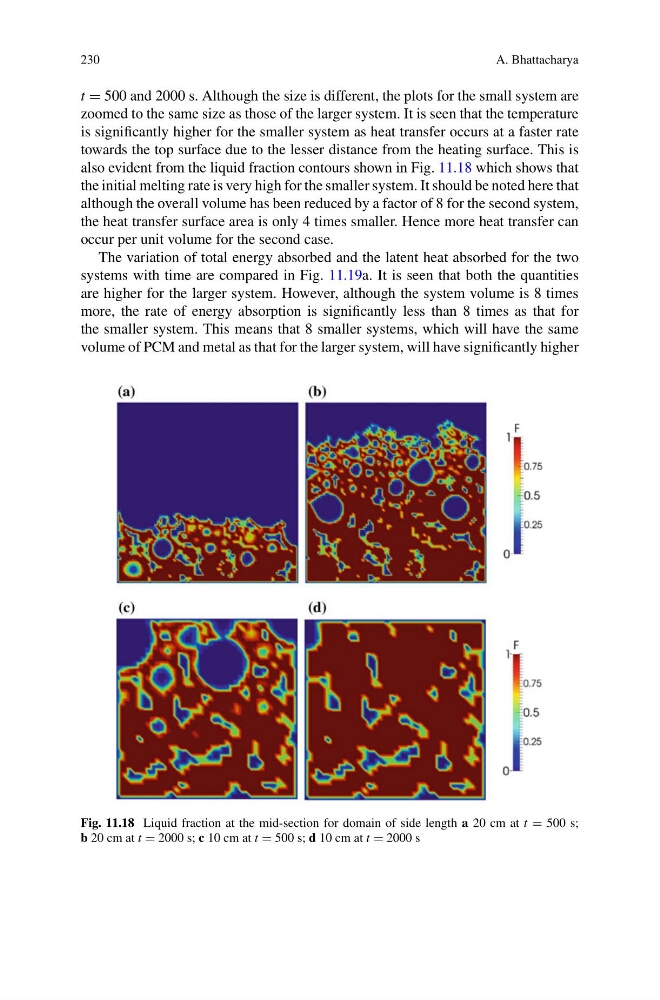
also evident from the liquid fraction contours shown in Fig. 11.18 which shows that
the initial melting rate is very high for the smaller system. It should be noted here that
although the overall volume has been reduced by a factor of 8 for the second system,
the heat transfer surface area is only 4 times smaller. Hence more heat transfer can
occur per unit volume for the second case.
The variation of total energy absorbed and the latent heat absorbed for the two
systems with time are compared in Fig. 11.19a. It is seen that both the quantities
are higher for the larger system. However, although the system volume is 8 times
more, the rate of energy absorption is significantly less than 8 times as that for
the smaller system. This means that 8 smaller systems, which will have the same
volume of PCM and metal as that for the larger system, will have significantly higher
Fig. 11.18 Liquid fraction at the mid-section for domain of side length a 20 cm at t = 500 s;
b 20 cm at t = 2000 s; c 10 cm at t = 500 s; d 10 cm at t = 2000 s
A. Bhattacharya
t = 500 and 2000 s. Although the size is different, the plots for the small system are
zoomed to the same size as those of the larger system. It is seen that the temperature
is significantly higher for the smaller system as heat transfer occurs at a faster rate
towards the top surface due to the lesser distance from the heating surface. This is
also evident from the liquid fraction contours shown in Fig. 11.18 which shows that
the initial melting rate is very high for the smaller system. It should be noted here that
although the overall volume has been reduced by a factor of 8 for the second system,
the heat transfer surface area is only 4 times smaller. Hence more heat transfer can
occur per unit volume for the second case.
The variation of total energy absorbed and the latent heat absorbed for the two
systems with time are compared in Fig. 11.19a. It is seen that both the quantities
are higher for the larger system. However, although the system volume is 8 times
more, the rate of energy absorption is significantly less than 8 times as that for
the smaller system. This means that 8 smaller systems, which will have the same
volume of PCM and metal as that for the larger system, will have significantly higher
Fig. 11.18 Liquid fraction at the mid-section for domain of side length a 20 cm at t = 500 s;
b 20 cm at t = 2000 s; c 10 cm at t = 500 s; d 10 cm at t = 2000 s