

218
A. Bhattacharya
The volume average enthalpy is defined in terms of the sensible and latent heat as
H = [C p pcm (1 − ϕ) + C p m ϕ]T + (1 − ϕ) f L
(11.5)
The volume fraction of liquid PCM is tracked using the nodal melt fraction parameter f. In Eqs. 11.4 and 11.5, ρ is the average density, K is the average thermal
conductivity and C p pcm and C p m are the specific heat of PCM and metal, respectively.
The detailed algorithm for solving the governing equation is described in Dinesh
and Bhattacharya (2019). The model has been previously validated with experimental results given in Chen et al. (2014) and verified with 1D analytical solutions for
melting and solidification (Dinesh and Bhattacharya 2019).
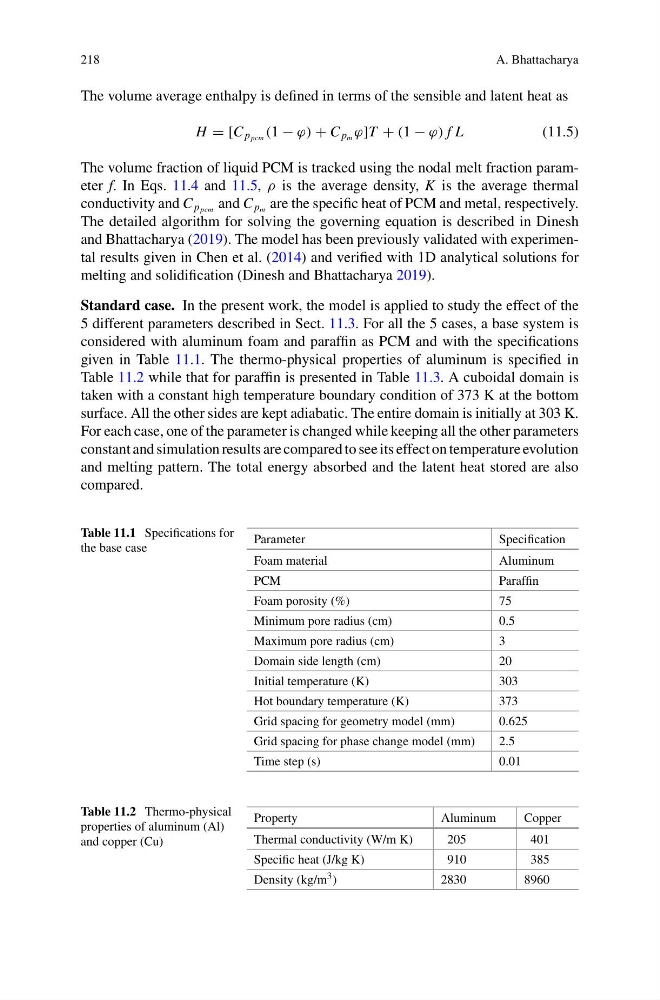
Standard case. In the present work, the model is applied to study the effect of the
5 different parameters described in Sect. 11.3. For all the 5 cases, a base system is
considered with aluminum foam and paraffin as PCM and with the specifications
given in Table 11.1. The thermo-physical properties of aluminum is specified in
Table 11.2 while that for paraffin is presented in Table 11.3. A cuboidal domain is
taken with a constant high temperature boundary condition of 373 K at the bottom
surface. All the other sides are kept adiabatic. The entire domain is initially at 303 K.
For each case, one of the parameter is changed while keeping all the other parameters
constant and simulation results are compared to see its effect on temperature evolution
and melting pattern. The total energy absorbed and the latent heat stored are also
compared.
Table 11.1 Specifications for
the base case
Parameter
Specification
Foam material
Aluminum
PCM
Paraffin
Foam porosity (%)
75
Minimum pore radius (cm)
0.5
Maximum pore radius (cm)
3
Domain side length (cm)
20
Initial temperature (K)
303
Hot boundary temperature (K)
373
Grid spacing for geometry model (mm)
0.625
Grid spacing for phase change model (mm)
2.5
Time step (s)
0.01
Table 11.2 Thermo-physical
properties of aluminum (Al)
and copper (Cu)
Property
Aluminum
Copper
Thermal conductivity (W/m K)
205
401
Specific heat (J/kg K)
910
385
Density (kg/m 3 )
2830
8960
A. Bhattacharya
The volume average enthalpy is defined in terms of the sensible and latent heat as
H = [C p pcm (1 − ϕ) + C p m ϕ]T + (1 − ϕ) f L
(11.5)
The volume fraction of liquid PCM is tracked using the nodal melt fraction parameter f. In Eqs. 11.4 and 11.5, ρ is the average density, K is the average thermal
conductivity and C p pcm and C p m are the specific heat of PCM and metal, respectively.
The detailed algorithm for solving the governing equation is described in Dinesh
and Bhattacharya (2019). The model has been previously validated with experimental results given in Chen et al. (2014) and verified with 1D analytical solutions for
melting and solidification (Dinesh and Bhattacharya 2019).
Standard case. In the present work, the model is applied to study the effect of the
5 different parameters described in Sect. 11.3. For all the 5 cases, a base system is
considered with aluminum foam and paraffin as PCM and with the specifications
given in Table 11.1. The thermo-physical properties of aluminum is specified in
Table 11.2 while that for paraffin is presented in Table 11.3. A cuboidal domain is
taken with a constant high temperature boundary condition of 373 K at the bottom
surface. All the other sides are kept adiabatic. The entire domain is initially at 303 K.
For each case, one of the parameter is changed while keeping all the other parameters
constant and simulation results are compared to see its effect on temperature evolution
and melting pattern. The total energy absorbed and the latent heat stored are also
compared.
Table 11.1 Specifications for
the base case
Parameter
Specification
Foam material
Aluminum
PCM
Paraffin
Foam porosity (%)
75
Minimum pore radius (cm)
0.5
Maximum pore radius (cm)
3
Domain side length (cm)
20
Initial temperature (K)
303
Hot boundary temperature (K)
373
Grid spacing for geometry model (mm)
0.625
Grid spacing for phase change model (mm)
2.5
Time step (s)
0.01
Table 11.2 Thermo-physical
properties of aluminum (Al)
and copper (Cu)
Property
Aluminum
Copper
Thermal conductivity (W/m K)
205
401
Specific heat (J/kg K)
910
385
Density (kg/m 3 )
2830
8960