

192
S. Sangwan and P. R. Chakraborty
Finally, combining Eqs. 10.23 and 10.21, and rearranging the terms we obtain the
expression for maximum coefficient of performance (C O P max ) given by:
C O P max =
Q evap − Q co − Q
≤
T c − T csat
T c
T esat
T csat − T esat
(10.24)
The second law efficiencies of the cycles described earlier are defined as:
η I I =
C O P cycle
C O P max
(10.25)
10.8 Results
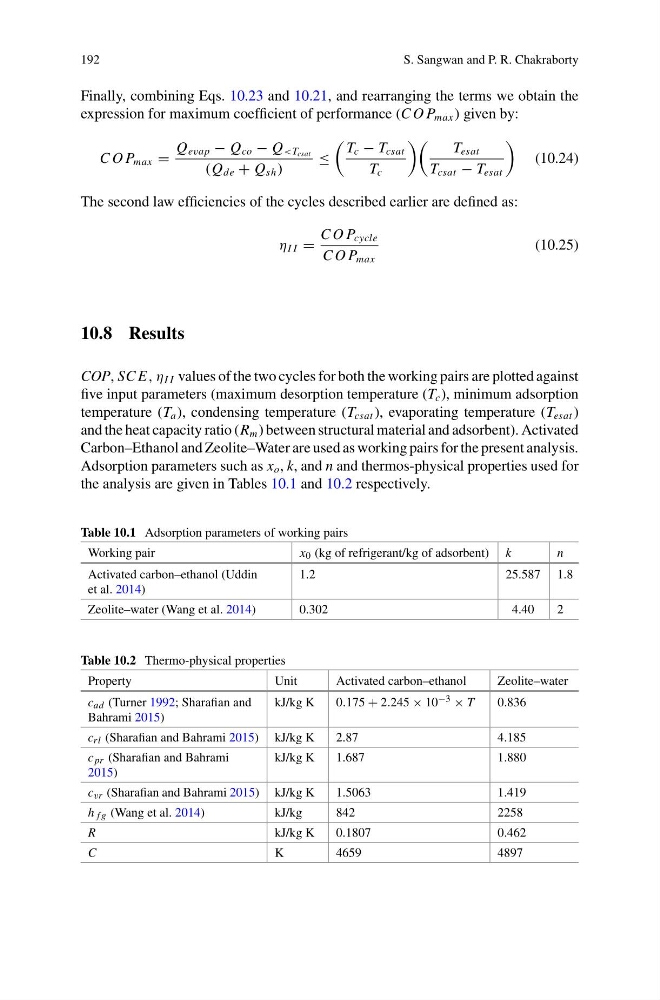
COP, SC E, η I I values of the two cycles for both the working pairs are plotted against
five input parameters (maximum desorption temperature (T c ), minimum adsorption
temperature (T a ), condensing temperature (T csat ), evaporating temperature (T esat )
and the heat capacity ratio (R m ) between structural material and adsorbent). Activated
Carbon–Ethanol and Zeolite–Water are used as working pairs for the present analysis.
Adsorption parameters such as x o , k, and n and thermos-physical properties used for
the analysis are given in Tables 10.1 and 10.2 respectively.
Table 10.1 Adsorption parameters of working pairs
Working pair
x 0 (kg of refrigerant/kg of adsorbent) k
n
Activated carbon–ethanol (Uddin
et al. 2014)
1.2
25.587 1.8
Zeolite–water (Wang et al. 2014)
0.302
4.40
2
Table 10.2 Thermo-physical properties
Property
Unit
Activated carbon–ethanol
Zeolite–water
c ad (Turner 1992; Sharafian and
Bahrami 2015)
kJ/kg K
0.175 + 2.245 × 10 −3 × T
0.836
c rl (Sharafian and Bahrami 2015) kJ/kg K
2.87
4.185
c pr (Sharafian and Bahrami
2015)
kJ/kg K
1.687
1.880
c vr (Sharafian and Bahrami 2015) kJ/kg K
1.5063
1.419
h f g (Wang et al. 2014)
kJ/kg
842
2258
R
kJ/kg K
0.1807
0.462
C
K
4659
4897
S. Sangwan and P. R. Chakraborty
Finally, combining Eqs. 10.23 and 10.21, and rearranging the terms we obtain the
expression for maximum coefficient of performance (C O P max ) given by:
C O P max =
Q evap − Q co − Q
≤
T c − T csat
T c
T esat
T csat − T esat
(10.24)
The second law efficiencies of the cycles described earlier are defined as:
η I I =
C O P cycle
C O P max
(10.25)
10.8 Results
COP, SC E, η I I values of the two cycles for both the working pairs are plotted against
five input parameters (maximum desorption temperature (T c ), minimum adsorption
temperature (T a ), condensing temperature (T csat ), evaporating temperature (T esat )
and the heat capacity ratio (R m ) between structural material and adsorbent). Activated
Carbon–Ethanol and Zeolite–Water are used as working pairs for the present analysis.
Adsorption parameters such as x o , k, and n and thermos-physical properties used for
the analysis are given in Tables 10.1 and 10.2 respectively.
Table 10.1 Adsorption parameters of working pairs
Working pair
x 0 (kg of refrigerant/kg of adsorbent) k
n
Activated carbon–ethanol (Uddin
et al. 2014)
1.2
25.587 1.8
Zeolite–water (Wang et al. 2014)
0.302
4.40
2
Table 10.2 Thermo-physical properties
Property
Unit
Activated carbon–ethanol
Zeolite–water
c ad (Turner 1992; Sharafian and
Bahrami 2015)
kJ/kg K
0.175 + 2.245 × 10 −3 × T
0.836
c rl (Sharafian and Bahrami 2015) kJ/kg K
2.87
4.185
c pr (Sharafian and Bahrami
2015)
kJ/kg K
1.687
1.880
c vr (Sharafian and Bahrami 2015) kJ/kg K
1.5063
1.419
h f g (Wang et al. 2014)
kJ/kg
842
2258
R
kJ/kg K
0.1807
0.462
C
K
4659
4897