

10 Thermodynamic Analysis of Activated Carbon–Ethanol …
191
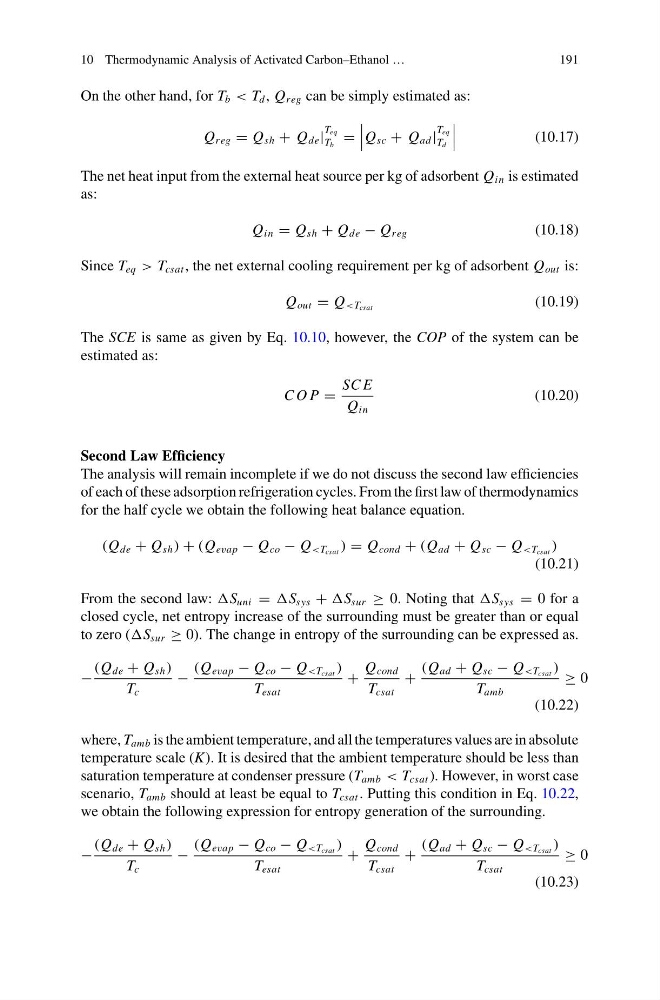
On the other hand, for T b < T d , Q reg can be simply estimated as:
Q reg = Q sh + Q de |
T eq
T b
=
Qsc + Q ad |
T eq
T d
(10.17)
The net heat input from the external heat source per kg of adsorbent Q in is estimated
as:
Q in = Q sh + Q de − Q reg
(10.18)
Since T eq > T csat , the net external cooling requirement per kg of adsorbent Q out is:
Q out = Q
The SCE is same as given by Eq. 10.10, however, the COP of the system can be
estimated as:
C O P =
SC E
Q in
(10.20)
Second Law Efficiency
The analysis will remain incomplete if we do not discuss the second law efficiencies
of each of these adsorption refrigeration cycles. From the first law of thermodynamics
for the half cycle we obtain the following heat balance equation.
(Q de + Q sh ) + (Q evap − Q co − Q
From the second law: S uni = S sys + S sur ≥ 0. Noting that S sys = 0 for a
closed cycle, net entropy increase of the surrounding must be greater than or equal
to zero (S sur ≥ 0). The change in entropy of the surrounding can be expressed as.
−
(Q de + Q sh )
T c
−
(Q evap − Q co − Q
+
Q cond
T csat
+
(Q ad + Q sc − Q
≥ 0
(10.22)
where, T amb is the ambient temperature, and all the temperatures values are in absolute
temperature scale (K). It is desired that the ambient temperature should be less than
saturation temperature at condenser pressure (T amb < T csat ). However, in worst case
scenario, T amb should at least be equal to T csat . Putting this condition in Eq. 10.22,
we obtain the following expression for entropy generation of the surrounding.
−
(Q de + Q sh )
T c
−
(Q evap − Q co − Q
+
Q cond
T csat
+
(Q ad + Q sc − Q
≥ 0
(10.23)
191
On the other hand, for T b < T d , Q reg can be simply estimated as:
Q reg = Q sh + Q de |
T eq
T b
=
Qsc + Q ad |
T eq
T d
(10.17)
The net heat input from the external heat source per kg of adsorbent Q in is estimated
as:
Q in = Q sh + Q de − Q reg
(10.18)
Since T eq > T csat , the net external cooling requirement per kg of adsorbent Q out is:
Q out = Q
The SCE is same as given by Eq. 10.10, however, the COP of the system can be
estimated as:
C O P =
SC E
Q in
(10.20)
Second Law Efficiency
The analysis will remain incomplete if we do not discuss the second law efficiencies
of each of these adsorption refrigeration cycles. From the first law of thermodynamics
for the half cycle we obtain the following heat balance equation.
(Q de + Q sh ) + (Q evap − Q co − Q
From the second law: S uni = S sys + S sur ≥ 0. Noting that S sys = 0 for a
closed cycle, net entropy increase of the surrounding must be greater than or equal
to zero (S sur ≥ 0). The change in entropy of the surrounding can be expressed as.
−
(Q de + Q sh )
T c
−
(Q evap − Q co − Q
+
Q cond
T csat
+
(Q ad + Q sc − Q
≥ 0
(10.22)
where, T amb is the ambient temperature, and all the temperatures values are in absolute
temperature scale (K). It is desired that the ambient temperature should be less than
saturation temperature at condenser pressure (T amb < T csat ). However, in worst case
scenario, T amb should at least be equal to T csat . Putting this condition in Eq. 10.22,
we obtain the following expression for entropy generation of the surrounding.
−
(Q de + Q sh )
T c
−
(Q evap − Q co − Q
+
Q cond
T csat
+
(Q ad + Q sc − Q
≥ 0
(10.23)