

10 Thermodynamic Analysis of Activated Carbon–Ethanol …
189
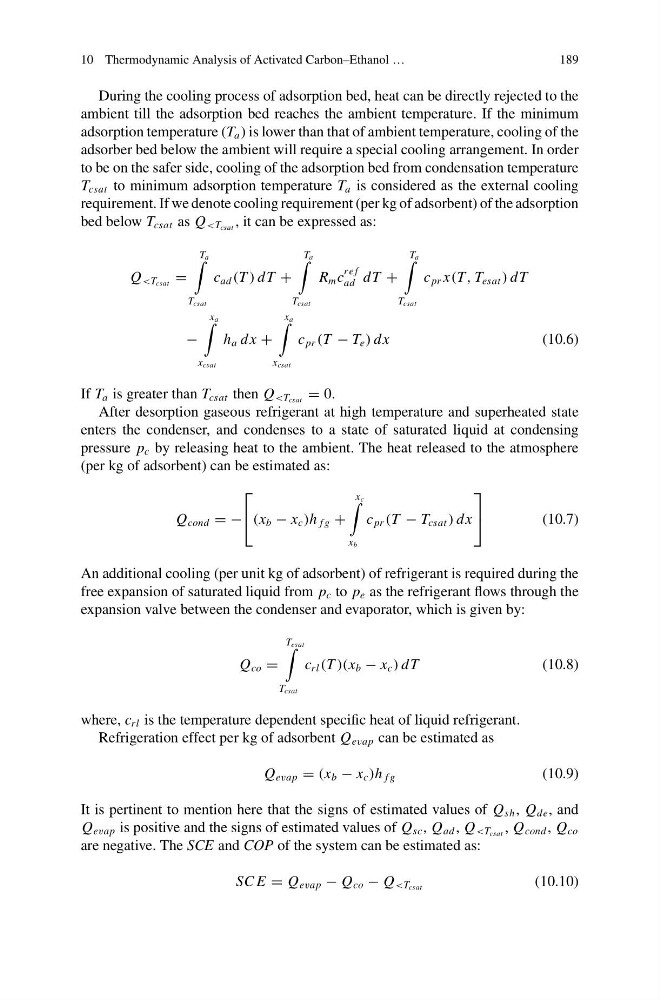
During the cooling process of adsorption bed, heat can be directly rejected to the
ambient till the adsorption bed reaches the ambient temperature. If the minimum
adsorption temperature (T a ) is lower than that of ambient temperature, cooling of the
adsorber bed below the ambient will require a special cooling arrangement. In order
to be on the safer side, cooling of the adsorption bed from condensation temperature
T csat to minimum adsorption temperature T a is considered as the external cooling
requirement. If we denote cooling requirement (per kg of adsorbent) of the adsorption
bed below T csat as Q
T csat
c ad (T ) dT +
T a
T csat
R m c
re f
ad dT +
T a
T csat
c pr x(T, T esat ) dT
−
x a
x csat
h a dx +
x a
x csat
c pr (T − T e ) dx
(10.6)
If T a is greater than T csat then Q
enters the condenser, and condenses to a state of saturated liquid at condensing
pressure p c by releasing heat to the ambient. The heat released to the atmosphere
(per kg of adsorbent) can be estimated as:
Q cond = −
⎡
⎣ (x b − x c )h f g +
x c
x b
c pr (T − T csat ) dx
⎤
⎦
(10.7)
An additional cooling (per unit kg of adsorbent) of refrigerant is required during the
free expansion of saturated liquid from p c to p e as the refrigerant flows through the
expansion valve between the condenser and evaporator, which is given by:
Q co =
T esat
T csat
c rl (T )(x b − x c ) dT
(10.8)
where, c rl is the temperature dependent specific heat of liquid refrigerant.
Refrigeration effect per kg of adsorbent Q evap can be estimated as
Q evap = (x b − x c )h f g
(10.9)
It is pertinent to mention here that the signs of estimated values of Q sh , Q de , and
Q evap is positive and the signs of estimated values of Q sc , Q ad , Q
SC E = Q evap − Q co − Q
189
During the cooling process of adsorption bed, heat can be directly rejected to the
ambient till the adsorption bed reaches the ambient temperature. If the minimum
adsorption temperature (T a ) is lower than that of ambient temperature, cooling of the
adsorber bed below the ambient will require a special cooling arrangement. In order
to be on the safer side, cooling of the adsorption bed from condensation temperature
T csat to minimum adsorption temperature T a is considered as the external cooling
requirement. If we denote cooling requirement (per kg of adsorbent) of the adsorption
bed below T csat as Q
T csat
c ad (T ) dT +
T a
T csat
R m c
re f
ad dT +
T a
T csat
c pr x(T, T esat ) dT
−
x a
x csat
h a dx +
x a
x csat
c pr (T − T e ) dx
(10.6)
If T a is greater than T csat then Q
enters the condenser, and condenses to a state of saturated liquid at condensing
pressure p c by releasing heat to the ambient. The heat released to the atmosphere
(per kg of adsorbent) can be estimated as:
Q cond = −
⎡
⎣ (x b − x c )h f g +
x c
x b
c pr (T − T csat ) dx
⎤
⎦
(10.7)
An additional cooling (per unit kg of adsorbent) of refrigerant is required during the
free expansion of saturated liquid from p c to p e as the refrigerant flows through the
expansion valve between the condenser and evaporator, which is given by:
Q co =
T esat
T csat
c rl (T )(x b − x c ) dT
(10.8)
where, c rl is the temperature dependent specific heat of liquid refrigerant.
Refrigeration effect per kg of adsorbent Q evap can be estimated as
Q evap = (x b − x c )h f g
(10.9)
It is pertinent to mention here that the signs of estimated values of Q sh , Q de , and
Q evap is positive and the signs of estimated values of Q sc , Q ad , Q
SC E = Q evap − Q co − Q