

188
S. Sangwan and P. R. Chakraborty
with that of adsorbent. c m is the combined specific heat capacity of the structural
material of bed and HTF, and m m is the combined mass of the same (c m m m =
c st m st +c H T F m H T F and m m = m st +m H T F ). x a = x b is the maximum concentration
of adsorbate adsorbed in the bed.
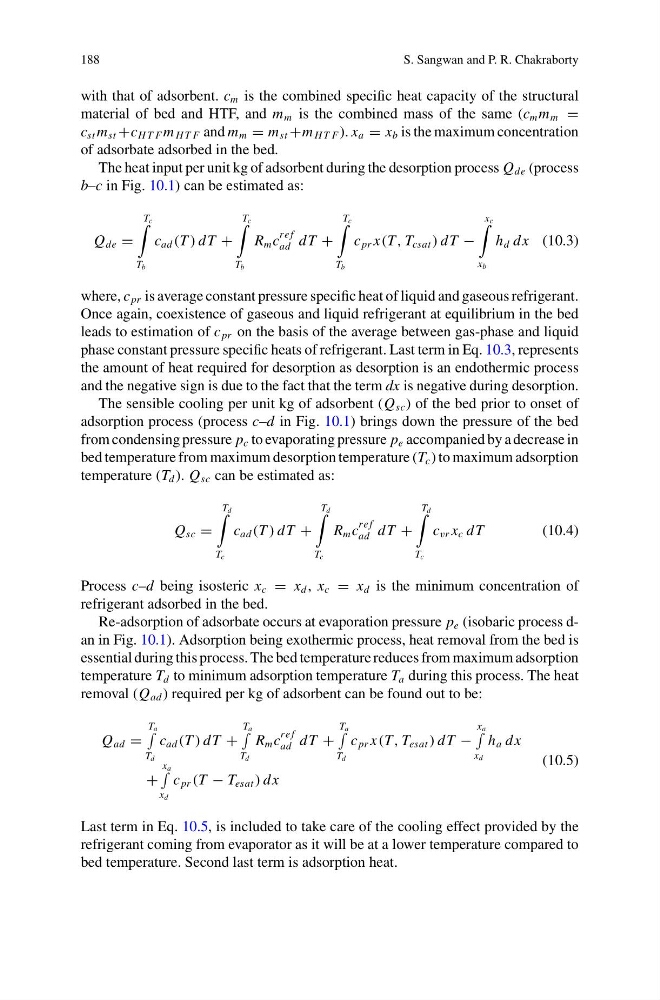
The heat input per unit kg of adsorbent during the desorption process Q de (process
b–c in Fig. 10.1) can be estimated as:
Q de =
T c
T b
c ad (T ) dT +
T c
T b
R m c
re f
ad dT +
T c
T b
c pr x(T, T csat ) dT −
x c
x b
h d dx (10.3)
where, c pr is average constant pressure specific heat of liquid and gaseous refrigerant.
Once again, coexistence of gaseous and liquid refrigerant at equilibrium in the bed
leads to estimation of c pr on the basis of the average between gas-phase and liquid
phase constant pressure specific heats of refrigerant. Last term in Eq. 10.3, represents
the amount of heat required for desorption as desorption is an endothermic process
and the negative sign is due to the fact that the term dx is negative during desorption.
The sensible cooling per unit kg of adsorbent (Q sc ) of the bed prior to onset of
adsorption process (process c–d in Fig. 10.1) brings down the pressure of the bed
from condensing pressure p c to evaporating pressure p e accompanied by a decrease in
bed temperature from maximum desorption temperature (T c ) to maximum adsorption
temperature (T d ). Q sc can be estimated as:
Q sc =
T d
T c
c ad (T ) dT +
T d
T c
R m c
re f
ad dT +
T d
T c
c vr x c dT
(10.4)
Process c–d being isosteric x c = x d , x c = x d is the minimum concentration of
refrigerant adsorbed in the bed.
Re-adsorption of adsorbate occurs at evaporation pressure p e (isobaric process dan in Fig. 10.1). Adsorption being exothermic process, heat removal from the bed is
essential during this process. The bed temperature reduces from maximum adsorption
temperature T d to minimum adsorption temperature T a during this process. The heat
removal (Q ad ) required per kg of adsorbent can be found out to be:
Q ad =
T a
T d
c ad (T ) dT +
T a
T d
R m c
re f
ad dT +
T a
T d
c pr x(T, T esat ) dT −
x a
x d
h a dx
+
x a
x d
c pr (T − T esat ) dx
(10.5)
Last term in Eq. 10.5, is included to take care of the cooling effect provided by the
refrigerant coming from evaporator as it will be at a lower temperature compared to
bed temperature. Second last term is adsorption heat.
S. Sangwan and P. R. Chakraborty
with that of adsorbent. c m is the combined specific heat capacity of the structural
material of bed and HTF, and m m is the combined mass of the same (c m m m =
c st m st +c H T F m H T F and m m = m st +m H T F ). x a = x b is the maximum concentration
of adsorbate adsorbed in the bed.
The heat input per unit kg of adsorbent during the desorption process Q de (process
b–c in Fig. 10.1) can be estimated as:
Q de =
T c
T b
c ad (T ) dT +
T c
T b
R m c
re f
ad dT +
T c
T b
c pr x(T, T csat ) dT −
x c
x b
h d dx (10.3)
where, c pr is average constant pressure specific heat of liquid and gaseous refrigerant.
Once again, coexistence of gaseous and liquid refrigerant at equilibrium in the bed
leads to estimation of c pr on the basis of the average between gas-phase and liquid
phase constant pressure specific heats of refrigerant. Last term in Eq. 10.3, represents
the amount of heat required for desorption as desorption is an endothermic process
and the negative sign is due to the fact that the term dx is negative during desorption.
The sensible cooling per unit kg of adsorbent (Q sc ) of the bed prior to onset of
adsorption process (process c–d in Fig. 10.1) brings down the pressure of the bed
from condensing pressure p c to evaporating pressure p e accompanied by a decrease in
bed temperature from maximum desorption temperature (T c ) to maximum adsorption
temperature (T d ). Q sc can be estimated as:
Q sc =
T d
T c
c ad (T ) dT +
T d
T c
R m c
re f
ad dT +
T d
T c
c vr x c dT
(10.4)
Process c–d being isosteric x c = x d , x c = x d is the minimum concentration of
refrigerant adsorbed in the bed.
Re-adsorption of adsorbate occurs at evaporation pressure p e (isobaric process dan in Fig. 10.1). Adsorption being exothermic process, heat removal from the bed is
essential during this process. The bed temperature reduces from maximum adsorption
temperature T d to minimum adsorption temperature T a during this process. The heat
removal (Q ad ) required per kg of adsorbent can be found out to be:
Q ad =
T a
T d
c ad (T ) dT +
T a
T d
R m c
re f
ad dT +
T a
T d
c pr x(T, T esat ) dT −
x a
x d
h a dx
+
x a
x d
c pr (T − T esat ) dx
(10.5)
Last term in Eq. 10.5, is included to take care of the cooling effect provided by the
refrigerant coming from evaporator as it will be at a lower temperature compared to
bed temperature. Second last term is adsorption heat.