

168
Md. A. Islam and B. B. Saha
are lower than the conventional system. Since the weight of the adsorption cooling
system is much higher, the indirect warming impact for building the cooling system is higher. However, TEWI of the solar cooling systems is much lower than the
conventional systems.
9.4 Results Comparison and Discussions
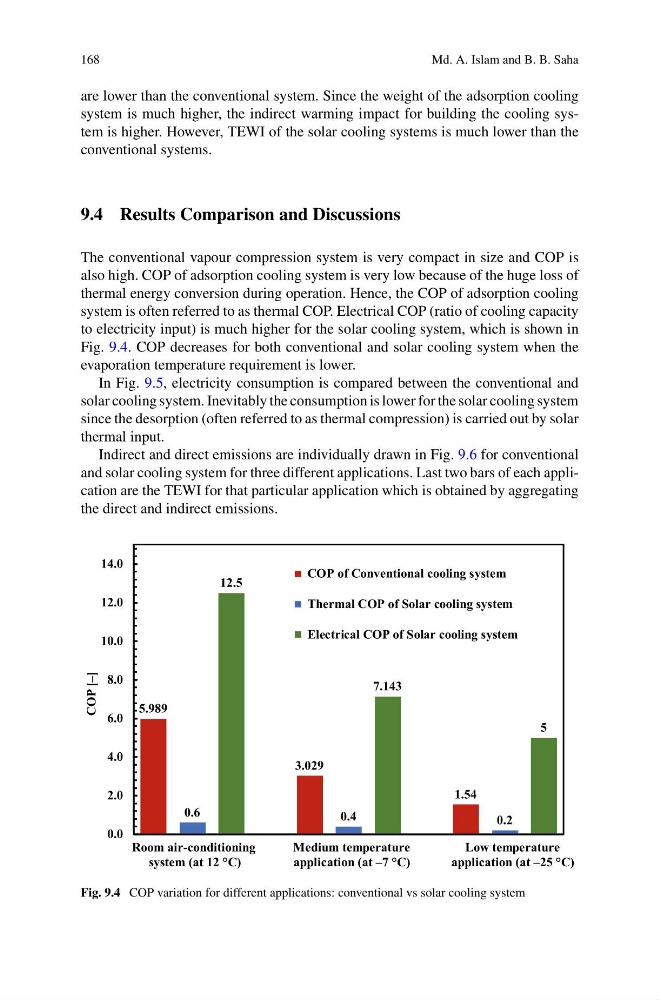
The conventional vapour compression system is very compact in size and COP is
also high. COP of adsorption cooling system is very low because of the huge loss of
thermal energy conversion during operation. Hence, the COP of adsorption cooling
system is often referred to as thermal COP. Electrical COP (ratio of cooling capacity
to electricity input) is much higher for the solar cooling system, which is shown in
Fig. 9.4. COP decreases for both conventional and solar cooling system when the
evaporation temperature requirement is lower.
In Fig. 9.5, electricity consumption is compared between the conventional and
solar cooling system. Inevitably the consumption is lower for the solar cooling system
since the desorption (often referred to as thermal compression) is carried out by solar
thermal input.
Indirect and direct emissions are individually drawn in Fig. 9.6 for conventional
and solar cooling system for three different applications. Last two bars of each application are the TEWI for that particular application which is obtained by aggregating
the direct and indirect emissions.
5.989
0.6
12.5
3.029
0.4
7.143
1.54
0.2
5
0.0
2.0
4.0
6.0
8.0
10.0
12.0
14.0
COP [–]
COP of Conventional cooling system
Thermal COP of Solar cooling system
Electrical COP of Solar cooling system
Medium temperature
application (at –7 °C)
Room air-conditioning
system (at 12 °C)
Low temperature
application (at –25 °C)
Fig. 9.4 COP variation for different applications: conventional vs solar cooling system
Md. A. Islam and B. B. Saha
are lower than the conventional system. Since the weight of the adsorption cooling
system is much higher, the indirect warming impact for building the cooling system is higher. However, TEWI of the solar cooling systems is much lower than the
conventional systems.
9.4 Results Comparison and Discussions
The conventional vapour compression system is very compact in size and COP is
also high. COP of adsorption cooling system is very low because of the huge loss of
thermal energy conversion during operation. Hence, the COP of adsorption cooling
system is often referred to as thermal COP. Electrical COP (ratio of cooling capacity
to electricity input) is much higher for the solar cooling system, which is shown in
Fig. 9.4. COP decreases for both conventional and solar cooling system when the
evaporation temperature requirement is lower.
In Fig. 9.5, electricity consumption is compared between the conventional and
solar cooling system. Inevitably the consumption is lower for the solar cooling system
since the desorption (often referred to as thermal compression) is carried out by solar
thermal input.
Indirect and direct emissions are individually drawn in Fig. 9.6 for conventional
and solar cooling system for three different applications. Last two bars of each application are the TEWI for that particular application which is obtained by aggregating
the direct and indirect emissions.
5.989
0.6
12.5
3.029
0.4
7.143
1.54
0.2
5
0.0
2.0
4.0
6.0
8.0
10.0
12.0
14.0
COP [–]
COP of Conventional cooling system
Thermal COP of Solar cooling system
Electrical COP of Solar cooling system
Medium temperature
application (at –7 °C)
Room air-conditioning
system (at 12 °C)
Low temperature
application (at –25 °C)
Fig. 9.4 COP variation for different applications: conventional vs solar cooling system