

9 TEWI Assessment of Conventional and Solar Powered Cooling Systems
167
of electricity, which is shown in Table 9.7. The required amount of adsorbent and
refrigerant also increases for lower temperature applications.
An adsorption system has two or more beds. The frames of the beds are usually
made of stainless steel. The beds contain adsorbent and heat exchangers. Hence, the
weight of an adsorption system is ten times or higher than the conventional system
of the same cooling capacity. The weight of a 10 kW solar room air-conditioning
cooling system is about 900 kg according to manufacturer’s specification. Weight
of medium and low-temperature systems have been considered higher due to the
higher adsorbent and heat exchanger requirement. The weight percentage of steel,
aluminum, copper and other materials have been modified due to the constructional
difference with the conventional cooling system. The system has a higher lifetime
and requires lower maintenance than the conventional systems because there are very
few moving parts in this system.
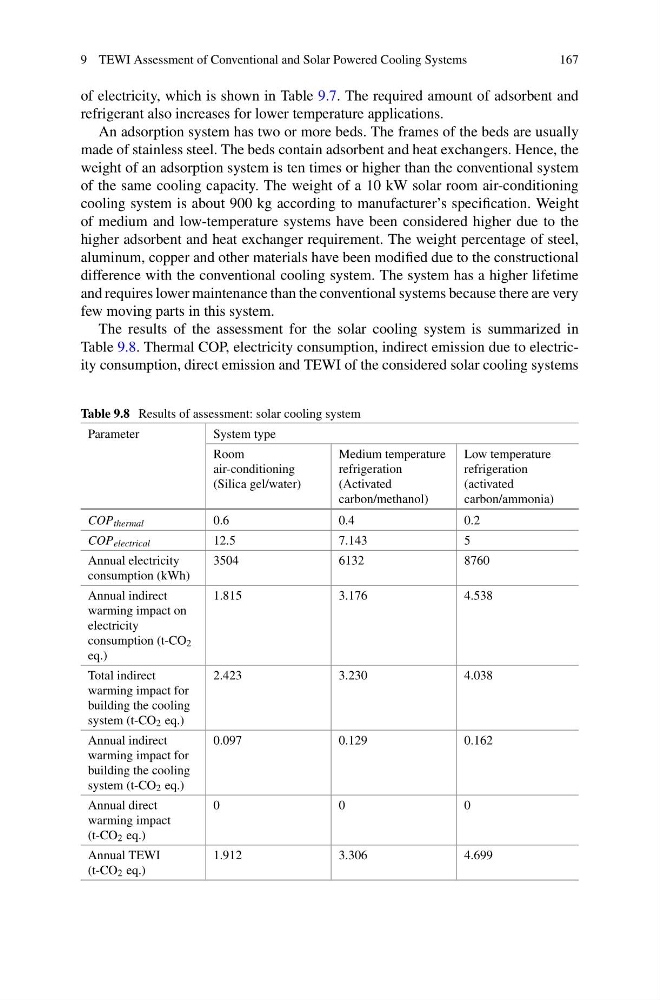
The results of the assessment for the solar cooling system is summarized in
Table 9.8. Thermal COP, electricity consumption, indirect emission due to electricity consumption, direct emission and TEWI of the considered solar cooling systems
Table 9.8 Results of assessment: solar cooling system
Parameter
System type
Room
air-conditioning
(Silica gel/water)
Medium temperature
refrigeration
(Activated
carbon/methanol)
Low temperature
refrigeration
(activated
carbon/ammonia)
COP thermal
0.6
0.4
0.2
COP electrical
12.5
7.143
5
Annual electricity
consumption (kWh)
3504
6132
8760
Annual indirect
warming impact on
electricity
consumption (t-CO 2
eq.)
1.815
3.176
4.538
Total indirect
warming impact for
building the cooling
system (t-CO 2 eq.)
2.423
3.230
4.038
Annual indirect
warming impact for
building the cooling
system (t-CO 2 eq.)
0.097
0.129
0.162
Annual direct
warming impact
(t-CO 2 eq.)
0
0
0
Annual TEWI
(t-CO 2 eq.)
1.912
3.306
4.699
167
of electricity, which is shown in Table 9.7. The required amount of adsorbent and
refrigerant also increases for lower temperature applications.
An adsorption system has two or more beds. The frames of the beds are usually
made of stainless steel. The beds contain adsorbent and heat exchangers. Hence, the
weight of an adsorption system is ten times or higher than the conventional system
of the same cooling capacity. The weight of a 10 kW solar room air-conditioning
cooling system is about 900 kg according to manufacturer’s specification. Weight
of medium and low-temperature systems have been considered higher due to the
higher adsorbent and heat exchanger requirement. The weight percentage of steel,
aluminum, copper and other materials have been modified due to the constructional
difference with the conventional cooling system. The system has a higher lifetime
and requires lower maintenance than the conventional systems because there are very
few moving parts in this system.
The results of the assessment for the solar cooling system is summarized in
Table 9.8. Thermal COP, electricity consumption, indirect emission due to electricity consumption, direct emission and TEWI of the considered solar cooling systems
Table 9.8 Results of assessment: solar cooling system
Parameter
System type
Room
air-conditioning
(Silica gel/water)
Medium temperature
refrigeration
(Activated
carbon/methanol)
Low temperature
refrigeration
(activated
carbon/ammonia)
COP thermal
0.6
0.4
0.2
COP electrical
12.5
7.143
5
Annual electricity
consumption (kWh)
3504
6132
8760
Annual indirect
warming impact on
electricity
consumption (t-CO 2
eq.)
1.815
3.176
4.538
Total indirect
warming impact for
building the cooling
system (t-CO 2 eq.)
2.423
3.230
4.038
Annual indirect
warming impact for
building the cooling
system (t-CO 2 eq.)
0.097
0.129
0.162
Annual direct
warming impact
(t-CO 2 eq.)
0
0
0
Annual TEWI
(t-CO 2 eq.)
1.912
3.306
4.699