

9 TEWI Assessment of Conventional and Solar Powered Cooling Systems
161
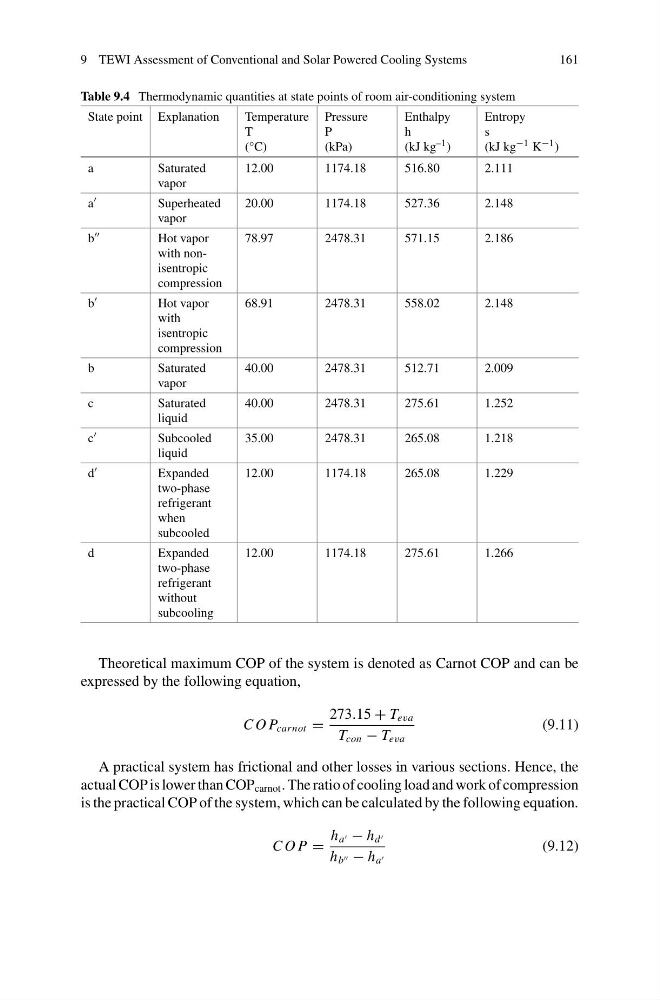
Table 9.4 Thermodynamic quantities at state points of room air-conditioning system
State point Explanation
Temperature
T
(°C)
Pressure
P
(kPa)
Enthalpy
h
(kJ kg –1 )
Entropy
s
(kJ kg −1 K −1 )
a
Saturated
vapor
12.00
1174.18
516.80
2.111
a
Superheated
vapor
20.00
1174.18
527.36
2.148
b
Hot vapor
with nonisentropic
compression
78.97
2478.31
571.15
2.186
b
Hot vapor
with
isentropic
compression
68.91
2478.31
558.02
2.148
b
Saturated
vapor
40.00
2478.31
512.71
2.009
c
Saturated
liquid
40.00
2478.31
275.61
1.252
c
Subcooled
liquid
35.00
2478.31
265.08
1.218
d
Expanded
two-phase
refrigerant
when
subcooled
12.00
1174.18
265.08
1.229
d
Expanded
two-phase
refrigerant
without
subcooling
12.00
1174.18
275.61
1.266
Theoretical maximum COP of the system is denoted as Carnot COP and can be
expressed by the following equation,
C O P carnot =
273.15 + T eva
T con − T eva
(9.11)
A practical system has frictional and other losses in various sections. Hence, the
actual COP is lower than COP carnot . The ratio of cooling load and work of compression
is the practical COP of the system, which can be calculated by the following equation.
C O P =
h a − h d
h b − h a
(9.12)
161
Table 9.4 Thermodynamic quantities at state points of room air-conditioning system
State point Explanation
Temperature
T
(°C)
Pressure
P
(kPa)
Enthalpy
h
(kJ kg –1 )
Entropy
s
(kJ kg −1 K −1 )
a
Saturated
vapor
12.00
1174.18
516.80
2.111
a
Superheated
vapor
20.00
1174.18
527.36
2.148
b
Hot vapor
with nonisentropic
compression
78.97
2478.31
571.15
2.186
b
Hot vapor
with
isentropic
compression
68.91
2478.31
558.02
2.148
b
Saturated
vapor
40.00
2478.31
512.71
2.009
c
Saturated
liquid
40.00
2478.31
275.61
1.252
c
Subcooled
liquid
35.00
2478.31
265.08
1.218
d
Expanded
two-phase
refrigerant
when
subcooled
12.00
1174.18
265.08
1.229
d
Expanded
two-phase
refrigerant
without
subcooling
12.00
1174.18
275.61
1.266
Theoretical maximum COP of the system is denoted as Carnot COP and can be
expressed by the following equation,
C O P carnot =
273.15 + T eva
T con − T eva
(9.11)
A practical system has frictional and other losses in various sections. Hence, the
actual COP is lower than COP carnot . The ratio of cooling load and work of compression
is the practical COP of the system, which can be calculated by the following equation.
C O P =
h a − h d
h b − h a
(9.12)