

140
M. Muttakin et al.
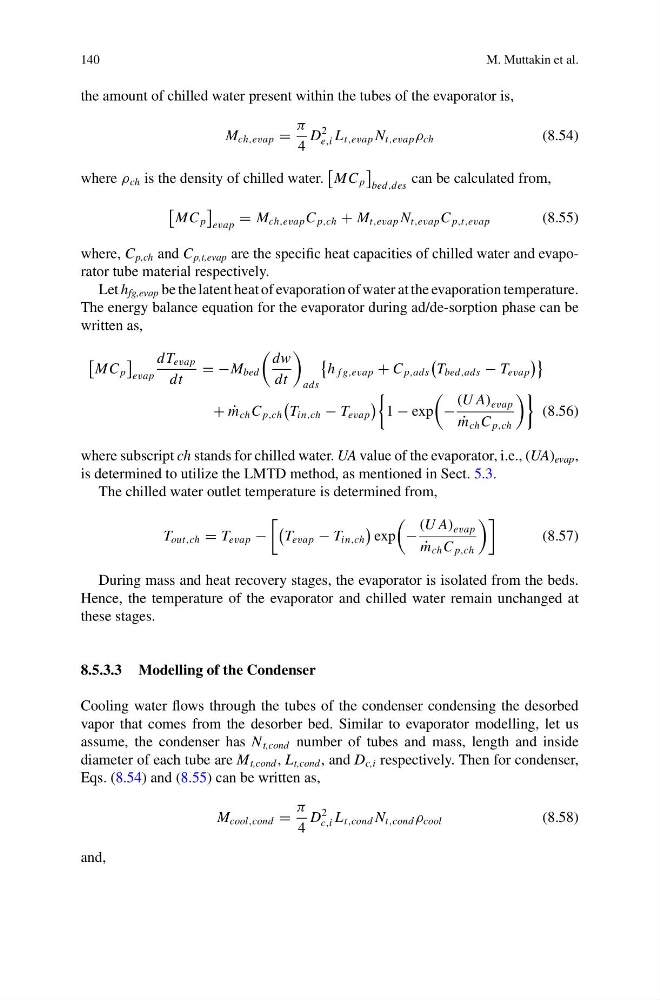
the amount of chilled water present within the tubes of the evaporator is,
M ch,evap =
π
4
D
2
e,i L t,evap N t,evap ρ ch
(8.54)
where ρ ch is the density of chilled water.
MC p
bed,des
can be calculated from,
MC p
evap
= M ch,evap C p,ch + M t,evap N t,evap C p,t,evap
(8.55)
where, C p,ch and C p,t,evap are the specific heat capacities of chilled water and evaporator tube material respectively.
Let h fg,evap be the latent heat of evaporation of water at the evaporation temperature.
The energy balance equation for the evaporator during ad/de-sorption phase can be
written as,
MC p
evap
dT evap
dt
= −M bed
dw
dt
ads
h f g,evap + C p,ads
T bed,ads − T evap
+ ˙
m ch C p,ch
T in,ch − T evap
1 − exp
−
(U A) evap
˙
m ch C p,ch
(8.56)
where subscript ch stands for chilled water. UA value of the evaporator, i.e., (UA) evap ,
is determined to utilize the LMTD method, as mentioned in Sect. 5.3.
The chilled water outlet temperature is determined from,
T out,ch = T evap −
T evap − T in,ch
exp
−
(U A) evap
˙
m ch C p,ch
(8.57)
During mass and heat recovery stages, the evaporator is isolated from the beds.
Hence, the temperature of the evaporator and chilled water remain unchanged at
these stages.
8.5.3.3 Modelling of the Condenser
Cooling water flows through the tubes of the condenser condensing the desorbed
vapor that comes from the desorber bed. Similar to evaporator modelling, let us
assume, the condenser has N t,cond number of tubes and mass, length and inside
diameter of each tube are M t,cond , L t,cond , and D c,i respectively. Then for condenser,
Eqs. (8.54) and (8.55) can be written as,
M cool,cond =
π
4
D
2
c,i L t,cond N t,cond ρ cool
(8.58)
and,
M. Muttakin et al.
the amount of chilled water present within the tubes of the evaporator is,
M ch,evap =
π
4
D
2
e,i L t,evap N t,evap ρ ch
(8.54)
where ρ ch is the density of chilled water.
MC p
bed,des
can be calculated from,
MC p
evap
= M ch,evap C p,ch + M t,evap N t,evap C p,t,evap
(8.55)
where, C p,ch and C p,t,evap are the specific heat capacities of chilled water and evaporator tube material respectively.
Let h fg,evap be the latent heat of evaporation of water at the evaporation temperature.
The energy balance equation for the evaporator during ad/de-sorption phase can be
written as,
MC p
evap
dT evap
dt
= −M bed
dw
dt
ads
h f g,evap + C p,ads
T bed,ads − T evap
+ ˙
m ch C p,ch
T in,ch − T evap
1 − exp
−
(U A) evap
˙
m ch C p,ch
(8.56)
where subscript ch stands for chilled water. UA value of the evaporator, i.e., (UA) evap ,
is determined to utilize the LMTD method, as mentioned in Sect. 5.3.
The chilled water outlet temperature is determined from,
T out,ch = T evap −
T evap − T in,ch
exp
−
(U A) evap
˙
m ch C p,ch
(8.57)
During mass and heat recovery stages, the evaporator is isolated from the beds.
Hence, the temperature of the evaporator and chilled water remain unchanged at
these stages.
8.5.3.3 Modelling of the Condenser
Cooling water flows through the tubes of the condenser condensing the desorbed
vapor that comes from the desorber bed. Similar to evaporator modelling, let us
assume, the condenser has N t,cond number of tubes and mass, length and inside
diameter of each tube are M t,cond , L t,cond , and D c,i respectively. Then for condenser,
Eqs. (8.54) and (8.55) can be written as,
M cool,cond =
π
4
D
2
c,i L t,cond N t,cond ρ cool
(8.58)
and,