

108
K. V. S. Teja et al.
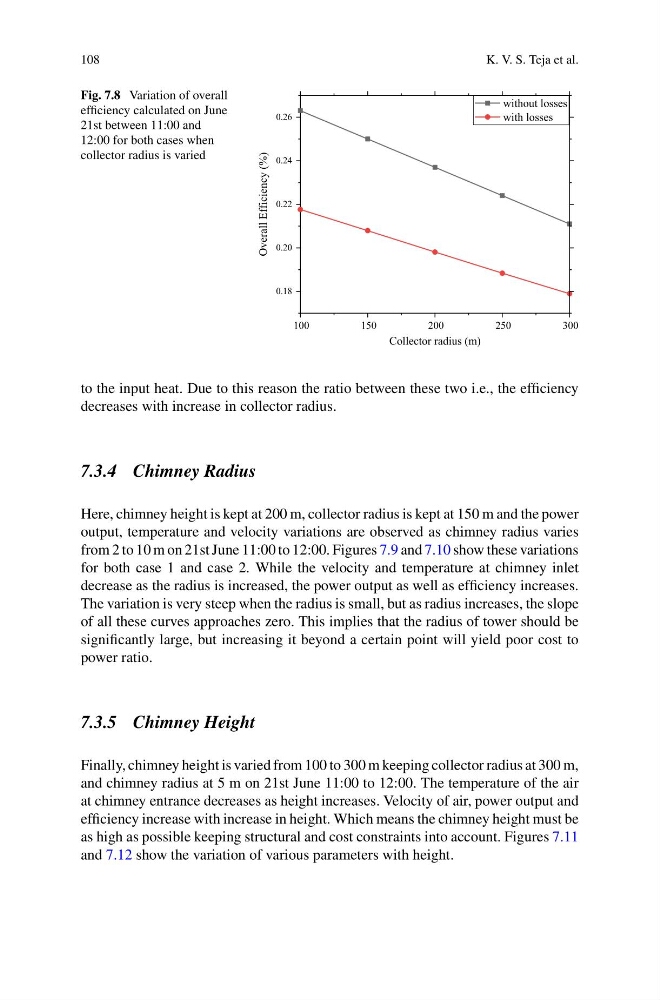
Fig. 7.8 Variation of overall
efficiency calculated on June
21st between 11:00 and
12:00 for both cases when
collector radius is varied
100
150
200
250
300
0.18
0.20
0.22
0.24
0.26
Overall Efficiency (%)
Collector radius (m)
without losses
with losses
to the input heat. Due to this reason the ratio between these two i.e., the efficiency
decreases with increase in collector radius.
7.3.4 Chimney Radius
Here, chimney height is kept at 200 m, collector radius is kept at 150 m and the power
output, temperature and velocity variations are observed as chimney radius varies
from 2 to 10 m on 21st June 11:00 to 12:00. Figures 7.9 and 7.10 show these variations
for both case 1 and case 2. While the velocity and temperature at chimney inlet
decrease as the radius is increased, the power output as well as efficiency increases.
The variation is very steep when the radius is small, but as radius increases, the slope
of all these curves approaches zero. This implies that the radius of tower should be
significantly large, but increasing it beyond a certain point will yield poor cost to
power ratio.
7.3.5 Chimney Height
Finally, chimney height is varied from 100 to 300 m keeping collector radius at 300 m,
and chimney radius at 5 m on 21st June 11:00 to 12:00. The temperature of the air
at chimney entrance decreases as height increases. Velocity of air, power output and
efficiency increase with increase in height. Which means the chimney height must be
as high as possible keeping structural and cost constraints into account. Figures 7.11
and 7.12 show the variation of various parameters with height.
K. V. S. Teja et al.
Fig. 7.8 Variation of overall
efficiency calculated on June
21st between 11:00 and
12:00 for both cases when
collector radius is varied
100
150
200
250
300
0.18
0.20
0.22
0.24
0.26
Overall Efficiency (%)
Collector radius (m)
without losses
with losses
to the input heat. Due to this reason the ratio between these two i.e., the efficiency
decreases with increase in collector radius.
7.3.4 Chimney Radius
Here, chimney height is kept at 200 m, collector radius is kept at 150 m and the power
output, temperature and velocity variations are observed as chimney radius varies
from 2 to 10 m on 21st June 11:00 to 12:00. Figures 7.9 and 7.10 show these variations
for both case 1 and case 2. While the velocity and temperature at chimney inlet
decrease as the radius is increased, the power output as well as efficiency increases.
The variation is very steep when the radius is small, but as radius increases, the slope
of all these curves approaches zero. This implies that the radius of tower should be
significantly large, but increasing it beyond a certain point will yield poor cost to
power ratio.
7.3.5 Chimney Height
Finally, chimney height is varied from 100 to 300 m keeping collector radius at 300 m,
and chimney radius at 5 m on 21st June 11:00 to 12:00. The temperature of the air
at chimney entrance decreases as height increases. Velocity of air, power output and
efficiency increase with increase in height. Which means the chimney height must be
as high as possible keeping structural and cost constraints into account. Figures 7.11
and 7.12 show the variation of various parameters with height.