

102
K. V. S. Teja et al.
Clearly, it can be observed that the efficiency of the plant is a function of the chimney
height. Depending on mechanical and economic constraints, the chimney height must
be kept as high as possible.
7.2.2 Case 2 (with Losses)
For case 2, the collector losses from the top surface are taken into account. Additionally, the reflectivity and absorptivity of glass is taken into account. Assuming
refractive index of glass (m) as 1.5+10
−7 i, the average wavelength of solar spectrum
is assumed to be 0.5 µm. The corresponding reflectivity, absorptivity and transmissivity are calculated. Transmissivity is found to be around 0.912, which shows the
fraction of solar radiation that actually is incident on the ground.
Accordingly, the temperature of the glass roof is calculated. From the top surface
of the greenhouse roof, convective and radiative losses are calculated and subtracted
from the incident heat flux and the power output is calculated again. The results
obtained in case 1 and case 2 are compared.
In order to calculate the roof temperature, certain assumptions have to be taken,
as analytical solution for this is not easily obtained. First of all, the roof temperature
is assumed to be constant throughout. This temperature is assumed to be equal to
the average of ambient temperature and mean air temperature inside the plant. It
is known that the temperature at the periphery is equal to the ambient atmospheric
temperature and temperature at the centre is equal to the temperature at the chimney
entrance. So, assuming the temperature distribution along the radial direction to be
linear, assume the mean temperature of the air is the temperature of air at the A coll /2
mark along the radial direction. At radius r coll = 86.267 m, the area = A coll /2.
Using linear interpolation, temperature at r coll = 86.267 m can be calculated. Now,
roof temperature can be determined.
Convection losses
Assuming wind velocity as 0, the convection losses take place via natural convection
only. But in reality, the wind velocity cannot be determined theoretically and is constantly fluctuating. So, if only natural convection is considered, the Nusselt number
is calculated and then heat transfer coefficient is obtained to be around 1.8 W/m
2 K
(Incropera et al. 1993). Actual heat transfer coefficient is obviously higher than that,
hence it is assumed to be around 5 W/m
2 K.
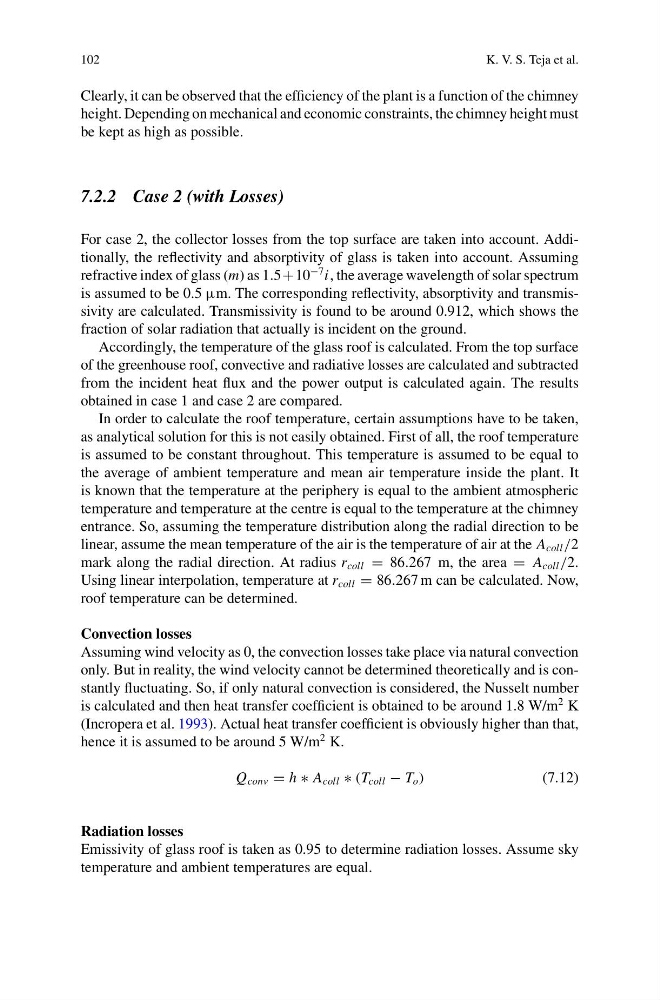
Q conv = h ∗ A coll ∗ (T coll − T o )
(7.12)
Radiation losses
Emissivity of glass roof is taken as 0.95 to determine radiation losses. Assume sky
temperature and ambient temperatures are equal.
K. V. S. Teja et al.
Clearly, it can be observed that the efficiency of the plant is a function of the chimney
height. Depending on mechanical and economic constraints, the chimney height must
be kept as high as possible.
7.2.2 Case 2 (with Losses)
For case 2, the collector losses from the top surface are taken into account. Additionally, the reflectivity and absorptivity of glass is taken into account. Assuming
refractive index of glass (m) as 1.5+10
−7 i, the average wavelength of solar spectrum
is assumed to be 0.5 µm. The corresponding reflectivity, absorptivity and transmissivity are calculated. Transmissivity is found to be around 0.912, which shows the
fraction of solar radiation that actually is incident on the ground.
Accordingly, the temperature of the glass roof is calculated. From the top surface
of the greenhouse roof, convective and radiative losses are calculated and subtracted
from the incident heat flux and the power output is calculated again. The results
obtained in case 1 and case 2 are compared.
In order to calculate the roof temperature, certain assumptions have to be taken,
as analytical solution for this is not easily obtained. First of all, the roof temperature
is assumed to be constant throughout. This temperature is assumed to be equal to
the average of ambient temperature and mean air temperature inside the plant. It
is known that the temperature at the periphery is equal to the ambient atmospheric
temperature and temperature at the centre is equal to the temperature at the chimney
entrance. So, assuming the temperature distribution along the radial direction to be
linear, assume the mean temperature of the air is the temperature of air at the A coll /2
mark along the radial direction. At radius r coll = 86.267 m, the area = A coll /2.
Using linear interpolation, temperature at r coll = 86.267 m can be calculated. Now,
roof temperature can be determined.
Convection losses
Assuming wind velocity as 0, the convection losses take place via natural convection
only. But in reality, the wind velocity cannot be determined theoretically and is constantly fluctuating. So, if only natural convection is considered, the Nusselt number
is calculated and then heat transfer coefficient is obtained to be around 1.8 W/m
2 K
(Incropera et al. 1993). Actual heat transfer coefficient is obviously higher than that,
hence it is assumed to be around 5 W/m
2 K.
Q conv = h ∗ A coll ∗ (T coll − T o )
(7.12)
Radiation losses
Emissivity of glass roof is taken as 0.95 to determine radiation losses. Assume sky
temperature and ambient temperatures are equal.