

100
K. V. S. Teja et al.
a solar chimney was proposed by Zandian and Ashjaee (2013). By doing so, the
efficiency of solar updraft towers was improved. Also, the power generated by these
units was around 10 times more than the one located in Manzanares.
By using water or some other fluid as thermal storage medium, plant can be
operational even during the night. But here, the plant is assumed to be operational
during the day only (i.e. from sunrise to sunset). Also, neglect the losses due to
atmospheric interactions like fog, rain, clouds. Power output was calculated for sunny
day. Ambient temperature is taken as the monthly average temperature of Ropar from
sunrise to sunset. The ground is assumed to be a black body.
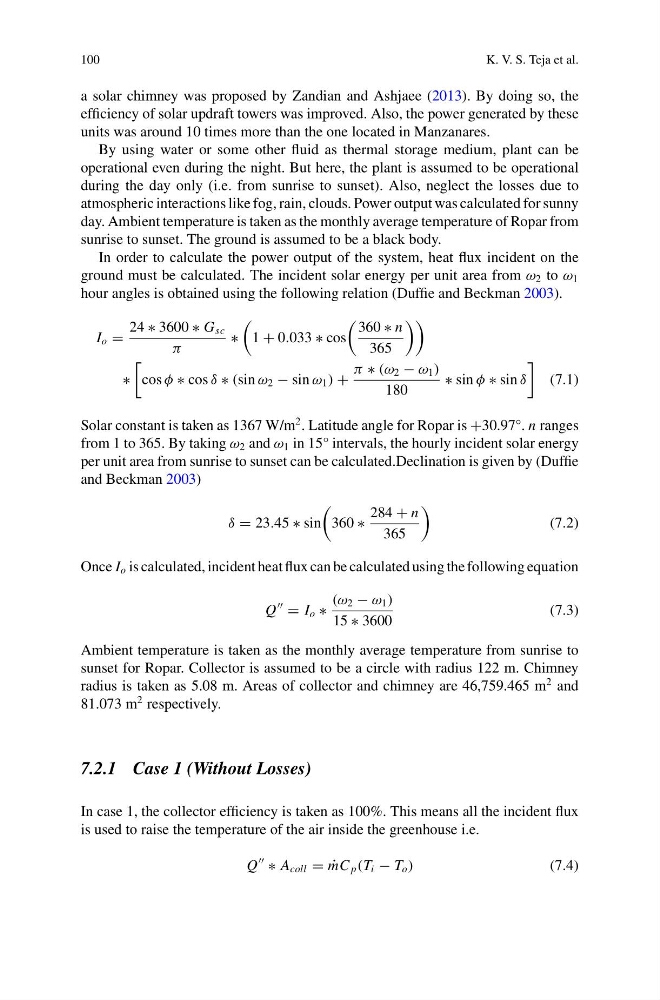
In order to calculate the power output of the system, heat flux incident on the
ground must be calculated. The incident solar energy per unit area from ω 2 to ω 1
hour angles is obtained using the following relation (Duffie and Beckman 2003).
I o =
24 ∗ 3600 ∗ G sc
π
∗
1 + 0.033 ∗ cos
360 ∗ n
365
∗
cos φ ∗ cos δ ∗ (sin ω 2 − sin ω 1 ) +
π ∗ (ω 2 − ω 1 )
180
∗ sin φ ∗ sin δ
(7.1)
Solar constant is taken as 1367 W/m
2 . Latitude angle for Ropar is +30.97°. n ranges
from 1 to 365. By taking ω 2 and ω 1 in 15° intervals, the hourly incident solar energy
per unit area from sunrise to sunset can be calculated.Declination is given by (Duffie
and Beckman 2003)
δ = 23.45 ∗ sin
360 ∗
284 + n
365
(7.2)
Once I o is calculated, incident heat flux can be calculated using the following equation
Q
= I o ∗
(ω 2 − ω 1 )
15 ∗ 3600
(7.3)
Ambient temperature is taken as the monthly average temperature from sunrise to
sunset for Ropar. Collector is assumed to be a circle with radius 122 m. Chimney
radius is taken as 5.08 m. Areas of collector and chimney are 46,759.465 m
2 and
81.073 m
2 respectively.
7.2.1 Case 1 (Without Losses)
In case 1, the collector efficiency is taken as 100%. This means all the incident flux
is used to raise the temperature of the air inside the greenhouse i.e.
Q
∗ A coll = ˙
mC p (T i − T o )
(7.4)
K. V. S. Teja et al.
a solar chimney was proposed by Zandian and Ashjaee (2013). By doing so, the
efficiency of solar updraft towers was improved. Also, the power generated by these
units was around 10 times more than the one located in Manzanares.
By using water or some other fluid as thermal storage medium, plant can be
operational even during the night. But here, the plant is assumed to be operational
during the day only (i.e. from sunrise to sunset). Also, neglect the losses due to
atmospheric interactions like fog, rain, clouds. Power output was calculated for sunny
day. Ambient temperature is taken as the monthly average temperature of Ropar from
sunrise to sunset. The ground is assumed to be a black body.
In order to calculate the power output of the system, heat flux incident on the
ground must be calculated. The incident solar energy per unit area from ω 2 to ω 1
hour angles is obtained using the following relation (Duffie and Beckman 2003).
I o =
24 ∗ 3600 ∗ G sc
π
∗
1 + 0.033 ∗ cos
360 ∗ n
365
∗
cos φ ∗ cos δ ∗ (sin ω 2 − sin ω 1 ) +
π ∗ (ω 2 − ω 1 )
180
∗ sin φ ∗ sin δ
(7.1)
Solar constant is taken as 1367 W/m
2 . Latitude angle for Ropar is +30.97°. n ranges
from 1 to 365. By taking ω 2 and ω 1 in 15° intervals, the hourly incident solar energy
per unit area from sunrise to sunset can be calculated.Declination is given by (Duffie
and Beckman 2003)
δ = 23.45 ∗ sin
360 ∗
284 + n
365
(7.2)
Once I o is calculated, incident heat flux can be calculated using the following equation
Q
= I o ∗
(ω 2 − ω 1 )
15 ∗ 3600
(7.3)
Ambient temperature is taken as the monthly average temperature from sunrise to
sunset for Ropar. Collector is assumed to be a circle with radius 122 m. Chimney
radius is taken as 5.08 m. Areas of collector and chimney are 46,759.465 m
2 and
81.073 m
2 respectively.
7.2.1 Case 1 (Without Losses)
In case 1, the collector efficiency is taken as 100%. This means all the incident flux
is used to raise the temperature of the air inside the greenhouse i.e.
Q
∗ A coll = ˙
mC p (T i − T o )
(7.4)