

92
N. Sharma and R. Choudhary
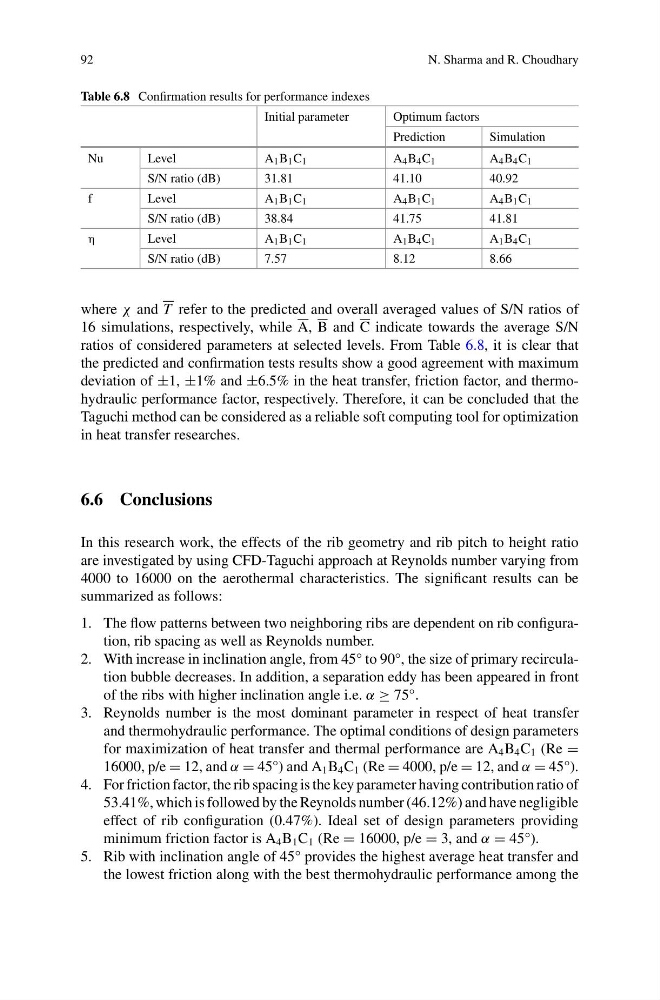
Table 6.8 Confirmation results for performance indexes
Initial parameter
Optimum factors
Prediction
Simulation
Nu
Level
A 1 B 1 C 1
A 4 B 4 C 1
A 4 B 4 C 1
S/N ratio (dB)
31.81
41.10
40.92
f
Level
A 1 B 1 C 1
A 4 B 1 C 1
A 4 B 1 C 1
S/N ratio (dB)
38.84
41.75
41.81
η
Level
A 1 B 1 C 1
A 1 B 4 C 1
A 1 B 4 C 1
S/N ratio (dB)
7.57
8.12
8.66
where χ and T refer to the predicted and overall averaged values of S/N ratios of
16 simulations, respectively, while A, B and C indicate towards the average S/N
ratios of considered parameters at selected levels. From Table 6.8, it is clear that
the predicted and confirmation tests results show a good agreement with maximum
deviation of ±1, ±1% and ±6.5% in the heat transfer, friction factor, and thermohydraulic performance factor, respectively. Therefore, it can be concluded that the
Taguchi method can be considered as a reliable soft computing tool for optimization
in heat transfer researches.
6.6 Conclusions
In this research work, the effects of the rib geometry and rib pitch to height ratio
are investigated by using CFD-Taguchi approach at Reynolds number varying from
4000 to 16000 on the aerothermal characteristics. The significant results can be
summarized as follows:
1. The flow patterns between two neighboring ribs are dependent on rib configuration, rib spacing as well as Reynolds number.
2. With increase in inclination angle, from 45° to 90°, the size of primary recirculation bubble decreases. In addition, a separation eddy has been appeared in front
of the ribs with higher inclination angle i.e. α ≥ 75°.
3. Reynolds number is the most dominant parameter in respect of heat transfer
and thermohydraulic performance. The optimal conditions of design parameters
for maximization of heat transfer and thermal performance are A 4 B 4 C 1 (Re =
16000, p/e = 12, and α = 45°) and A 1 B 4 C 1 (Re = 4000, p/e = 12, and α = 45°).
4. For friction factor, the rib spacing is the key parameter having contribution ratio of
53.41%, which is followed by the Reynolds number (46.12%) and have negligible
effect of rib configuration (0.47%). Ideal set of design parameters providing
minimum friction factor is A 4 B 1 C 1 (Re = 16000, p/e = 3, and α = 45°).
5. Rib with inclination angle of 45° provides the highest average heat transfer and
the lowest friction along with the best thermohydraulic performance among the
N. Sharma and R. Choudhary
Table 6.8 Confirmation results for performance indexes
Initial parameter
Optimum factors
Prediction
Simulation
Nu
Level
A 1 B 1 C 1
A 4 B 4 C 1
A 4 B 4 C 1
S/N ratio (dB)
31.81
41.10
40.92
f
Level
A 1 B 1 C 1
A 4 B 1 C 1
A 4 B 1 C 1
S/N ratio (dB)
38.84
41.75
41.81
η
Level
A 1 B 1 C 1
A 1 B 4 C 1
A 1 B 4 C 1
S/N ratio (dB)
7.57
8.12
8.66
where χ and T refer to the predicted and overall averaged values of S/N ratios of
16 simulations, respectively, while A, B and C indicate towards the average S/N
ratios of considered parameters at selected levels. From Table 6.8, it is clear that
the predicted and confirmation tests results show a good agreement with maximum
deviation of ±1, ±1% and ±6.5% in the heat transfer, friction factor, and thermohydraulic performance factor, respectively. Therefore, it can be concluded that the
Taguchi method can be considered as a reliable soft computing tool for optimization
in heat transfer researches.
6.6 Conclusions
In this research work, the effects of the rib geometry and rib pitch to height ratio
are investigated by using CFD-Taguchi approach at Reynolds number varying from
4000 to 16000 on the aerothermal characteristics. The significant results can be
summarized as follows:
1. The flow patterns between two neighboring ribs are dependent on rib configuration, rib spacing as well as Reynolds number.
2. With increase in inclination angle, from 45° to 90°, the size of primary recirculation bubble decreases. In addition, a separation eddy has been appeared in front
of the ribs with higher inclination angle i.e. α ≥ 75°.
3. Reynolds number is the most dominant parameter in respect of heat transfer
and thermohydraulic performance. The optimal conditions of design parameters
for maximization of heat transfer and thermal performance are A 4 B 4 C 1 (Re =
16000, p/e = 12, and α = 45°) and A 1 B 4 C 1 (Re = 4000, p/e = 12, and α = 45°).
4. For friction factor, the rib spacing is the key parameter having contribution ratio of
53.41%, which is followed by the Reynolds number (46.12%) and have negligible
effect of rib configuration (0.47%). Ideal set of design parameters providing
minimum friction factor is A 4 B 1 C 1 (Re = 16000, p/e = 3, and α = 45°).
5. Rib with inclination angle of 45° provides the highest average heat transfer and
the lowest friction along with the best thermohydraulic performance among the