

are much evident in Patancheru as a result of toxic wastes discharged from pharmaceutical industries.
19 Similarly, people living in Kanpur, Ranipet and Vellore are
suffering from acute shortage of drinking water and are facing severe health impacts
due to pollution from tanneries. The discharge from chromite mines in Orissa has
severely polluted surface water and underground aquifers, and people are using
mine discharge for drinking purposes.
4 Surface Water Pollution
The Sabarmati River water quality was analyzed upstream and downstream of
Ahmedabad to assess the impact of the city in the river water quality using monthly
data from April 2011 to March 2017. Analysis of the data revealed that the river is
in keeping with the norms when it enters Ahmedabad, but the river is dead
downstream. The impact of this pollution by the city is borne by the residents in the
peri-urban areas.
20 This is an example of just one river.
In 2018, the Central Water Commission brought out a report sharing the findings
of water quality vis-à-vis toxic metals in 16 river basins of India. Toxic metals
found in these river basins included cadmium, chromium, copper, iron, lead and
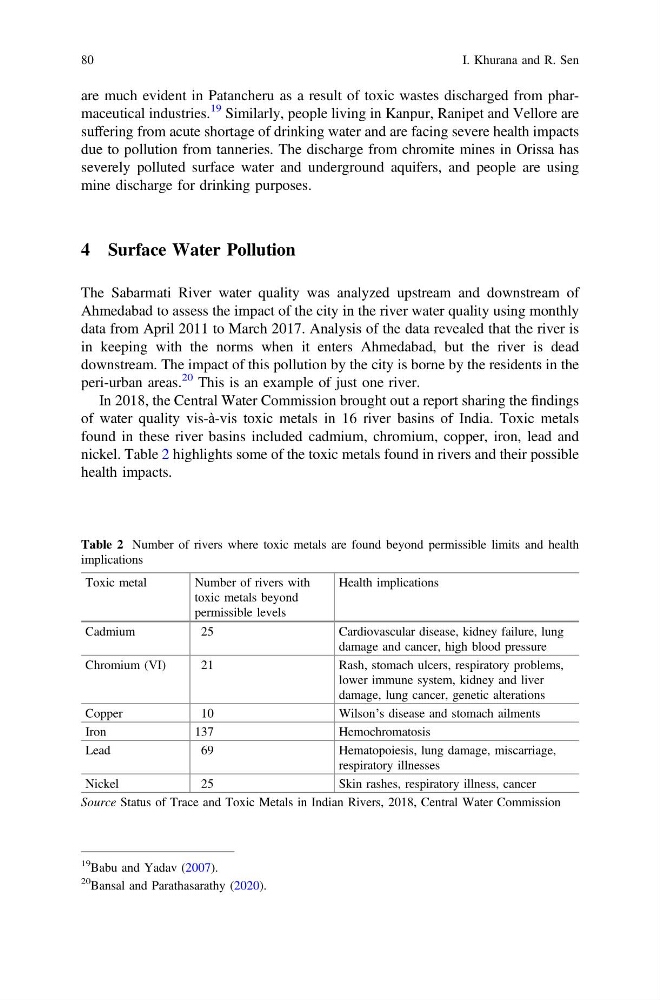
nickel. Table 2 highlights some of the toxic metals found in rivers and their possible
health impacts.
Table 2 Number of rivers where toxic metals are found beyond permissible limits and health
implications
Toxic metal
Number of rivers with
toxic metals beyond
permissible levels
Health implications
Cadmium
25
Cardiovascular disease, kidney failure, lung
damage and cancer, high blood pressure
Chromium (VI)
21
Rash, stomach ulcers, respiratory problems,
lower immune system, kidney and liver
damage, lung cancer, genetic alterations
Copper
10
Wilson’s disease and stomach ailments
Iron
137
Hemochromatosis
Lead
69
Hematopoiesis, lung damage, miscarriage,
respiratory illnesses
Nickel
25
Skin rashes, respiratory illness, cancer
Source Status of Trace and Toxic Metals in Indian Rivers, 2018, Central Water Commission
19
Babu and Yadav (2007).
20
Bansal and Parathasarathy (2020).
80
I. Khurana and R. Sen
19 Similarly, people living in Kanpur, Ranipet and Vellore are
suffering from acute shortage of drinking water and are facing severe health impacts
due to pollution from tanneries. The discharge from chromite mines in Orissa has
severely polluted surface water and underground aquifers, and people are using
mine discharge for drinking purposes.
4 Surface Water Pollution
The Sabarmati River water quality was analyzed upstream and downstream of
Ahmedabad to assess the impact of the city in the river water quality using monthly
data from April 2011 to March 2017. Analysis of the data revealed that the river is
in keeping with the norms when it enters Ahmedabad, but the river is dead
downstream. The impact of this pollution by the city is borne by the residents in the
peri-urban areas.
20 This is an example of just one river.
In 2018, the Central Water Commission brought out a report sharing the findings
of water quality vis-à-vis toxic metals in 16 river basins of India. Toxic metals
found in these river basins included cadmium, chromium, copper, iron, lead and
nickel. Table 2 highlights some of the toxic metals found in rivers and their possible
health impacts.
Table 2 Number of rivers where toxic metals are found beyond permissible limits and health
implications
Toxic metal
Number of rivers with
toxic metals beyond
permissible levels
Health implications
Cadmium
25
Cardiovascular disease, kidney failure, lung
damage and cancer, high blood pressure
Chromium (VI)
21
Rash, stomach ulcers, respiratory problems,
lower immune system, kidney and liver
damage, lung cancer, genetic alterations
Copper
10
Wilson’s disease and stomach ailments
Iron
137
Hemochromatosis
Lead
69
Hematopoiesis, lung damage, miscarriage,
respiratory illnesses
Nickel
25
Skin rashes, respiratory illness, cancer
Source Status of Trace and Toxic Metals in Indian Rivers, 2018, Central Water Commission
19
Babu and Yadav (2007).
20
Bansal and Parathasarathy (2020).
80
I. Khurana and R. Sen