

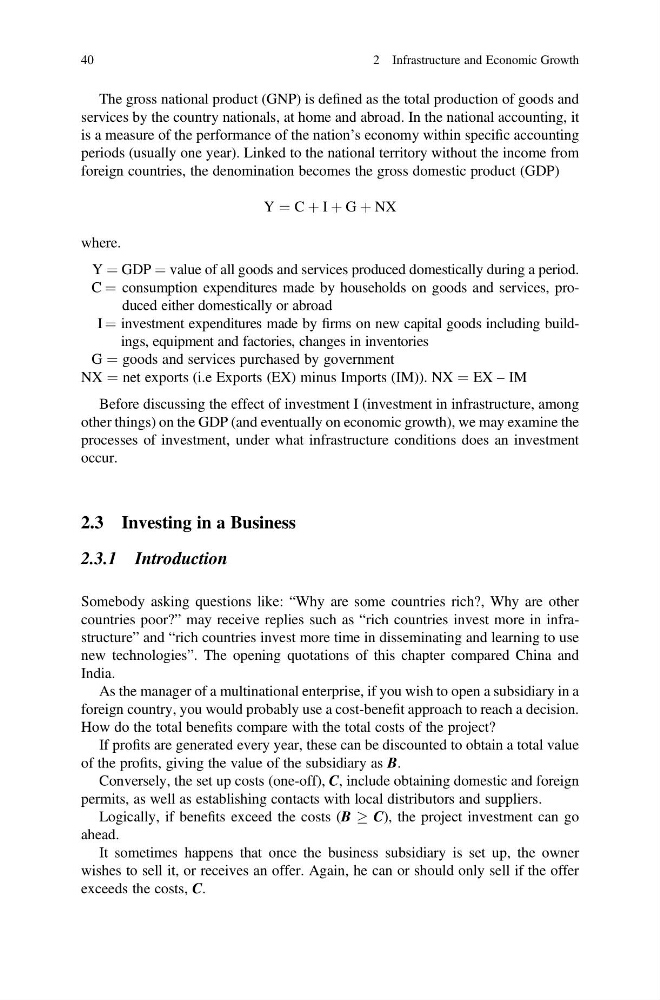
The gross national product (GNP) is defined as the total production of goods and
services by the country nationals, at home and abroad. In the national accounting, it
is a measure of the performance of the nation’s economy within specific accounting
periods (usually one year). Linked to the national territory without the income from
foreign countries, the denomination becomes the gross domestic product (GDP)
Y ¼ C þ I þ G þ NX
where.
Y ¼ GDP ¼ value of all goods and services produced domestically during a period.
C ¼ consumption expenditures made by households on goods and services, produced either domestically or abroad
I ¼ investment expenditures made by firms on new capital goods including buildings, equipment and factories, changes in inventories
G ¼ goods and services purchased by government
NX ¼ net exports (i.e Exports (EX) minus Imports (IM)). NX ¼ EX – IM
Before discussing the effect of investment I (investment in infrastructure, among
other things) on the GDP (and eventually on economic growth), we may examine the
processes of investment, under what infrastructure conditions does an investment
occur.
2.3 Investing in a Business
2.3.1 Introduction
Somebody asking questions like: “Why are some countries rich?, Why are other
countries poor?” may receive replies such as “rich countries invest more in infrastructure” and “rich countries invest more time in disseminating and learning to use
new technologies”. The opening quotations of this chapter compared China and
India.
As the manager of a multinational enterprise, if you wish to open a subsidiary in a
foreign country, you would probably use a cost-benefit approach to reach a decision.
How do the total benefits compare with the total costs of the project?
If profits are generated every year, these can be discounted to obtain a total value
of the profits, giving the value of the subsidiary as B.
Conversely, the set up costs (one-off), C, include obtaining domestic and foreign
permits, as well as establishing contacts with local distributors and suppliers.
Logically, if benefits exceed the costs (B ! C), the project investment can go
ahead.
It sometimes happens that once the business subsidiary is set up, the owner
wishes to sell it, or receives an offer. Again, he can or should only sell if the offer
exceeds the costs, C.
40
2 Infrastructure and Economic Growth
services by the country nationals, at home and abroad. In the national accounting, it
is a measure of the performance of the nation’s economy within specific accounting
periods (usually one year). Linked to the national territory without the income from
foreign countries, the denomination becomes the gross domestic product (GDP)
Y ¼ C þ I þ G þ NX
where.
Y ¼ GDP ¼ value of all goods and services produced domestically during a period.
C ¼ consumption expenditures made by households on goods and services, produced either domestically or abroad
I ¼ investment expenditures made by firms on new capital goods including buildings, equipment and factories, changes in inventories
G ¼ goods and services purchased by government
NX ¼ net exports (i.e Exports (EX) minus Imports (IM)). NX ¼ EX – IM
Before discussing the effect of investment I (investment in infrastructure, among
other things) on the GDP (and eventually on economic growth), we may examine the
processes of investment, under what infrastructure conditions does an investment
occur.
2.3 Investing in a Business
2.3.1 Introduction
Somebody asking questions like: “Why are some countries rich?, Why are other
countries poor?” may receive replies such as “rich countries invest more in infrastructure” and “rich countries invest more time in disseminating and learning to use
new technologies”. The opening quotations of this chapter compared China and
India.
As the manager of a multinational enterprise, if you wish to open a subsidiary in a
foreign country, you would probably use a cost-benefit approach to reach a decision.
How do the total benefits compare with the total costs of the project?
If profits are generated every year, these can be discounted to obtain a total value
of the profits, giving the value of the subsidiary as B.
Conversely, the set up costs (one-off), C, include obtaining domestic and foreign
permits, as well as establishing contacts with local distributors and suppliers.
Logically, if benefits exceed the costs (B ! C), the project investment can go
ahead.
It sometimes happens that once the business subsidiary is set up, the owner
wishes to sell it, or receives an offer. Again, he can or should only sell if the offer
exceeds the costs, C.
40
2 Infrastructure and Economic Growth