

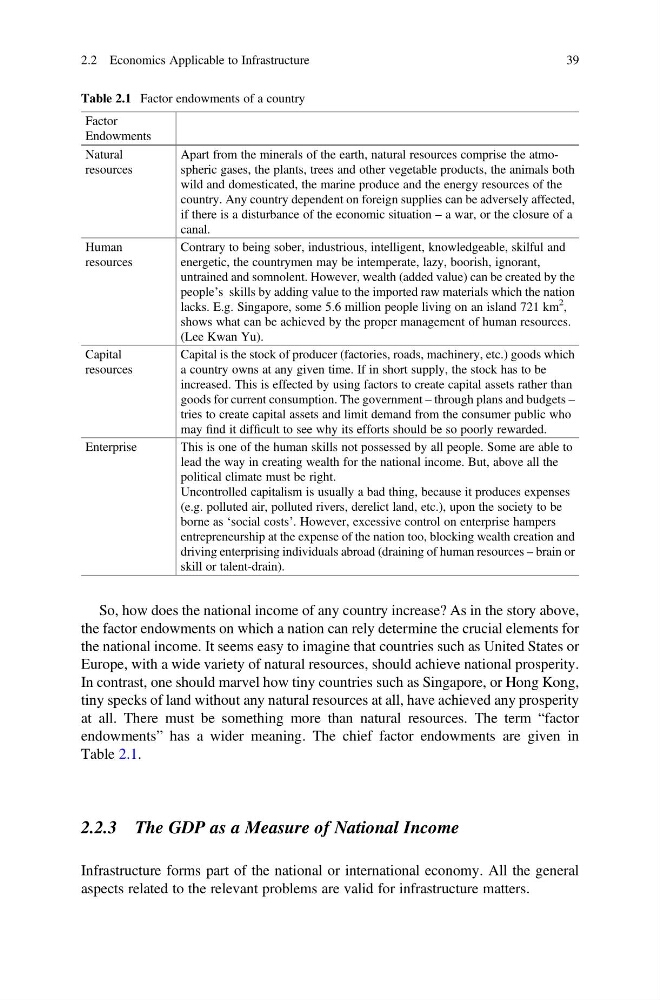
So, how does the national income of any country increase? As in the story above,
the factor endowments on which a nation can rely determine the crucial elements for
the national income. It seems easy to imagine that countries such as United States or
Europe, with a wide variety of natural resources, should achieve national prosperity.
In contrast, one should marvel how tiny countries such as Singapore, or Hong Kong,
tiny specks of land without any natural resources at all, have achieved any prosperity
at all. There must be something more than natural resources. The term “factor
endowments” has a wider meaning. The chief factor endowments are given in
Table 2.1.
2.2.3 The GDP as a Measure of National Income
Infrastructure forms part of the national or international economy. All the general
aspects related to the relevant problems are valid for infrastructure matters.
Table 2.1 Factor endowments of a country
Factor
Endowments
Natural
resources
Apart from the minerals of the earth, natural resources comprise the atmospheric gases, the plants, trees and other vegetable products, the animals both
wild and domesticated, the marine produce and the energy resources of the
country. Any country dependent on foreign supplies can be adversely affected,
if there is a disturbance of the economic situation – a war, or the closure of a
canal.
Human
resources
Contrary to being sober, industrious, intelligent, knowledgeable, skilful and
energetic, the countrymen may be intemperate, lazy, boorish, ignorant,
untrained and somnolent. However, wealth (added value) can be created by the
people’s skills by adding value to the imported raw materials which the nation
lacks. E.g. Singapore, some 5.6 million people living on an island 721 km
2
,
shows what can be achieved by the proper management of human resources.
(Lee Kwan Yu).
Capital
resources
Capital is the stock of producer (factories, roads, machinery, etc.) goods which
a country owns at any given time. If in short supply, the stock has to be
increased. This is effected by using factors to create capital assets rather than
goods for current consumption. The government – through plans and budgets –
tries to create capital assets and limit demand from the consumer public who
may find it difficult to see why its efforts should be so poorly rewarded.
Enterprise
This is one of the human skills not possessed by all people. Some are able to
lead the way in creating wealth for the national income. But, above all the
political climate must be right.
Uncontrolled capitalism is usually a bad thing, because it produces expenses
(e.g. polluted air, polluted rivers, derelict land, etc.), upon the society to be
borne as ‘social costs’. However, excessive control on enterprise hampers
entrepreneurship at the expense of the nation too, blocking wealth creation and
driving enterprising individuals abroad (draining of human resources – brain or
skill or talent-drain).
2.2 Economics Applicable to Infrastructure
39
the factor endowments on which a nation can rely determine the crucial elements for
the national income. It seems easy to imagine that countries such as United States or
Europe, with a wide variety of natural resources, should achieve national prosperity.
In contrast, one should marvel how tiny countries such as Singapore, or Hong Kong,
tiny specks of land without any natural resources at all, have achieved any prosperity
at all. There must be something more than natural resources. The term “factor
endowments” has a wider meaning. The chief factor endowments are given in
Table 2.1.
2.2.3 The GDP as a Measure of National Income
Infrastructure forms part of the national or international economy. All the general
aspects related to the relevant problems are valid for infrastructure matters.
Table 2.1 Factor endowments of a country
Factor
Endowments
Natural
resources
Apart from the minerals of the earth, natural resources comprise the atmospheric gases, the plants, trees and other vegetable products, the animals both
wild and domesticated, the marine produce and the energy resources of the
country. Any country dependent on foreign supplies can be adversely affected,
if there is a disturbance of the economic situation – a war, or the closure of a
canal.
Human
resources
Contrary to being sober, industrious, intelligent, knowledgeable, skilful and
energetic, the countrymen may be intemperate, lazy, boorish, ignorant,
untrained and somnolent. However, wealth (added value) can be created by the
people’s skills by adding value to the imported raw materials which the nation
lacks. E.g. Singapore, some 5.6 million people living on an island 721 km
2
,
shows what can be achieved by the proper management of human resources.
(Lee Kwan Yu).
Capital
resources
Capital is the stock of producer (factories, roads, machinery, etc.) goods which
a country owns at any given time. If in short supply, the stock has to be
increased. This is effected by using factors to create capital assets rather than
goods for current consumption. The government – through plans and budgets –
tries to create capital assets and limit demand from the consumer public who
may find it difficult to see why its efforts should be so poorly rewarded.
Enterprise
This is one of the human skills not possessed by all people. Some are able to
lead the way in creating wealth for the national income. But, above all the
political climate must be right.
Uncontrolled capitalism is usually a bad thing, because it produces expenses
(e.g. polluted air, polluted rivers, derelict land, etc.), upon the society to be
borne as ‘social costs’. However, excessive control on enterprise hampers
entrepreneurship at the expense of the nation too, blocking wealth creation and
driving enterprising individuals abroad (draining of human resources – brain or
skill or talent-drain).
2.2 Economics Applicable to Infrastructure
39