

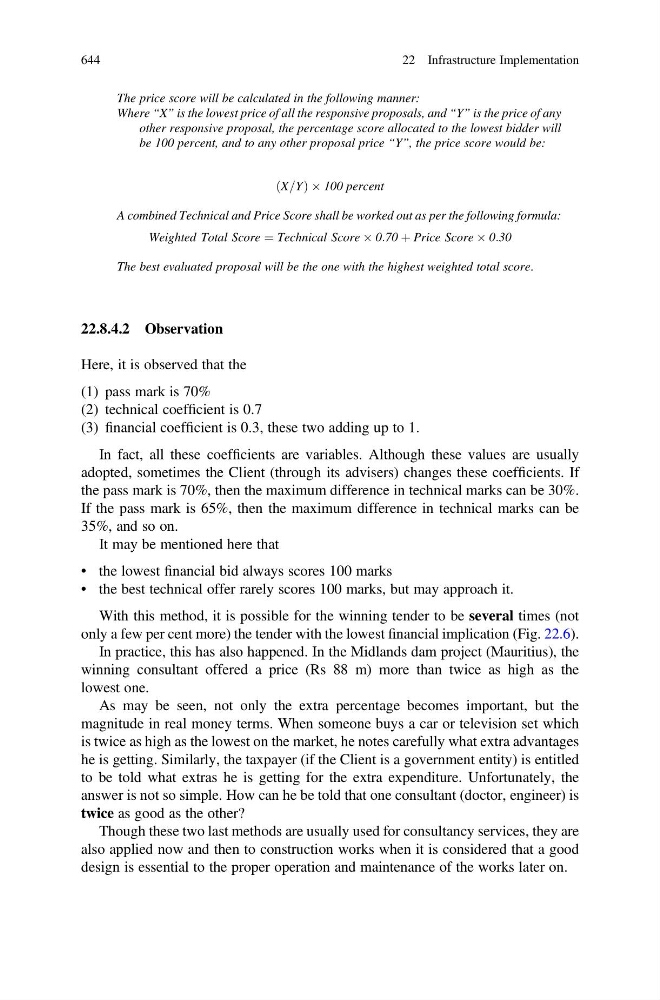
The price score will be calculated in the following manner:
Where “X” is the lowest price of all the responsive proposals, and “Y” is the price of any
other responsive proposal, the percentage score allocated to the lowest bidder will
be 100 percent, and to any other proposal price “Y”, the price score would be:
X=Y
ð
ÞÂ100 percent
A combined Technical and Price Score shall be worked out as per the following formula:
Weighted Total Score ¼ Technical Score  0:70 þ Price Score  0:30
The best evaluated proposal will be the one with the highest weighted total score.
22.8.4.2 Observation
Here, it is observed that the
(1) pass mark is 70%
(2) technical coefficient is 0.7
(3) financial coefficient is 0.3, these two adding up to 1.
In fact, all these coefficients are variables. Although these values are usually
adopted, sometimes the Client (through its advisers) changes these coefficients. If
the pass mark is 70%, then the maximum difference in technical marks can be 30%.
If the pass mark is 65%, then the maximum difference in technical marks can be
35%, and so on.
It may be mentioned here that
• the lowest financial bid always scores 100 marks
• the best technical offer rarely scores 100 marks, but may approach it.
With this method, it is possible for the winning tender to be several times (not
only a few per cent more) the tender with the lowest financial implication (Fig. 22.6).
In practice, this has also happened. In the Midlands dam project (Mauritius), the
winning consultant offered a price (Rs 88 m) more than twice as high as the
lowest one.
As may be seen, not only the extra percentage becomes important, but the
magnitude in real money terms. When someone buys a car or television set which
is twice as high as the lowest on the market, he notes carefully what extra advantages
he is getting. Similarly, the taxpayer (if the Client is a government entity) is entitled
to be told what extras he is getting for the extra expenditure. Unfortunately, the
answer is not so simple. How can he be told that one consultant (doctor, engineer) is
twice as good as the other?
Though these two last methods are usually used for consultancy services, they are
also applied now and then to construction works when it is considered that a good
design is essential to the proper operation and maintenance of the works later on.
644
22 Infrastructure Implementation