

(3) Tangibles: the supplier organisation presents a professional view to outsiders
(4) Empathy: the team members are considerate and are empowered to resolve
problems
(5) Responsiveness: the staff members respond to enquiries within the estimated
time frame
Questionnaires designed with the RATER metrics will help discover the gaps
between what the company offers and what the customers expect. This information
can then be used to bring changes that increase retention.
21.7.2 Understanding the RATER Metrics
The RATER metrics – reliability, assurance, tangibles, empathy, and
responsiveness – are the five service dimensions which customers use (mostly
unconsciously) to assess a supplier or service provider. Each of these metrics is
explained below in Table 21.5.
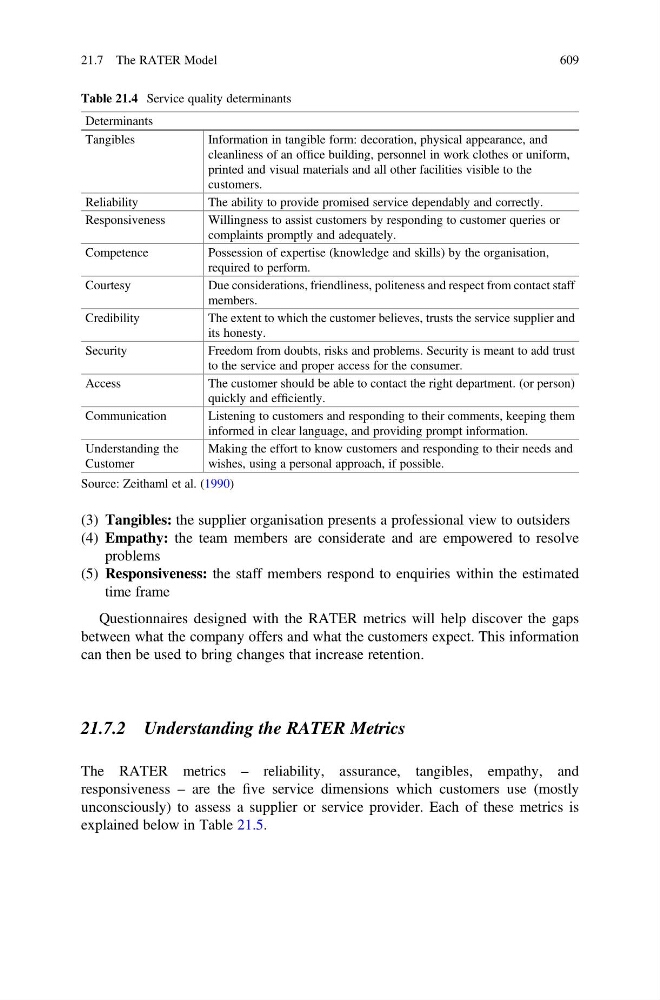
Table 21.4 Service quality determinants
Determinants
Tangibles
Information in tangible form: decoration, physical appearance, and
cleanliness of an office building, personnel in work clothes or uniform,
printed and visual materials and all other facilities visible to the
customers.
Reliability
The ability to provide promised service dependably and correctly.
Responsiveness
Willingness to assist customers by responding to customer queries or
complaints promptly and adequately.
Competence
Possession of expertise (knowledge and skills) by the organisation,
required to perform.
Courtesy
Due considerations, friendliness, politeness and respect from contact staff
members.
Credibility
The extent to which the customer believes, trusts the service supplier and
its honesty.
Security
Freedom from doubts, risks and problems. Security is meant to add trust
to the service and proper access for the consumer.
Access
The customer should be able to contact the right department. (or person)
quickly and efficiently.
Communication
Listening to customers and responding to their comments, keeping them
informed in clear language, and providing prompt information.
Understanding the
Customer
Making the effort to know customers and responding to their needs and
wishes, using a personal approach, if possible.
Source: Zeithaml et al. (1990)
21.7 The RATER Model
609