

21.6.4 Service Quality Determinants
The SERVQUAL Model, was first tested on a telecommunications, a banking and a
maintenance company. The original questionnaire with almost 100 items was finally
reduced to 25 which were deemed important by the consumers in relation to
customer service. In the end, this eventually resulted in the following ten dimensions
(see Table 21.4) that still maintain an important role in the SERVQUAL Model:
21.7 The RATER Model
21.7.1 The RATER Model
While the SERVQUAL Model works with 10 dimensions to measure the quality of
service, a smaller version of the SERVQUAL Model working with 5 dimensions is
the RATER Model. Customer service is not always easy to assess, in particular if
only 4% of unhappy customers do complain, while the service supplier might be
believing that everything is satisfactory. If enough data is collected over months of
complaints and feedback, the RATER framework can help produce a plan for
improvement, from information to action by separating service issues into the five
service dimensions, customers are concerned about:
(1) Reliability: the supplier delivers as promised
(2) Assurance: the supplier organisation inspires confidence
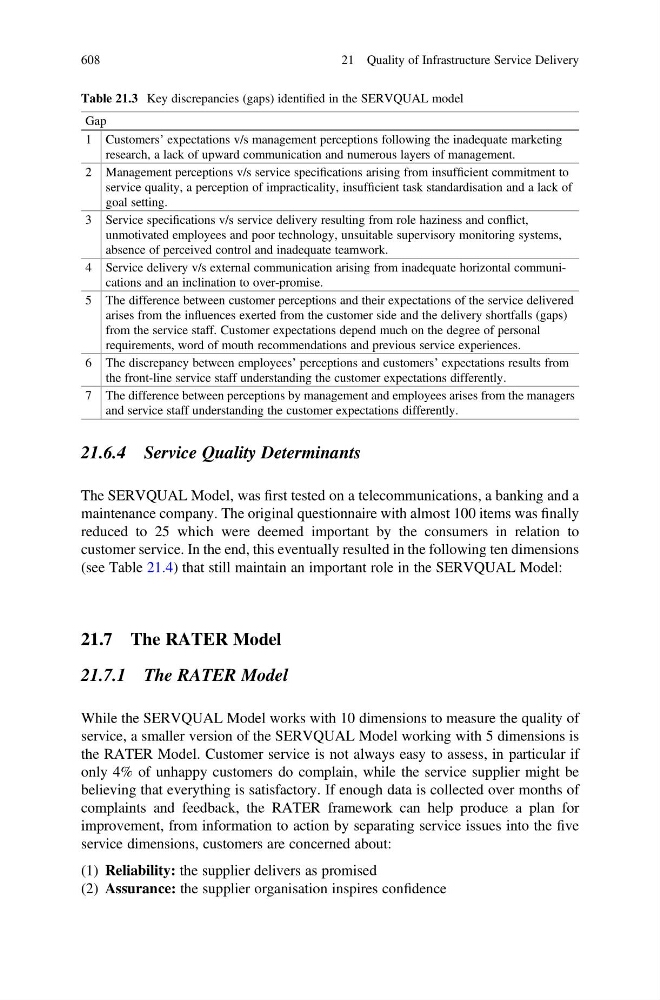
Table 21.3 Key discrepancies (gaps) identified in the SERVQUAL model
Gap
1 Customers’ expectations v/s management perceptions following the inadequate marketing
research, a lack of upward communication and numerous layers of management.
2 Management perceptions v/s service specifications arising from insufficient commitment to
service quality, a perception of impracticality, insufficient task standardisation and a lack of
goal setting.
3 Service specifications v/s service delivery resulting from role haziness and conflict,
unmotivated employees and poor technology, unsuitable supervisory monitoring systems,
absence of perceived control and inadequate teamwork.
4 Service delivery v/s external communication arising from inadequate horizontal communications and an inclination to over-promise.
5 The difference between customer perceptions and their expectations of the service delivered
arises from the influences exerted from the customer side and the delivery shortfalls (gaps)
from the service staff. Customer expectations depend much on the degree of personal
requirements, word of mouth recommendations and previous service experiences.
6 The discrepancy between employees’ perceptions and customers’ expectations results from
the front-line service staff understanding the customer expectations differently.
7 The difference between perceptions by management and employees arises from the managers
and service staff understanding the customer expectations differently.
608
21 Quality of Infrastructure Service Delivery