

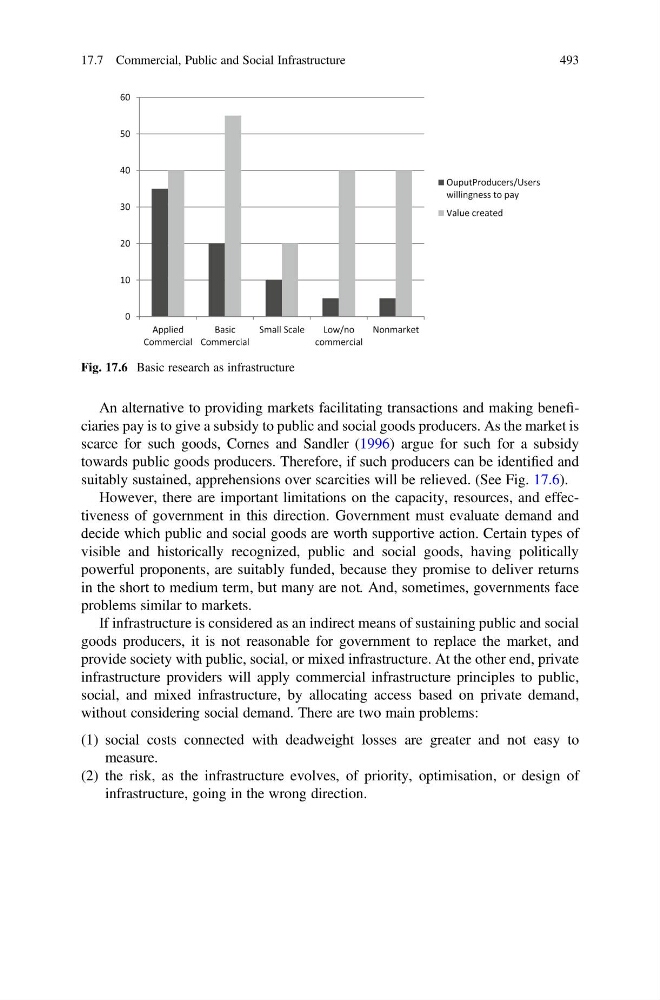
An alternative to providing markets facilitating transactions and making beneficiaries pay is to give a subsidy to public and social goods producers. As the market is
scarce for such goods, Cornes and Sandler (1996) argue for such for a subsidy
towards public goods producers. Therefore, if such producers can be identified and
suitably sustained, apprehensions over scarcities will be relieved. (See Fig. 17.6).
However, there are important limitations on the capacity, resources, and effectiveness of government in this direction. Government must evaluate demand and
decide which public and social goods are worth supportive action. Certain types of
visible and historically recognized, public and social goods, having politically
powerful proponents, are suitably funded, because they promise to deliver returns
in the short to medium term, but many are not. And, sometimes, governments face
problems similar to markets.
If infrastructure is considered as an indirect means of sustaining public and social
goods producers, it is not reasonable for government to replace the market, and
provide society with public, social, or mixed infrastructure. At the other end, private
infrastructure providers will apply commercial infrastructure principles to public,
social, and mixed infrastructure, by allocating access based on private demand,
without considering social demand. There are two main problems:
(1) social costs connected with deadweight losses are greater and not easy to
measure.
(2) the risk, as the infrastructure evolves, of priority, optimisation, or design of
infrastructure, going in the wrong direction.
Fig. 17.6 Basic research as infrastructure
17.7 Commercial, Public and Social Infrastructure
493
scarce for such goods, Cornes and Sandler (1996) argue for such for a subsidy
towards public goods producers. Therefore, if such producers can be identified and
suitably sustained, apprehensions over scarcities will be relieved. (See Fig. 17.6).
However, there are important limitations on the capacity, resources, and effectiveness of government in this direction. Government must evaluate demand and
decide which public and social goods are worth supportive action. Certain types of
visible and historically recognized, public and social goods, having politically
powerful proponents, are suitably funded, because they promise to deliver returns
in the short to medium term, but many are not. And, sometimes, governments face
problems similar to markets.
If infrastructure is considered as an indirect means of sustaining public and social
goods producers, it is not reasonable for government to replace the market, and
provide society with public, social, or mixed infrastructure. At the other end, private
infrastructure providers will apply commercial infrastructure principles to public,
social, and mixed infrastructure, by allocating access based on private demand,
without considering social demand. There are two main problems:
(1) social costs connected with deadweight losses are greater and not easy to
measure.
(2) the risk, as the infrastructure evolves, of priority, optimisation, or design of
infrastructure, going in the wrong direction.
Fig. 17.6 Basic research as infrastructure
17.7 Commercial, Public and Social Infrastructure
493