

An important question for infrastructure is whether there is an optimal level of
congestion. However, contrary to most club goods, keeping a small membership size
is not usually possible for infrastructure services, because such facilities should be
available to the public users to facilitate and induce productive behaviour entailing
increased benefits for society.
17.2.2 Consumption Goods and Capital Goods
In the analysis of nonrival and partially (non) rival resources, it is necessary to
differentiate between capital goods and consumption goods, which, like apples or
oranges, are used directly to provide private benefits. Consumption goods meet
consumer demand and can be considered as ends (end-products or outputs) in
themselves. In contrast, capital goods, such as a tractor or a harvesting process, are
required as inputs to produce or generate other goods. The capital goods meet
demand (e.g. turbines) which are generated by demand for the outputs
(e.g. electricity) and are means rather than ends. Economists knowingly call capital
goods “factors of production” as contrary to raw materials (e.g., oil, coal) or
intermediate goods (e.g., timber, screws), the capital goods are not consumed,
used up, or otherwise processed and incorporated into the final output product for
consumption. Thus, the way economists distinguish capital goods from intermediate
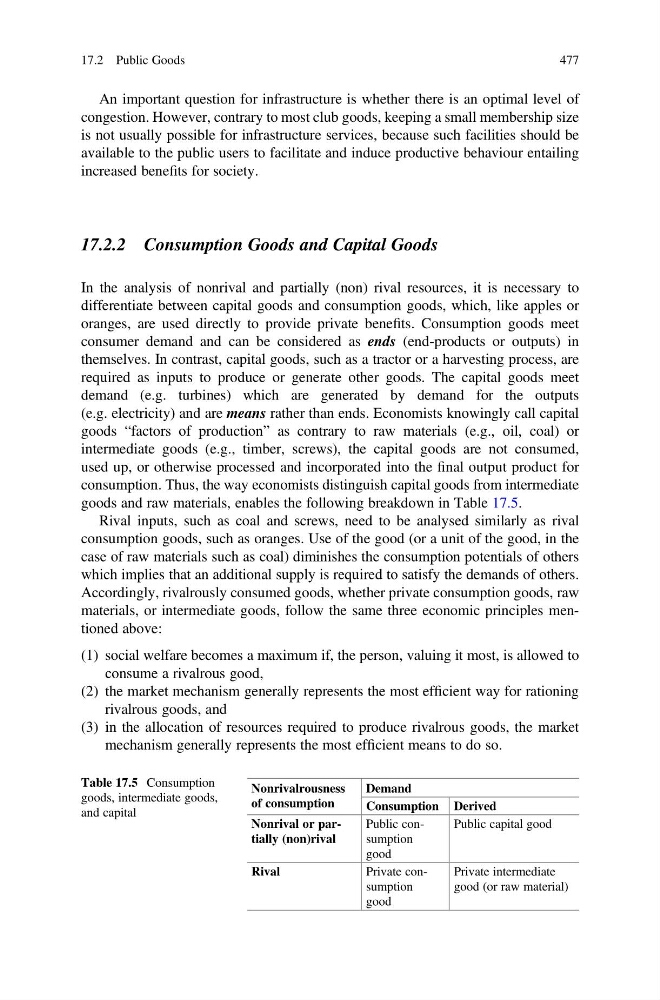
goods and raw materials, enables the following breakdown in Table 17.5.
Rival inputs, such as coal and screws, need to be analysed similarly as rival
consumption goods, such as oranges. Use of the good (or a unit of the good, in the
case of raw materials such as coal) diminishes the consumption potentials of others
which implies that an additional supply is required to satisfy the demands of others.
Accordingly, rivalrously consumed goods, whether private consumption goods, raw
materials, or intermediate goods, follow the same three economic principles mentioned above:
(1) social welfare becomes a maximum if, the person, valuing it most, is allowed to
consume a rivalrous good,
(2) the market mechanism generally represents the most efficient way for rationing
rivalrous goods, and
(3) in the allocation of resources required to produce rivalrous goods, the market
mechanism generally represents the most efficient means to do so.
Table 17.5 Consumption
goods, intermediate goods,
and capital
Nonrivalrousness
of consumption
Demand
Consumption Derived
Nonrival or partially (non)rival
Public consumption
good
Public capital good
Rival
Private consumption
good
Private intermediate
good (or raw material)
17.2 Public Goods
477
congestion. However, contrary to most club goods, keeping a small membership size
is not usually possible for infrastructure services, because such facilities should be
available to the public users to facilitate and induce productive behaviour entailing
increased benefits for society.
17.2.2 Consumption Goods and Capital Goods
In the analysis of nonrival and partially (non) rival resources, it is necessary to
differentiate between capital goods and consumption goods, which, like apples or
oranges, are used directly to provide private benefits. Consumption goods meet
consumer demand and can be considered as ends (end-products or outputs) in
themselves. In contrast, capital goods, such as a tractor or a harvesting process, are
required as inputs to produce or generate other goods. The capital goods meet
demand (e.g. turbines) which are generated by demand for the outputs
(e.g. electricity) and are means rather than ends. Economists knowingly call capital
goods “factors of production” as contrary to raw materials (e.g., oil, coal) or
intermediate goods (e.g., timber, screws), the capital goods are not consumed,
used up, or otherwise processed and incorporated into the final output product for
consumption. Thus, the way economists distinguish capital goods from intermediate
goods and raw materials, enables the following breakdown in Table 17.5.
Rival inputs, such as coal and screws, need to be analysed similarly as rival
consumption goods, such as oranges. Use of the good (or a unit of the good, in the
case of raw materials such as coal) diminishes the consumption potentials of others
which implies that an additional supply is required to satisfy the demands of others.
Accordingly, rivalrously consumed goods, whether private consumption goods, raw
materials, or intermediate goods, follow the same three economic principles mentioned above:
(1) social welfare becomes a maximum if, the person, valuing it most, is allowed to
consume a rivalrous good,
(2) the market mechanism generally represents the most efficient way for rationing
rivalrous goods, and
(3) in the allocation of resources required to produce rivalrous goods, the market
mechanism generally represents the most efficient means to do so.
Table 17.5 Consumption
goods, intermediate goods,
and capital
Nonrivalrousness
of consumption
Demand
Consumption Derived
Nonrival or partially (non)rival
Public consumption
good
Public capital good
Rival
Private consumption
good
Private intermediate
good (or raw material)
17.2 Public Goods
477