

goods, which are durable goods having finite capacity. However, this capacity may
be potentially renewed and potentially shared. Other conditions (e.g., how the goods
and services are managed, how many users there are, and the availability) will
influence whether these goods and services are used nonrivalrously or rivalrously.
These resources are called partially (non)rival goods because they can be managed
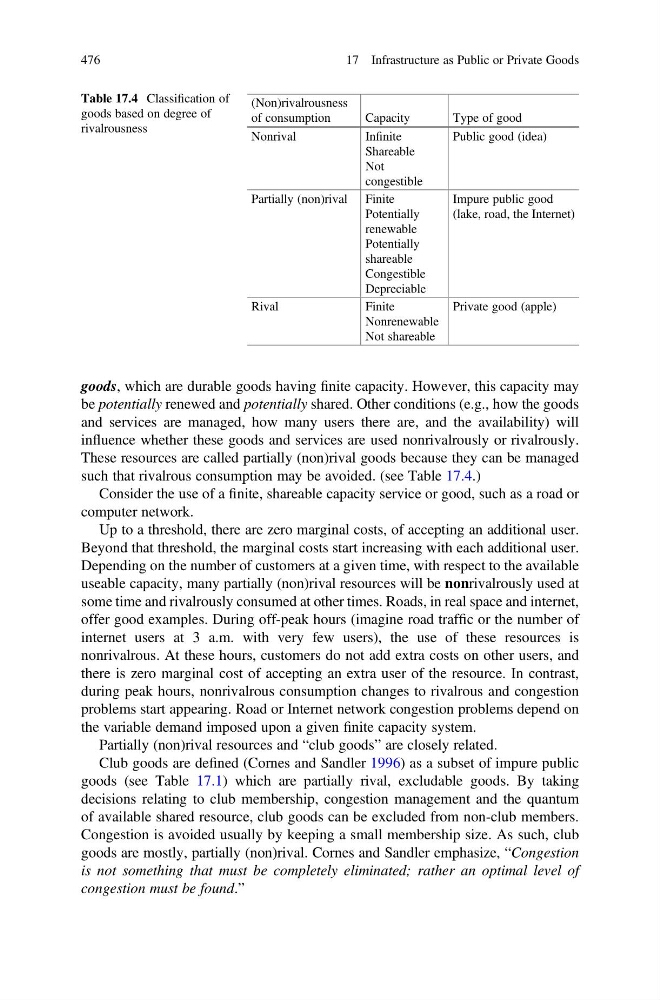
such that rivalrous consumption may be avoided. (see Table 17.4.)
Consider the use of a finite, shareable capacity service or good, such as a road or
computer network.
Up to a threshold, there are zero marginal costs, of accepting an additional user.
Beyond that threshold, the marginal costs start increasing with each additional user.
Depending on the number of customers at a given time, with respect to the available
useable capacity, many partially (non)rival resources will be nonrivalrously used at
some time and rivalrously consumed at other times. Roads, in real space and internet,
offer good examples. During off-peak hours (imagine road traffic or the number of
internet users at 3 a.m. with very few users), the use of these resources is
nonrivalrous. At these hours, customers do not add extra costs on other users, and
there is zero marginal cost of accepting an extra user of the resource. In contrast,
during peak hours, nonrivalrous consumption changes to rivalrous and congestion
problems start appearing. Road or Internet network congestion problems depend on
the variable demand imposed upon a given finite capacity system.
Partially (non)rival resources and “club goods” are closely related.
Club goods are defined (Cornes and Sandler 1996) as a subset of impure public
goods (see Table 17.1) which are partially rival, excludable goods. By taking
decisions relating to club membership, congestion management and the quantum
of available shared resource, club goods can be excluded from non-club members.
Congestion is avoided usually by keeping a small membership size. As such, club
goods are mostly, partially (non)rival. Cornes and Sandler emphasize, “Congestion
is not something that must be completely eliminated; rather an optimal level of
congestion must be found.”
Table 17.4 Classification of
goods based on degree of
rivalrousness
(Non)rivalrousness
of consumption
Capacity
Type of good
Nonrival
Infinite
Shareable
Not
congestible
Public good (idea)
Partially (non)rival Finite
Potentially
renewable
Potentially
shareable
Congestible
Depreciable
Impure public good
(lake, road, the Internet)
Rival
Finite
Nonrenewable
Not shareable
Private good (apple)
476
17 Infrastructure as Public or Private Goods
be potentially renewed and potentially shared. Other conditions (e.g., how the goods
and services are managed, how many users there are, and the availability) will
influence whether these goods and services are used nonrivalrously or rivalrously.
These resources are called partially (non)rival goods because they can be managed
such that rivalrous consumption may be avoided. (see Table 17.4.)
Consider the use of a finite, shareable capacity service or good, such as a road or
computer network.
Up to a threshold, there are zero marginal costs, of accepting an additional user.
Beyond that threshold, the marginal costs start increasing with each additional user.
Depending on the number of customers at a given time, with respect to the available
useable capacity, many partially (non)rival resources will be nonrivalrously used at
some time and rivalrously consumed at other times. Roads, in real space and internet,
offer good examples. During off-peak hours (imagine road traffic or the number of
internet users at 3 a.m. with very few users), the use of these resources is
nonrivalrous. At these hours, customers do not add extra costs on other users, and
there is zero marginal cost of accepting an extra user of the resource. In contrast,
during peak hours, nonrivalrous consumption changes to rivalrous and congestion
problems start appearing. Road or Internet network congestion problems depend on
the variable demand imposed upon a given finite capacity system.
Partially (non)rival resources and “club goods” are closely related.
Club goods are defined (Cornes and Sandler 1996) as a subset of impure public
goods (see Table 17.1) which are partially rival, excludable goods. By taking
decisions relating to club membership, congestion management and the quantum
of available shared resource, club goods can be excluded from non-club members.
Congestion is avoided usually by keeping a small membership size. As such, club
goods are mostly, partially (non)rival. Cornes and Sandler emphasize, “Congestion
is not something that must be completely eliminated; rather an optimal level of
congestion must be found.”
Table 17.4 Classification of
goods based on degree of
rivalrousness
(Non)rivalrousness
of consumption
Capacity
Type of good
Nonrival
Infinite
Shareable
Not
congestible
Public good (idea)
Partially (non)rival Finite
Potentially
renewable
Potentially
shareable
Congestible
Depreciable
Impure public good
(lake, road, the Internet)
Rival
Finite
Nonrenewable
Not shareable
Private good (apple)
476
17 Infrastructure as Public or Private Goods