

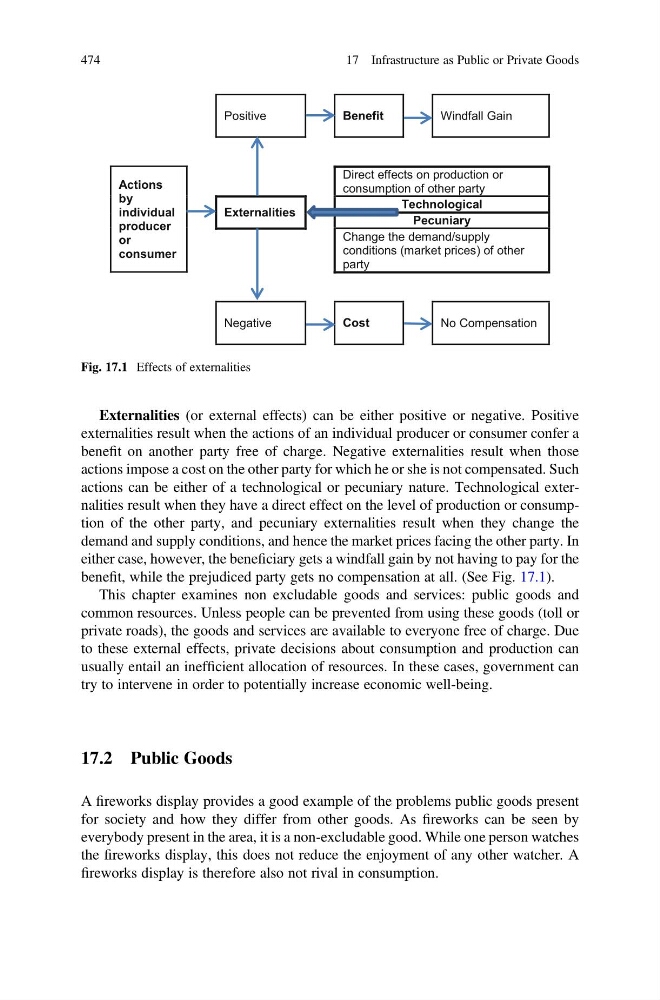
Externalities (or external effects) can be either positive or negative. Positive
externalities result when the actions of an individual producer or consumer confer a
benefit on another party free of charge. Negative externalities result when those
actions impose a cost on the other party for which he or she is not compensated. Such
actions can be either of a technological or pecuniary nature. Technological externalities result when they have a direct effect on the level of production or consumption of the other party, and pecuniary externalities result when they change the
demand and supply conditions, and hence the market prices facing the other party. In
either case, however, the beneficiary gets a windfall gain by not having to pay for the
benefit, while the prejudiced party gets no compensation at all. (See Fig. 17.1).
This chapter examines non excludable goods and services: public goods and
common resources. Unless people can be prevented from using these goods (toll or
private roads), the goods and services are available to everyone free of charge. Due
to these external effects, private decisions about consumption and production can
usually entail an inefficient allocation of resources. In these cases, government can
try to intervene in order to potentially increase economic well-being.
17.2 Public Goods
A fireworks display provides a good example of the problems public goods present
for society and how they differ from other goods. As fireworks can be seen by
everybody present in the area, it is a non-excludable good. While one person watches
the fireworks display, this does not reduce the enjoyment of any other watcher. A
fireworks display is therefore also not rival in consumption.
Positive
Benefit
Windfall Gain
Actions
by
individual
producer
or
consumer
Direct effects on production or
consumption of other party
Externalities
Technological
Pecuniary
Change the demand/supply
conditions (market prices) of other
party
Negative
Cost
No Compensation
Fig. 17.1 Effects of externalities
474
17 Infrastructure as Public or Private Goods
externalities result when the actions of an individual producer or consumer confer a
benefit on another party free of charge. Negative externalities result when those
actions impose a cost on the other party for which he or she is not compensated. Such
actions can be either of a technological or pecuniary nature. Technological externalities result when they have a direct effect on the level of production or consumption of the other party, and pecuniary externalities result when they change the
demand and supply conditions, and hence the market prices facing the other party. In
either case, however, the beneficiary gets a windfall gain by not having to pay for the
benefit, while the prejudiced party gets no compensation at all. (See Fig. 17.1).
This chapter examines non excludable goods and services: public goods and
common resources. Unless people can be prevented from using these goods (toll or
private roads), the goods and services are available to everyone free of charge. Due
to these external effects, private decisions about consumption and production can
usually entail an inefficient allocation of resources. In these cases, government can
try to intervene in order to potentially increase economic well-being.
17.2 Public Goods
A fireworks display provides a good example of the problems public goods present
for society and how they differ from other goods. As fireworks can be seen by
everybody present in the area, it is a non-excludable good. While one person watches
the fireworks display, this does not reduce the enjoyment of any other watcher. A
fireworks display is therefore also not rival in consumption.
Positive
Benefit
Windfall Gain
Actions
by
individual
producer
or
consumer
Direct effects on production or
consumption of other party
Externalities
Technological
Pecuniary
Change the demand/supply
conditions (market prices) of other
party
Negative
Cost
No Compensation
Fig. 17.1 Effects of externalities
474
17 Infrastructure as Public or Private Goods