

The classification scheme of Table 17.1 thus distinguishes a good or service as
public or private only on these two characteristics instead of the good or service
being publicly or privately owned, provided, or financed.
Economists recognize, however, that this classification is an oversimplification,
because both consumption (non)rivalrousness and (non)excludability depend on the
extent or degree. Thus, goods or services rarely fit exactly within the tight boxes of
Table 17.1.
17.1.2 Excludability
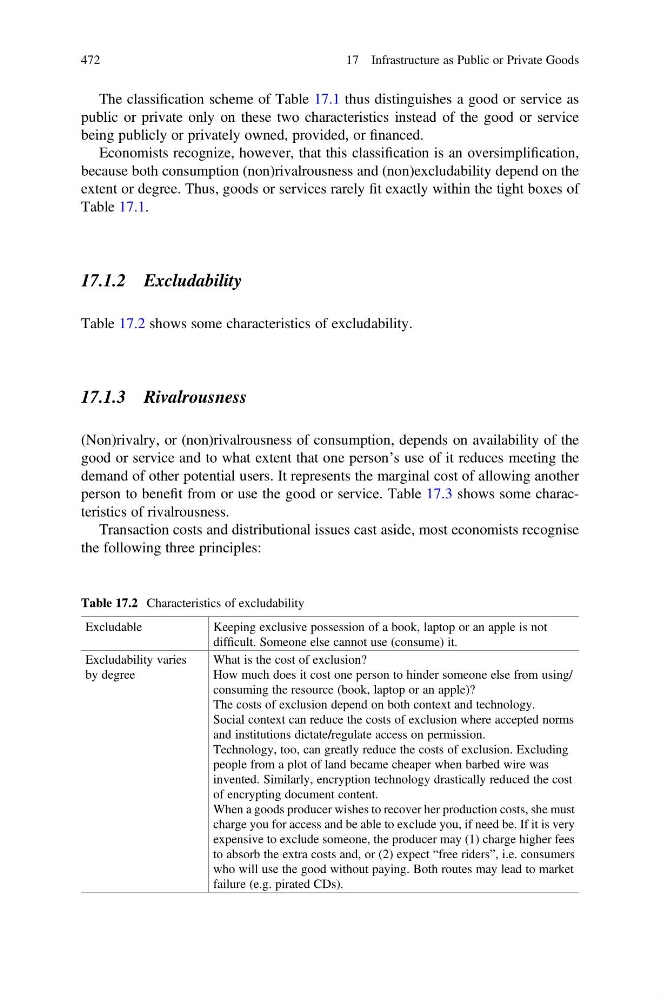
Table 17.2 shows some characteristics of excludability.
17.1.3 Rivalrousness
(Non)rivalry, or (non)rivalrousness of consumption, depends on availability of the
good or service and to what extent that one person’s use of it reduces meeting the
demand of other potential users. It represents the marginal cost of allowing another
person to benefit from or use the good or service. Table 17.3 shows some characteristics of rivalrousness.
Transaction costs and distributional issues cast aside, most economists recognise
the following three principles:
Table 17.2 Characteristics of excludability
Excludable
Keeping exclusive possession of a book, laptop or an apple is not
difficult. Someone else cannot use (consume) it.
Excludability varies
by degree
What is the cost of exclusion?
How much does it cost one person to hinder someone else from using/
consuming the resource (book, laptop or an apple)?
The costs of exclusion depend on both context and technology.
Social context can reduce the costs of exclusion where accepted norms
and institutions dictate/regulate access on permission.
Technology, too, can greatly reduce the costs of exclusion. Excluding
people from a plot of land became cheaper when barbed wire was
invented. Similarly, encryption technology drastically reduced the cost
of encrypting document content.
When a goods producer wishes to recover her production costs, she must
charge you for access and be able to exclude you, if need be. If it is very
expensive to exclude someone, the producer may (1) charge higher fees
to absorb the extra costs and, or (2) expect “free riders”, i.e. consumers
who will use the good without paying. Both routes may lead to market
failure (e.g. pirated CDs).
472
17 Infrastructure as Public or Private Goods
public or private only on these two characteristics instead of the good or service
being publicly or privately owned, provided, or financed.
Economists recognize, however, that this classification is an oversimplification,
because both consumption (non)rivalrousness and (non)excludability depend on the
extent or degree. Thus, goods or services rarely fit exactly within the tight boxes of
Table 17.1.
17.1.2 Excludability
Table 17.2 shows some characteristics of excludability.
17.1.3 Rivalrousness
(Non)rivalry, or (non)rivalrousness of consumption, depends on availability of the
good or service and to what extent that one person’s use of it reduces meeting the
demand of other potential users. It represents the marginal cost of allowing another
person to benefit from or use the good or service. Table 17.3 shows some characteristics of rivalrousness.
Transaction costs and distributional issues cast aside, most economists recognise
the following three principles:
Table 17.2 Characteristics of excludability
Excludable
Keeping exclusive possession of a book, laptop or an apple is not
difficult. Someone else cannot use (consume) it.
Excludability varies
by degree
What is the cost of exclusion?
How much does it cost one person to hinder someone else from using/
consuming the resource (book, laptop or an apple)?
The costs of exclusion depend on both context and technology.
Social context can reduce the costs of exclusion where accepted norms
and institutions dictate/regulate access on permission.
Technology, too, can greatly reduce the costs of exclusion. Excluding
people from a plot of land became cheaper when barbed wire was
invented. Similarly, encryption technology drastically reduced the cost
of encrypting document content.
When a goods producer wishes to recover her production costs, she must
charge you for access and be able to exclude you, if need be. If it is very
expensive to exclude someone, the producer may (1) charge higher fees
to absorb the extra costs and, or (2) expect “free riders”, i.e. consumers
who will use the good without paying. Both routes may lead to market
failure (e.g. pirated CDs).
472
17 Infrastructure as Public or Private Goods