

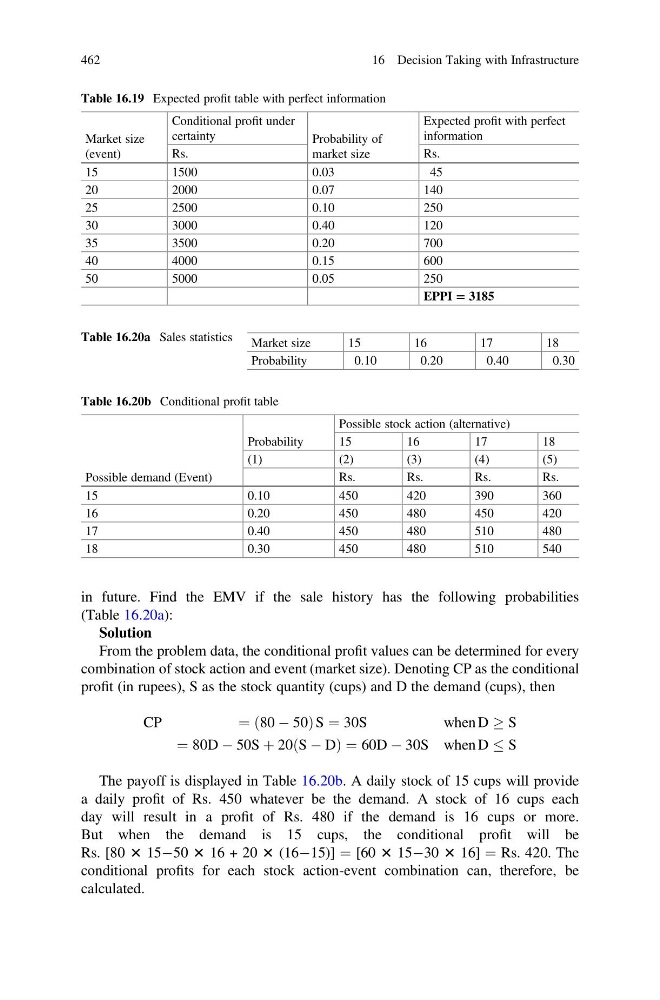
in future. Find the EMV if the sale history has the following probabilities
(Table 16.20a):
Solution
From the problem data, the conditional profit values can be determined for every
combination of stock action and event (market size). Denoting CP as the conditional
profit (in rupees), S as the stock quantity (cups) and D the demand (cups), then
CP
¼ 80 À 50
ð
ÞS ¼ 30S
when D ! S
¼ 80D À 50S þ 20 S À D
ð
Þ¼60D À 30S when D S
The payoff is displayed in Table 16.20b. A daily stock of 15 cups will provide
a daily profit of Rs. 450 whatever be the demand. A stock of 16 cups each
day will result in a profit of Rs. 480 if the demand is 16 cups or more.
But when the demand is 15 cups, the conditional profit will be
Rs. [80 3 15À50 3 16 + 20 3 (16À15)] ¼ [60 3 15À30 3 16] ¼ Rs. 420. The
conditional profits for each stock action-event combination can, therefore, be
calculated.
Table 16.19 Expected profit table with perfect information
Market size
(event)
Conditional profit under
certainty
Probability of
market size
Expected profit with perfect
information
Rs.
Rs.
15
1500
0.03
45
20
2000
0.07
140
25
2500
0.10
250
30
3000
0.40
120
35
3500
0.20
700
40
4000
0.15
600
50
5000
0.05
250
EPPI = 3185
Table 16.20a Sales statistics Market size
15
16
17
18
Probability
0.10
0.20
0.40
0.30
Table 16.20b Conditional profit table
Possible demand (Event)
Probability
Possible stock action (alternative)
15
16
17
18
(1)
(2)
(3)
(4)
(5)
Rs.
Rs.
Rs.
Rs.
15
0.10
450
420
390
360
16
0.20
450
480
450
420
17
0.40
450
480
510
480
18
0.30
450
480
510
540
462
16 Decision Taking with Infrastructure
(Table 16.20a):
Solution
From the problem data, the conditional profit values can be determined for every
combination of stock action and event (market size). Denoting CP as the conditional
profit (in rupees), S as the stock quantity (cups) and D the demand (cups), then
CP
¼ 80 À 50
ð
ÞS ¼ 30S
when D ! S
¼ 80D À 50S þ 20 S À D
ð
Þ¼60D À 30S when D S
The payoff is displayed in Table 16.20b. A daily stock of 15 cups will provide
a daily profit of Rs. 450 whatever be the demand. A stock of 16 cups each
day will result in a profit of Rs. 480 if the demand is 16 cups or more.
But when the demand is 15 cups, the conditional profit will be
Rs. [80 3 15À50 3 16 + 20 3 (16À15)] ¼ [60 3 15À30 3 16] ¼ Rs. 420. The
conditional profits for each stock action-event combination can, therefore, be
calculated.
Table 16.19 Expected profit table with perfect information
Market size
(event)
Conditional profit under
certainty
Probability of
market size
Expected profit with perfect
information
Rs.
Rs.
15
1500
0.03
45
20
2000
0.07
140
25
2500
0.10
250
30
3000
0.40
120
35
3500
0.20
700
40
4000
0.15
600
50
5000
0.05
250
EPPI = 3185
Table 16.20a Sales statistics Market size
15
16
17
18
Probability
0.10
0.20
0.40
0.30
Table 16.20b Conditional profit table
Possible demand (Event)
Probability
Possible stock action (alternative)
15
16
17
18
(1)
(2)
(3)
(4)
(5)
Rs.
Rs.
Rs.
Rs.
15
0.10
450
420
390
360
16
0.20
450
480
450
420
17
0.40
450
480
510
480
18
0.30
450
480
510
540
462
16 Decision Taking with Infrastructure