

(2) under EMV criterion, the decision alternative is based on either largest EMV
value or smallest EMV value depending on whether it is of a maximization or a
minimization type of problem
16.6.3 Expected Value of Perfect Information (EVPI)
In the newsgirl problem discussed above the occurrence of states of nature was
associated with probability. Accurate and complete information related to demand in
the future (called perfect information), would eliminate all uncertainty from the
problem. If she possessed this perfect information, she would tell in advance how
many copies were going to be required each day. Under such circumstances she
would each day purchase only the exact number of copies required that day. For a
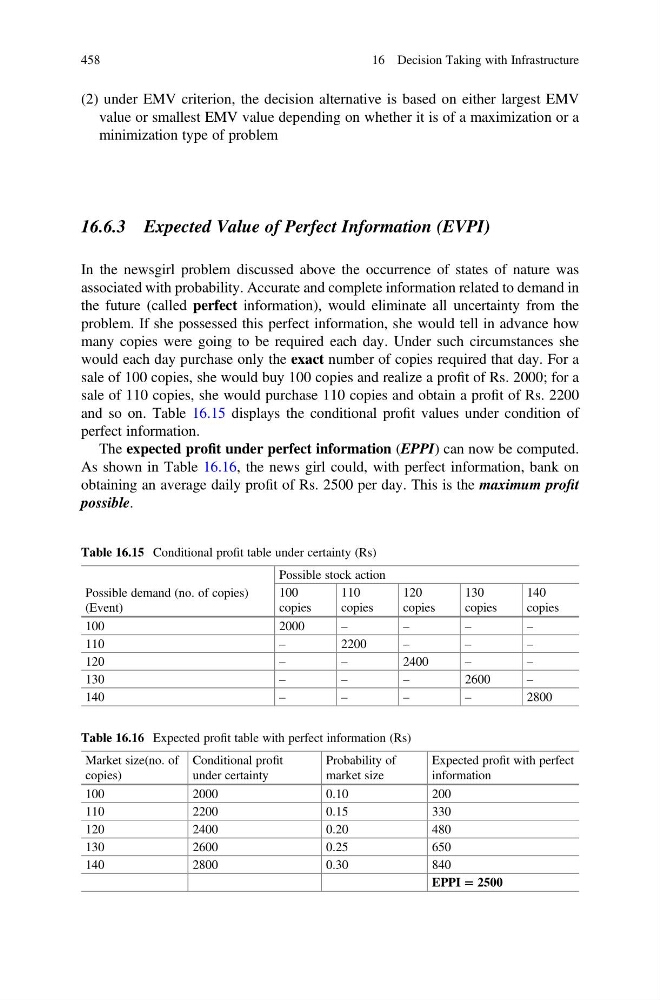
sale of 100 copies, she would buy 100 copies and realize a profit of Rs. 2000; for a
sale of 110 copies, she would purchase 110 copies and obtain a profit of Rs. 2200
and so on. Table 16.15 displays the conditional profit values under condition of
perfect information.
The expected profit under perfect information (EPPI) can now be computed.
As shown in Table 16.16, the news girl could, with perfect information, bank on
obtaining an average daily profit of Rs. 2500 per day. This is the maximum profit
possible.
Table 16.15 Conditional profit table under certainty (Rs)
Possible demand (no. of copies)
(Event)
Possible stock action
100
copies
110
copies
120
copies
130
copies
140
copies
100
2000
–
–
–
–
110
–
2200
–
–
–
120
–
–
2400
–
–
130
–
–
–
2600
–
140
–
–
–
–
2800
Table 16.16 Expected profit table with perfect information (Rs)
Market size(no. of
copies)
Conditional profit
under certainty
Probability of
market size
Expected profit with perfect
information
100
2000
0.10
200
110
2200
0.15
330
120
2400
0.20
480
130
2600
0.25
650
140
2800
0.30
840
EPPI = 2500
458
16 Decision Taking with Infrastructure
value or smallest EMV value depending on whether it is of a maximization or a
minimization type of problem
16.6.3 Expected Value of Perfect Information (EVPI)
In the newsgirl problem discussed above the occurrence of states of nature was
associated with probability. Accurate and complete information related to demand in
the future (called perfect information), would eliminate all uncertainty from the
problem. If she possessed this perfect information, she would tell in advance how
many copies were going to be required each day. Under such circumstances she
would each day purchase only the exact number of copies required that day. For a
sale of 100 copies, she would buy 100 copies and realize a profit of Rs. 2000; for a
sale of 110 copies, she would purchase 110 copies and obtain a profit of Rs. 2200
and so on. Table 16.15 displays the conditional profit values under condition of
perfect information.
The expected profit under perfect information (EPPI) can now be computed.
As shown in Table 16.16, the news girl could, with perfect information, bank on
obtaining an average daily profit of Rs. 2500 per day. This is the maximum profit
possible.
Table 16.15 Conditional profit table under certainty (Rs)
Possible demand (no. of copies)
(Event)
Possible stock action
100
copies
110
copies
120
copies
130
copies
140
copies
100
2000
–
–
–
–
110
–
2200
–
–
–
120
–
–
2400
–
–
130
–
–
–
2600
–
140
–
–
–
–
2800
Table 16.16 Expected profit table with perfect information (Rs)
Market size(no. of
copies)
Conditional profit
under certainty
Probability of
market size
Expected profit with perfect
information
100
2000
0.10
200
110
2200
0.15
330
120
2400
0.20
480
130
2600
0.25
650
140
2800
0.30
840
EPPI = 2500
458
16 Decision Taking with Infrastructure