

16.5.5 Laplace Criterion (Criterion of Rationality)
This criterion rests on what is identified as the principle of insufficient reason.
Given that the probabilities connected to the different events occurrence are not
known, there is no justification to believe that these probabilities are different. This
criterion therefore allocates equal probabilities to all the events (states of nature) of
each alternative decision and chooses the option corresponding to the maximum
expected payoff. Therefore, if n represents the number of events and P’s indicate the
payoffs, then the expected value for strategy, say s 1 is
1
n
P 1 þ P 2 þ . . . þ P n
½
Table 16.1 is reproduced as Table 16.6 to explain the above criterion.
Thus the subcontracting alternative corresponds to the expected maximum
average payoff of Rs. 85,000.
Example 16.1
Table 16.7 shows the payoff of different strategies (alternatives) S 1 , S 2 , S 3 against
conditions (events) N 1 , N 2 , N 3 and N 4 :
What decisions would be considered using the following approaches:
(i) Pessimistic (maximin)
(ii) Optimistic (Maximax)
(iii) Regret (minimax) and
(iv) Equal probability? (Table 16.8)
Solution. For the given payoff matrix, the values corresponding to pessimistic,
optimistic and equal penalty criteria are given below.
Thus,
under the pessimistic approach, S 2 is the optimal decision,
under the optimistic approach, S 2 or S 3 are the decision alternatives and
under the equal probability approach, S 3 is the alternative to be selected.
Table 16.9 indicates the regret for every state of nature (event) and for each
alternative determined by the expression
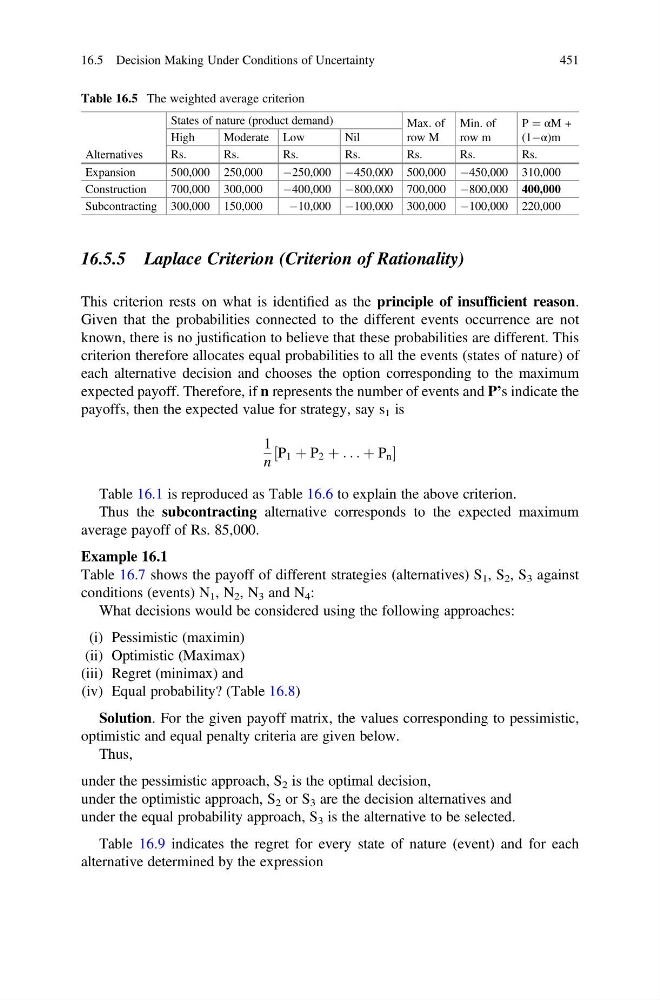
Table 16.5 The weighted average criterion
Alternatives
States of nature (product demand)
Max. of
row M
Min. of
row m
P ¼ αM +
(1Àα)m
High
Moderate Low
Nil
Rs.
Rs.
Rs.
Rs.
Rs.
Rs.
Rs.
Expansion
500,000 250,000
À250,000 À450,000 500,000 À450,000 310,000
Construction
700,000 300,000
À400,000 À800,000 700,000 À800,000 400,000
Subcontracting 300,000 150,000
À10,000 À100,000 300,000 À100,000 220,000
16.5 Decision Making Under Conditions of Uncertainty
451
This criterion rests on what is identified as the principle of insufficient reason.
Given that the probabilities connected to the different events occurrence are not
known, there is no justification to believe that these probabilities are different. This
criterion therefore allocates equal probabilities to all the events (states of nature) of
each alternative decision and chooses the option corresponding to the maximum
expected payoff. Therefore, if n represents the number of events and P’s indicate the
payoffs, then the expected value for strategy, say s 1 is
1
n
P 1 þ P 2 þ . . . þ P n
½
Table 16.1 is reproduced as Table 16.6 to explain the above criterion.
Thus the subcontracting alternative corresponds to the expected maximum
average payoff of Rs. 85,000.
Example 16.1
Table 16.7 shows the payoff of different strategies (alternatives) S 1 , S 2 , S 3 against
conditions (events) N 1 , N 2 , N 3 and N 4 :
What decisions would be considered using the following approaches:
(i) Pessimistic (maximin)
(ii) Optimistic (Maximax)
(iii) Regret (minimax) and
(iv) Equal probability? (Table 16.8)
Solution. For the given payoff matrix, the values corresponding to pessimistic,
optimistic and equal penalty criteria are given below.
Thus,
under the pessimistic approach, S 2 is the optimal decision,
under the optimistic approach, S 2 or S 3 are the decision alternatives and
under the equal probability approach, S 3 is the alternative to be selected.
Table 16.9 indicates the regret for every state of nature (event) and for each
alternative determined by the expression
Table 16.5 The weighted average criterion
Alternatives
States of nature (product demand)
Max. of
row M
Min. of
row m
P ¼ αM +
(1Àα)m
High
Moderate Low
Nil
Rs.
Rs.
Rs.
Rs.
Rs.
Rs.
Rs.
Expansion
500,000 250,000
À250,000 À450,000 500,000 À450,000 310,000
Construction
700,000 300,000
À400,000 À800,000 700,000 À800,000 400,000
Subcontracting 300,000 150,000
À10,000 À100,000 300,000 À100,000 220,000
16.5 Decision Making Under Conditions of Uncertainty
451