

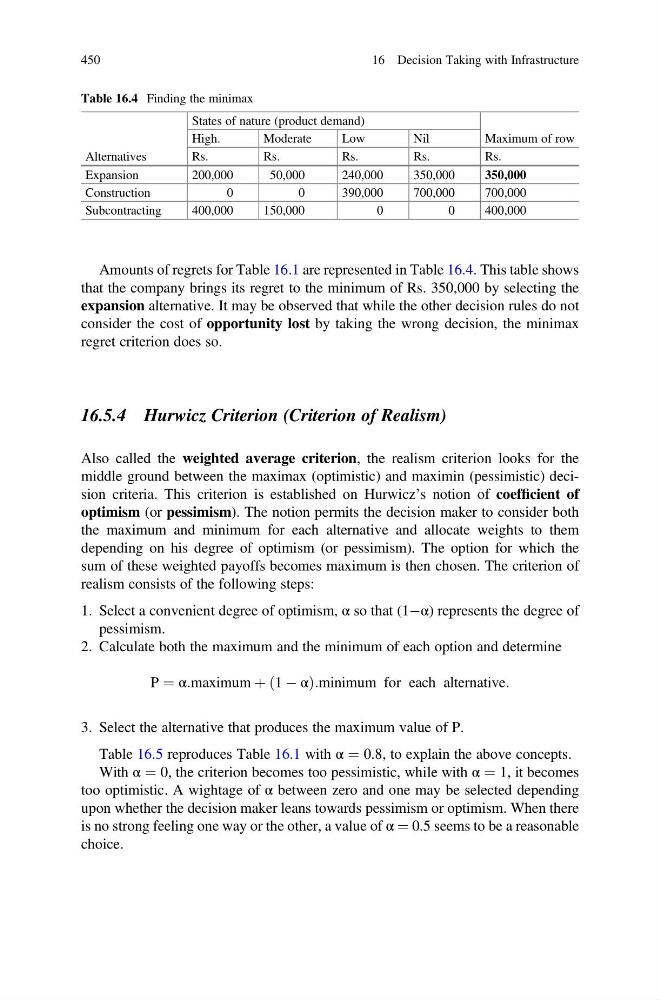
Amounts of regrets for Table 16.1 are represented in Table 16.4. This table shows
that the company brings its regret to the minimum of Rs. 350,000 by selecting the
expansion alternative. It may be observed that while the other decision rules do not
consider the cost of opportunity lost by taking the wrong decision, the minimax
regret criterion does so.
16.5.4 Hurwicz Criterion (Criterion of Realism)
Also called the weighted average criterion, the realism criterion looks for the
middle ground between the maximax (optimistic) and maximin (pessimistic) decision criteria. This criterion is established on Hurwicz’s notion of coefficient of
optimism (or pessimism). The notion permits the decision maker to consider both
the maximum and minimum for each alternative and allocate weights to them
depending on his degree of optimism (or pessimism). The option for which the
sum of these weighted payoffs becomes maximum is then chosen. The criterion of
realism consists of the following steps:
1. Select a convenient degree of optimism, α so that (1Àα) represents the degree of
pessimism.
2. Calculate both the maximum and the minimum of each option and determine
P ¼ α:maximum þ 1 À α
ð
Þ:minimum for each alternative:
3. Select the alternative that produces the maximum value of P.
Table 16.5 reproduces Table 16.1 with α ¼ 0.8, to explain the above concepts.
With α ¼ 0, the criterion becomes too pessimistic, while with α ¼ 1, it becomes
too optimistic. A wightage of α between zero and one may be selected depending
upon whether the decision maker leans towards pessimism or optimism. When there
is no strong feeling one way or the other, a value of α ¼ 0.5 seems to be a reasonable
choice.
Table 16.4 Finding the minimax
Alternatives
States of nature (product demand)
Maximum of row
High.
Moderate
Low
Nil
Rs.
Rs.
Rs.
Rs.
Rs.
Expansion
200,000
50,000
240,000
350,000
350,000
Construction
0
0
390,000
700,000
700,000
Subcontracting
400,000
150,000
0
0
400,000
450
16 Decision Taking with Infrastructure
that the company brings its regret to the minimum of Rs. 350,000 by selecting the
expansion alternative. It may be observed that while the other decision rules do not
consider the cost of opportunity lost by taking the wrong decision, the minimax
regret criterion does so.
16.5.4 Hurwicz Criterion (Criterion of Realism)
Also called the weighted average criterion, the realism criterion looks for the
middle ground between the maximax (optimistic) and maximin (pessimistic) decision criteria. This criterion is established on Hurwicz’s notion of coefficient of
optimism (or pessimism). The notion permits the decision maker to consider both
the maximum and minimum for each alternative and allocate weights to them
depending on his degree of optimism (or pessimism). The option for which the
sum of these weighted payoffs becomes maximum is then chosen. The criterion of
realism consists of the following steps:
1. Select a convenient degree of optimism, α so that (1Àα) represents the degree of
pessimism.
2. Calculate both the maximum and the minimum of each option and determine
P ¼ α:maximum þ 1 À α
ð
Þ:minimum for each alternative:
3. Select the alternative that produces the maximum value of P.
Table 16.5 reproduces Table 16.1 with α ¼ 0.8, to explain the above concepts.
With α ¼ 0, the criterion becomes too pessimistic, while with α ¼ 1, it becomes
too optimistic. A wightage of α between zero and one may be selected depending
upon whether the decision maker leans towards pessimism or optimism. When there
is no strong feeling one way or the other, a value of α ¼ 0.5 seems to be a reasonable
choice.
Table 16.4 Finding the minimax
Alternatives
States of nature (product demand)
Maximum of row
High.
Moderate
Low
Nil
Rs.
Rs.
Rs.
Rs.
Rs.
Expansion
200,000
50,000
240,000
350,000
350,000
Construction
0
0
390,000
700,000
700,000
Subcontracting
400,000
150,000
0
0
400,000
450
16 Decision Taking with Infrastructure