

Example 15.7
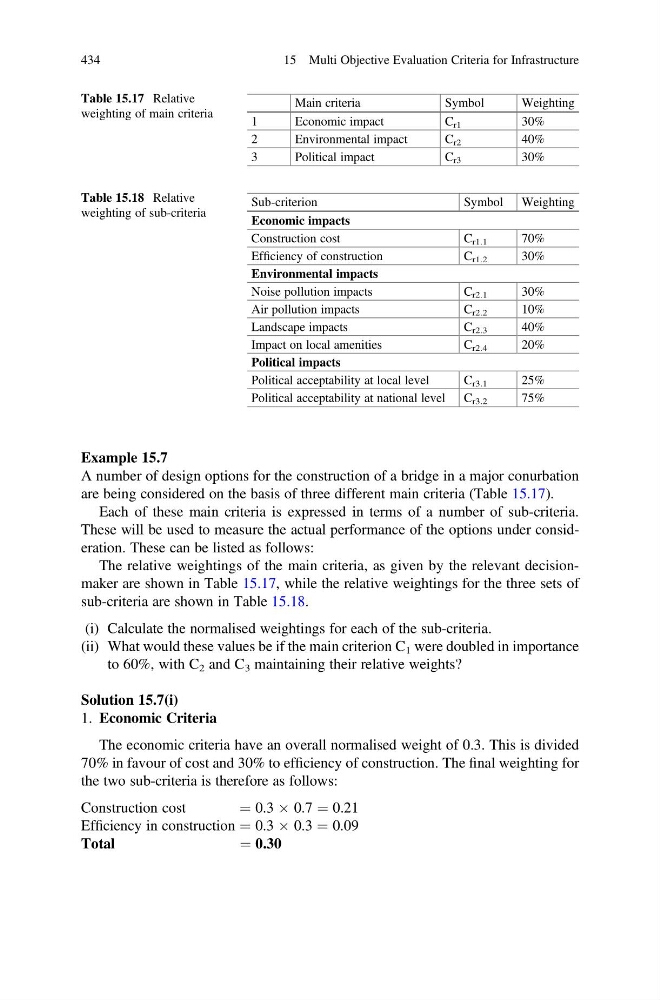
A number of design options for the construction of a bridge in a major conurbation
are being considered on the basis of three different main criteria (Table 15.17).
Each of these main criteria is expressed in terms of a number of sub-criteria.
These will be used to measure the actual performance of the options under consideration. These can be listed as follows:
The relative weightings of the main criteria, as given by the relevant decisionmaker are shown in Table 15.17, while the relative weightings for the three sets of
sub-criteria are shown in Table 15.18.
(i) Calculate the normalised weightings for each of the sub-criteria.
(ii) What would these values be if the main criterion C 1 were doubled in importance
to 60%, with C 2 and C 3 maintaining their relative weights?
Solution 15.7(i)
1. Economic Criteria
The economic criteria have an overall normalised weight of 0.3. This is divided
70% in favour of cost and 30% to efficiency of construction. The final weighting for
the two sub-criteria is therefore as follows:
Construction cost
¼ 0.3 Â 0.7 ¼ 0.21
Efficiency in construction ¼ 0.3 Â 0.3 ¼ 0.09
Total
¼ 0.30
Table 15.17 Relative
weighting of main criteria
Main criteria
Symbol
Weighting
1
Economic impact
C r1
30%
2
Environmental impact
C r2
40%
3
Political impact
C r3
30%
Table 15.18 Relative
weighting of sub-criteria
Sub-criterion
Symbol Weighting
Economic impacts
Construction cost
C r1.1
70%
Efficiency of construction
C r1.2
30%
Environmental impacts
Noise pollution impacts
C r2.1
30%
Air pollution impacts
C r2.2
10%
Landscape impacts
C r2.3
40%
Impact on local amenities
C r2.4
20%
Political impacts
Political acceptability at local level
C r3.1
25%
Political acceptability at national level C r3.2
75%
434
15 Multi Objective Evaluation Criteria for Infrastructure
A number of design options for the construction of a bridge in a major conurbation
are being considered on the basis of three different main criteria (Table 15.17).
Each of these main criteria is expressed in terms of a number of sub-criteria.
These will be used to measure the actual performance of the options under consideration. These can be listed as follows:
The relative weightings of the main criteria, as given by the relevant decisionmaker are shown in Table 15.17, while the relative weightings for the three sets of
sub-criteria are shown in Table 15.18.
(i) Calculate the normalised weightings for each of the sub-criteria.
(ii) What would these values be if the main criterion C 1 were doubled in importance
to 60%, with C 2 and C 3 maintaining their relative weights?
Solution 15.7(i)
1. Economic Criteria
The economic criteria have an overall normalised weight of 0.3. This is divided
70% in favour of cost and 30% to efficiency of construction. The final weighting for
the two sub-criteria is therefore as follows:
Construction cost
¼ 0.3 Â 0.7 ¼ 0.21
Efficiency in construction ¼ 0.3 Â 0.3 ¼ 0.09
Total
¼ 0.30
Table 15.17 Relative
weighting of main criteria
Main criteria
Symbol
Weighting
1
Economic impact
C r1
30%
2
Environmental impact
C r2
40%
3
Political impact
C r3
30%
Table 15.18 Relative
weighting of sub-criteria
Sub-criterion
Symbol Weighting
Economic impacts
Construction cost
C r1.1
70%
Efficiency of construction
C r1.2
30%
Environmental impacts
Noise pollution impacts
C r2.1
30%
Air pollution impacts
C r2.2
10%
Landscape impacts
C r2.3
40%
Impact on local amenities
C r2.4
20%
Political impacts
Political acceptability at local level
C r3.1
25%
Political acceptability at national level C r3.2
75%
434
15 Multi Objective Evaluation Criteria for Infrastructure