

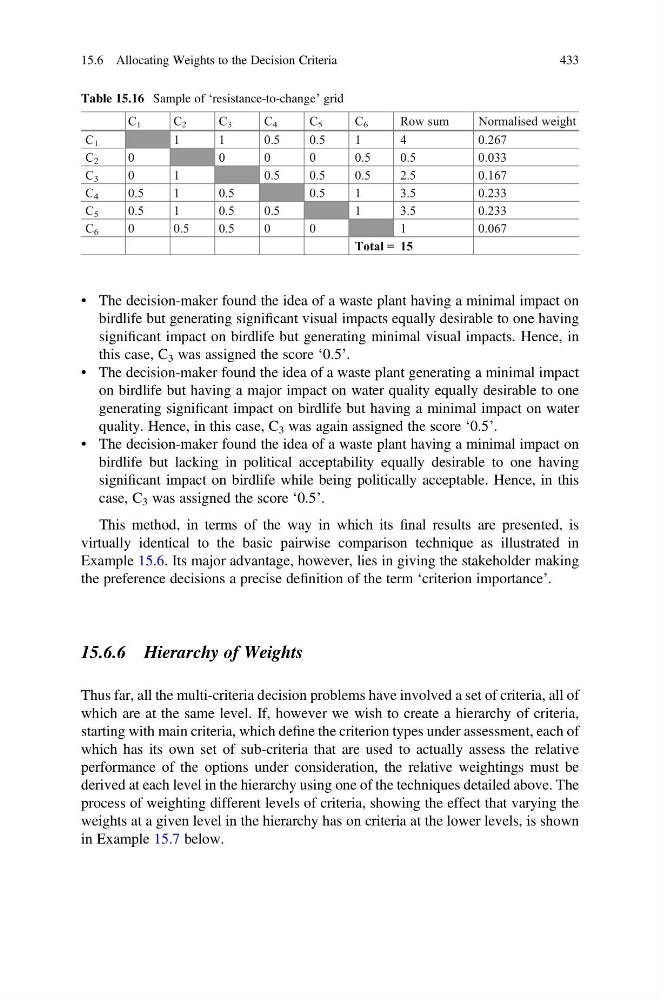
• The decision-maker found the idea of a waste plant having a minimal impact on
birdlife but generating significant visual impacts equally desirable to one having
significant impact on birdlife but generating minimal visual impacts. Hence, in
this case, C 3 was assigned the score ‘0.5’.
• The decision-maker found the idea of a waste plant generating a minimal impact
on birdlife but having a major impact on water quality equally desirable to one
generating significant impact on birdlife but having a minimal impact on water
quality. Hence, in this case, C 3 was again assigned the score ‘0.5’.
• The decision-maker found the idea of a waste plant having a minimal impact on
birdlife but lacking in political acceptability equally desirable to one having
significant impact on birdlife while being politically acceptable. Hence, in this
case, C 3 was assigned the score ‘0.5’.
This method, in terms of the way in which its final results are presented, is
virtually identical to the basic pairwise comparison technique as illustrated in
Example 15.6. Its major advantage, however, lies in giving the stakeholder making
the preference decisions a precise definition of the term ‘criterion importance’.
15.6.6 Hierarchy of Weights
Thus far, all the multi-criteria decision problems have involved a set of criteria, all of
which are at the same level. If, however we wish to create a hierarchy of criteria,
starting with main criteria, which define the criterion types under assessment, each of
which has its own set of sub-criteria that are used to actually assess the relative
performance of the options under consideration, the relative weightings must be
derived at each level in the hierarchy using one of the techniques detailed above. The
process of weighting different levels of criteria, showing the effect that varying the
weights at a given level in the hierarchy has on criteria at the lower levels, is shown
in Example 15.7 below.
Table 15.16 Sample of ‘resistance-to-change’ grid
C 1
C 2
C 3
C 4
C 5
C 6
Row sum
Normalised weight
C 1
1
1
0.5
0.5
1
4
0.267
C 2
0
0
0
0
0.5
0.5
0.033
C 3
0
1
0.5
0.5
0.5
2.5
0.167
C 4
0.5
1
0.5
0.5
1
3.5
0.233
C 5
0.5
1
0.5
0.5
1
3.5
0.233
C 6
0
0.5
0.5
0
0
1
0.067
Total = 15
15.6 Allocating Weights to the Decision Criteria
433
birdlife but generating significant visual impacts equally desirable to one having
significant impact on birdlife but generating minimal visual impacts. Hence, in
this case, C 3 was assigned the score ‘0.5’.
• The decision-maker found the idea of a waste plant generating a minimal impact
on birdlife but having a major impact on water quality equally desirable to one
generating significant impact on birdlife but having a minimal impact on water
quality. Hence, in this case, C 3 was again assigned the score ‘0.5’.
• The decision-maker found the idea of a waste plant having a minimal impact on
birdlife but lacking in political acceptability equally desirable to one having
significant impact on birdlife while being politically acceptable. Hence, in this
case, C 3 was assigned the score ‘0.5’.
This method, in terms of the way in which its final results are presented, is
virtually identical to the basic pairwise comparison technique as illustrated in
Example 15.6. Its major advantage, however, lies in giving the stakeholder making
the preference decisions a precise definition of the term ‘criterion importance’.
15.6.6 Hierarchy of Weights
Thus far, all the multi-criteria decision problems have involved a set of criteria, all of
which are at the same level. If, however we wish to create a hierarchy of criteria,
starting with main criteria, which define the criterion types under assessment, each of
which has its own set of sub-criteria that are used to actually assess the relative
performance of the options under consideration, the relative weightings must be
derived at each level in the hierarchy using one of the techniques detailed above. The
process of weighting different levels of criteria, showing the effect that varying the
weights at a given level in the hierarchy has on criteria at the lower levels, is shown
in Example 15.7 below.
Table 15.16 Sample of ‘resistance-to-change’ grid
C 1
C 2
C 3
C 4
C 5
C 6
Row sum
Normalised weight
C 1
1
1
0.5
0.5
1
4
0.267
C 2
0
0
0
0
0.5
0.5
0.033
C 3
0
1
0.5
0.5
0.5
2.5
0.167
C 4
0.5
1
0.5
0.5
1
3.5
0.233
C 5
0.5
1
0.5
0.5
1
3.5
0.233
C 6
0
0.5
0.5
0
0
1
0.067
Total = 15
15.6 Allocating Weights to the Decision Criteria
433