

15.5.2 Expected Value
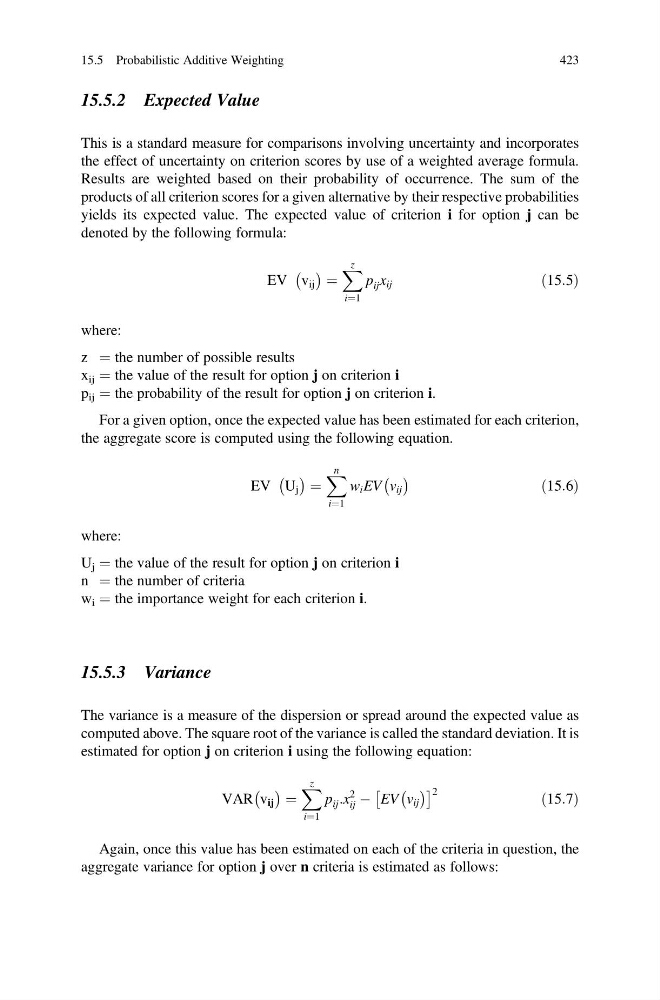
This is a standard measure for comparisons involving uncertainty and incorporates
the effect of uncertainty on criterion scores by use of a weighted average formula.
Results are weighted based on their probability of occurrence. The sum of the
products of all criterion scores for a given alternative by their respective probabilities
yields its expected value. The expected value of criterion i for option j can be
denoted by the following formula:
EV v ij
À Á ¼
X z
i¼1
p ij x ij
ð15:5Þ
where:
z ¼ the number of possible results
x ij ¼ the value of the result for option j on criterion i
p ij ¼ the probability of the result for option j on criterion i.
For a given option, once the expected value has been estimated for each criterion,
the aggregate score is computed using the following equation.
EV U j
À Á ¼
X n
i¼1
w i EV v ij
À Á
ð15:6Þ
where:
U j ¼ the value of the result for option j on criterion i
n ¼ the number of criteria
w i ¼ the importance weight for each criterion i.
15.5.3 Variance
The variance is a measure of the dispersion or spread around the expected value as
computed above. The square root of the variance is called the standard deviation. It is
estimated for option j on criterion i using the following equation:
VAR v ij
À Á ¼
X z
i¼1
p ij :x
2
ij À EV v ij
À Á
Â
à 2
ð15:7Þ
Again, once this value has been estimated on each of the criteria in question, the
aggregate variance for option j over n criteria is estimated as follows:
15.5 Probabilistic Additive Weighting
423
This is a standard measure for comparisons involving uncertainty and incorporates
the effect of uncertainty on criterion scores by use of a weighted average formula.
Results are weighted based on their probability of occurrence. The sum of the
products of all criterion scores for a given alternative by their respective probabilities
yields its expected value. The expected value of criterion i for option j can be
denoted by the following formula:
EV v ij
À Á ¼
X z
i¼1
p ij x ij
ð15:5Þ
where:
z ¼ the number of possible results
x ij ¼ the value of the result for option j on criterion i
p ij ¼ the probability of the result for option j on criterion i.
For a given option, once the expected value has been estimated for each criterion,
the aggregate score is computed using the following equation.
EV U j
À Á ¼
X n
i¼1
w i EV v ij
À Á
ð15:6Þ
where:
U j ¼ the value of the result for option j on criterion i
n ¼ the number of criteria
w i ¼ the importance weight for each criterion i.
15.5.3 Variance
The variance is a measure of the dispersion or spread around the expected value as
computed above. The square root of the variance is called the standard deviation. It is
estimated for option j on criterion i using the following equation:
VAR v ij
À Á ¼
X z
i¼1
p ij :x
2
ij À EV v ij
À Á
Â
à 2
ð15:7Þ
Again, once this value has been estimated on each of the criteria in question, the
aggregate variance for option j over n criteria is estimated as follows:
15.5 Probabilistic Additive Weighting
423