

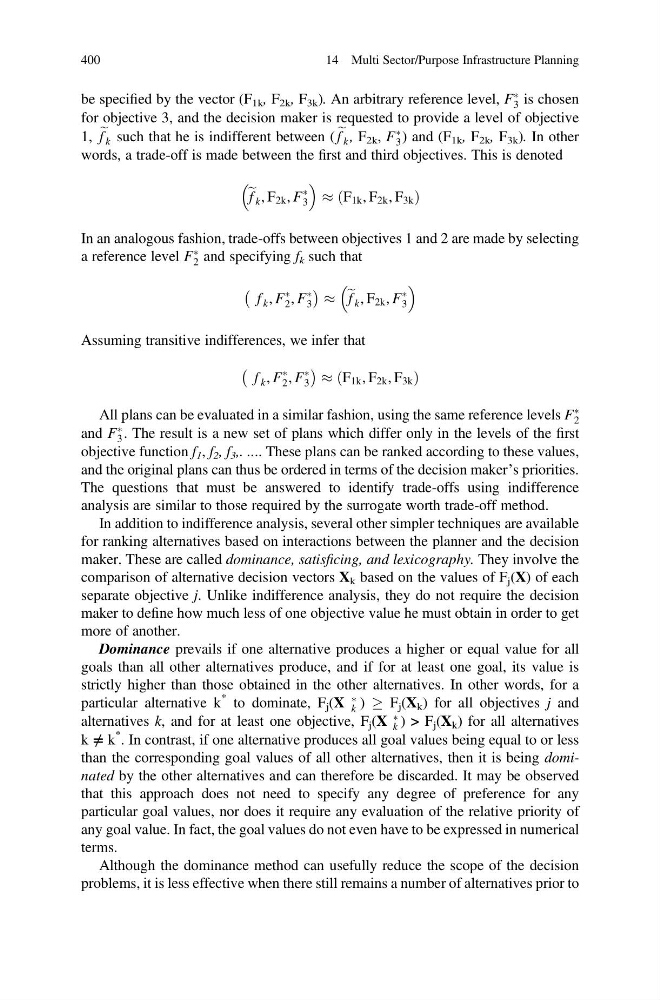
be specified by the vector (F 1k , F 2k , F 3k ). An arbitrary reference level, F
Ã
3 is chosen
for objective 3, and the decision maker is requested to provide a level of objective
1, e
f k such that he is indifferent between ( e
f k , F 2k , F
Ã
3 ) and (F 1k , F 2k , F 3k ). In other
words, a trade-off is made between the first and third objectives. This is denoted
e f k , F 2k , F
Ã
3
% F 1k , F 2k , F 3k
ð
Þ
In an analogous fashion, trade-offs between objectives 1 and 2 are made by selecting
a reference level F
Ã
2 and specifying f k such that
f k , F
Ã
2 , F
Ã
3
À
Á % e f k , F 2k , F
Ã
3
Assuming transitive indifferences, we infer that
f k , F
Ã
2 , F
Ã
3
À
Á % F 1k , F 2k , F 3k
ð
Þ
All plans can be evaluated in a similar fashion, using the same reference levels F
Ã
2
and F
Ã
3 . The result is a new set of plans which differ only in the levels of the first
objective function f 1 , f 2 , f 3 ,. .... These plans can be ranked according to these values,
and the original plans can thus be ordered in terms of the decision maker’s priorities.
The questions that must be answered to identify trade-offs using indifference
analysis are similar to those required by the surrogate worth trade-off method.
In addition to indifference analysis, several other simpler techniques are available
for ranking alternatives based on interactions between the planner and the decision
maker. These are called dominance, satisficing, and lexicography. They involve the
comparison of alternative decision vectors X k based on the values of F j (X) of each
separate objective j. Unlike indifference analysis, they do not require the decision
maker to define how much less of one objective value he must obtain in order to get
more of another.
Dominance prevails if one alternative produces a higher or equal value for all
goals than all other alternatives produce, and if for at least one goal, its value is
strictly higher than those obtained in the other alternatives. In other words, for a
particular alternative k
* to dominate, F j (X
Ã
k ) ! F j (X k ) for all objectives j and
alternatives k, and for at least one objective, F j (X
Ã
k ) > F j (X k ) for all alternatives
k ≠ k
* . In contrast, if one alternative produces all goal values being equal to or less
than the corresponding goal values of all other alternatives, then it is being dominated by the other alternatives and can therefore be discarded. It may be observed
that this approach does not need to specify any degree of preference for any
particular goal values, nor does it require any evaluation of the relative priority of
any goal value. In fact, the goal values do not even have to be expressed in numerical
terms.
Although the dominance method can usefully reduce the scope of the decision
problems, it is less effective when there still remains a number of alternatives prior to
400
14 Multi Sector/Purpose Infrastructure Planning
Ã
3 is chosen
for objective 3, and the decision maker is requested to provide a level of objective
1, e
f k such that he is indifferent between ( e
f k , F 2k , F
Ã
3 ) and (F 1k , F 2k , F 3k ). In other
words, a trade-off is made between the first and third objectives. This is denoted
e f k , F 2k , F
Ã
3
% F 1k , F 2k , F 3k
ð
Þ
In an analogous fashion, trade-offs between objectives 1 and 2 are made by selecting
a reference level F
Ã
2 and specifying f k such that
f k , F
Ã
2 , F
Ã
3
À
Á % e f k , F 2k , F
Ã
3
Assuming transitive indifferences, we infer that
f k , F
Ã
2 , F
Ã
3
À
Á % F 1k , F 2k , F 3k
ð
Þ
All plans can be evaluated in a similar fashion, using the same reference levels F
Ã
2
and F
Ã
3 . The result is a new set of plans which differ only in the levels of the first
objective function f 1 , f 2 , f 3 ,. .... These plans can be ranked according to these values,
and the original plans can thus be ordered in terms of the decision maker’s priorities.
The questions that must be answered to identify trade-offs using indifference
analysis are similar to those required by the surrogate worth trade-off method.
In addition to indifference analysis, several other simpler techniques are available
for ranking alternatives based on interactions between the planner and the decision
maker. These are called dominance, satisficing, and lexicography. They involve the
comparison of alternative decision vectors X k based on the values of F j (X) of each
separate objective j. Unlike indifference analysis, they do not require the decision
maker to define how much less of one objective value he must obtain in order to get
more of another.
Dominance prevails if one alternative produces a higher or equal value for all
goals than all other alternatives produce, and if for at least one goal, its value is
strictly higher than those obtained in the other alternatives. In other words, for a
particular alternative k
* to dominate, F j (X
Ã
k ) ! F j (X k ) for all objectives j and
alternatives k, and for at least one objective, F j (X
Ã
k ) > F j (X k ) for all alternatives
k ≠ k
* . In contrast, if one alternative produces all goal values being equal to or less
than the corresponding goal values of all other alternatives, then it is being dominated by the other alternatives and can therefore be discarded. It may be observed
that this approach does not need to specify any degree of preference for any
particular goal values, nor does it require any evaluation of the relative priority of
any goal value. In fact, the goal values do not even have to be expressed in numerical
terms.
Although the dominance method can usefully reduce the scope of the decision
problems, it is less effective when there still remains a number of alternatives prior to
400
14 Multi Sector/Purpose Infrastructure Planning