

2. Environmental Quality (EQ) which aims to improve the quality of the environment by managing, conserving, preserving, creating, restoring, or enhance the
quality of certain natural and cultural resources and ecological systems.
The beneficial and adverse impacts of any plan or project may then be classified
under four categories:
1. National Economic Development.
2. Environmental Quality.
3. Regional Development.
4. Social Well-Being.
Impacts for NED should be determined in monetary terms, but qualitative
parameters and nonmonetary quantification may be used for the other categories.
It is essential to prepare at least two plans, one of which stresses on NED, while
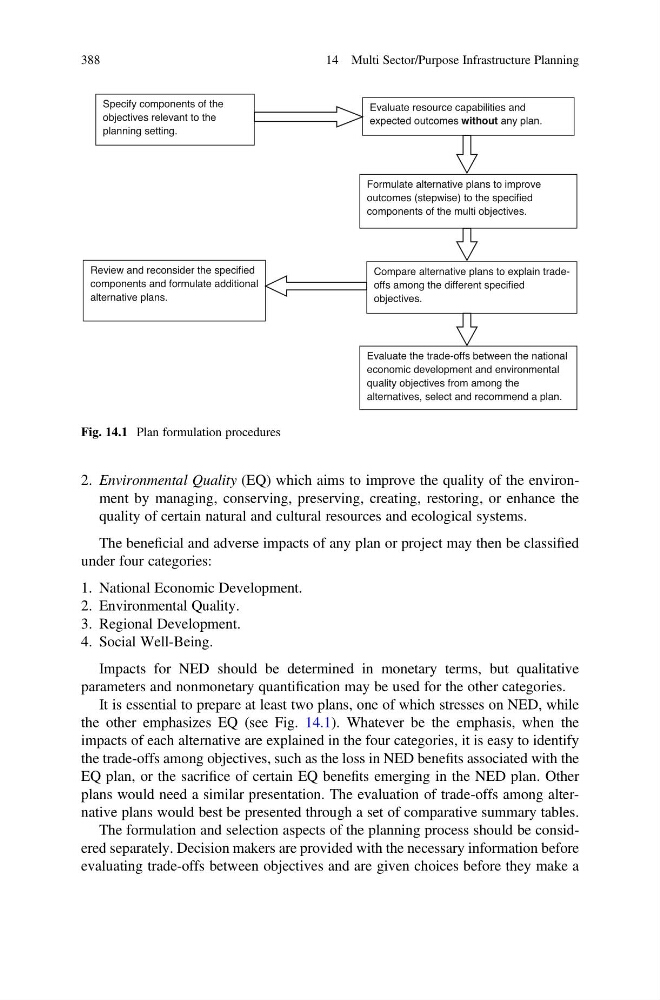
the other emphasizes EQ (see Fig. 14.1). Whatever be the emphasis, when the
impacts of each alternative are explained in the four categories, it is easy to identify
the trade-offs among objectives, such as the loss in NED benefits associated with the
EQ plan, or the sacrifice of certain EQ benefits emerging in the NED plan. Other
plans would need a similar presentation. The evaluation of trade-offs among alternative plans would best be presented through a set of comparative summary tables.
The formulation and selection aspects of the planning process should be considered separately. Decision makers are provided with the necessary information before
evaluating trade-offs between objectives and are given choices before they make a
\\
Specify components of the
objectives relevant to the
planning setting.
Evaluate resource capabilities and
expected outcomes without any plan.
Formulate alternative plans to improve
outcomes (stepwise) to the specified
components of the multi objectives.
Compare alternative plans to explain tradeoffs among the different specified
objectives.
Evaluate the trade-offs between the national
economic development and environmental
quality objectives from among the
alternatives, select and recommend a plan.
Review and reconsider the specified
components and formulate additional
alternative plans.
Fig. 14.1 Plan formulation procedures
388
14 Multi Sector/Purpose Infrastructure Planning
quality of certain natural and cultural resources and ecological systems.
The beneficial and adverse impacts of any plan or project may then be classified
under four categories:
1. National Economic Development.
2. Environmental Quality.
3. Regional Development.
4. Social Well-Being.
Impacts for NED should be determined in monetary terms, but qualitative
parameters and nonmonetary quantification may be used for the other categories.
It is essential to prepare at least two plans, one of which stresses on NED, while
the other emphasizes EQ (see Fig. 14.1). Whatever be the emphasis, when the
impacts of each alternative are explained in the four categories, it is easy to identify
the trade-offs among objectives, such as the loss in NED benefits associated with the
EQ plan, or the sacrifice of certain EQ benefits emerging in the NED plan. Other
plans would need a similar presentation. The evaluation of trade-offs among alternative plans would best be presented through a set of comparative summary tables.
The formulation and selection aspects of the planning process should be considered separately. Decision makers are provided with the necessary information before
evaluating trade-offs between objectives and are given choices before they make a
\\
Specify components of the
objectives relevant to the
planning setting.
Evaluate resource capabilities and
expected outcomes without any plan.
Formulate alternative plans to improve
outcomes (stepwise) to the specified
components of the multi objectives.
Compare alternative plans to explain tradeoffs among the different specified
objectives.
Evaluate the trade-offs between the national
economic development and environmental
quality objectives from among the
alternatives, select and recommend a plan.
Review and reconsider the specified
components and formulate additional
alternative plans.
Fig. 14.1 Plan formulation procedures
388
14 Multi Sector/Purpose Infrastructure Planning