

12.4 Factors Influencing Risk Perception
The perception of risks differs from person to person. According to psychologists,
some people will overstate a risk while others will underestimate it. Table 12.4 gives
the different parameters that affect the way we perceive risks.
It must be observed, however, that not only the culture of the country, but also the
people’s background will affect these perceptions. Thus, some youths will willfully
and carelessly take some risks, maybe as a result of bets. Even when the Meteorological Services have forecast strong winds, bad weather and high sea swells, they
will go out into the sea. In Mauritius, cyclones are welcome when they bring in rain
(not too much either), but are considered differently when they consist of very strong
winds (100–280 km/hr) without any significant rainfall.
12.5 Risk Hazard Classification
Different parameters such as perception, space and time, vulnerability and impact,
forecasting and prevention (Dauphiné 2001) may be used to classify the risk hazards
as in Table 12.5. The first column gives a list of such parameters that should better
help describe a risk hazard.
12.6 Measuring Disasters
In countries (Mauritius, Réunion, Rodrigues, etc.) which are often visited by
cyclones, the residents are familiar with hearing the different cyclone warnings,
and news of earthquakes. While cyclone warnings are based on a probability
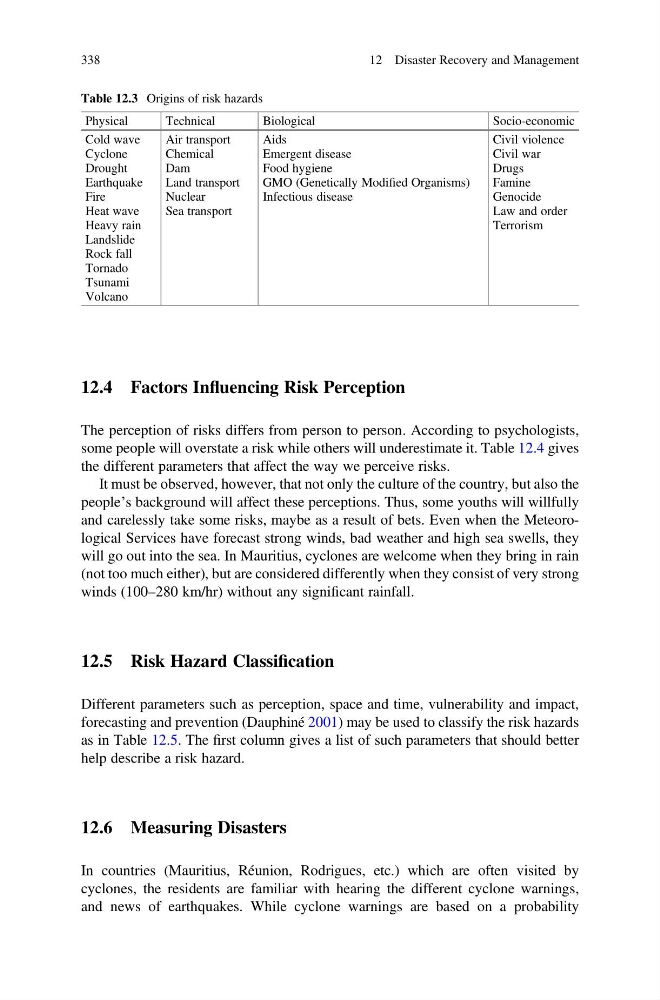
Table 12.3 Origins of risk hazards
Physical
Technical
Biological
Socio-economic
Cold wave
Air transport
Aids
Civil violence
Cyclone
Chemical
Emergent disease
Civil war
Drought
Dam
Food hygiene
Drugs
Earthquake
Land transport
GMO (Genetically Modified Organisms)
Famine
Fire
Nuclear
Infectious disease
Genocide
Heat wave
Sea transport
Law and order
Heavy rain
Terrorism
Landslide
Rock fall
Tornado
Tsunami
Volcano
338
12 Disaster Recovery and Management
The perception of risks differs from person to person. According to psychologists,
some people will overstate a risk while others will underestimate it. Table 12.4 gives
the different parameters that affect the way we perceive risks.
It must be observed, however, that not only the culture of the country, but also the
people’s background will affect these perceptions. Thus, some youths will willfully
and carelessly take some risks, maybe as a result of bets. Even when the Meteorological Services have forecast strong winds, bad weather and high sea swells, they
will go out into the sea. In Mauritius, cyclones are welcome when they bring in rain
(not too much either), but are considered differently when they consist of very strong
winds (100–280 km/hr) without any significant rainfall.
12.5 Risk Hazard Classification
Different parameters such as perception, space and time, vulnerability and impact,
forecasting and prevention (Dauphiné 2001) may be used to classify the risk hazards
as in Table 12.5. The first column gives a list of such parameters that should better
help describe a risk hazard.
12.6 Measuring Disasters
In countries (Mauritius, Réunion, Rodrigues, etc.) which are often visited by
cyclones, the residents are familiar with hearing the different cyclone warnings,
and news of earthquakes. While cyclone warnings are based on a probability
Table 12.3 Origins of risk hazards
Physical
Technical
Biological
Socio-economic
Cold wave
Air transport
Aids
Civil violence
Cyclone
Chemical
Emergent disease
Civil war
Drought
Dam
Food hygiene
Drugs
Earthquake
Land transport
GMO (Genetically Modified Organisms)
Famine
Fire
Nuclear
Infectious disease
Genocide
Heat wave
Sea transport
Law and order
Heavy rain
Terrorism
Landslide
Rock fall
Tornado
Tsunami
Volcano
338
12 Disaster Recovery and Management