

vulnerability entails some risk associated with social and economic liabilities, and
the possibility to cope with the resulting impacts.
Thus, if (1) effective recovery from a disaster, or (2) attaining a safe livelihood,
both rely on a proper access to resources, both households or individuals may
become vulnerable.
Well to do households having direct access to capital, tools and equipment, and
strong persons are those who can recover most quickly after a disastrous event.
Conversely, the poorest people, who can only settle in unsafe (unwanted) places
become the most vulnerable section of society.
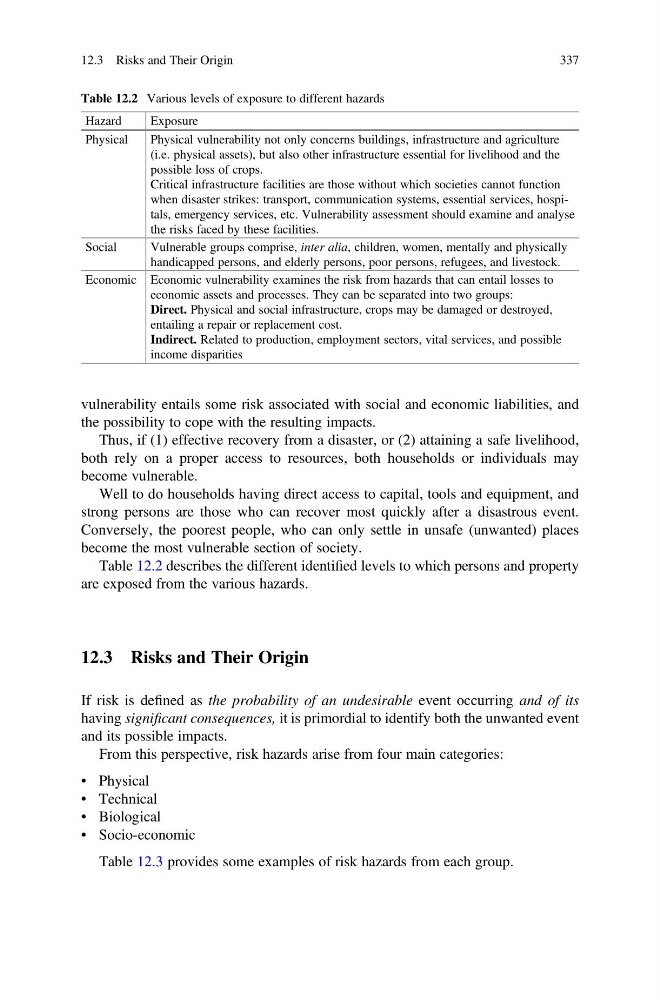
Table 12.2 describes the different identified levels to which persons and property
are exposed from the various hazards.
12.3 Risks and Their Origin
If risk is defined as the probability of an undesirable event occurring and of its
having significant consequences, it is primordial to identify both the unwanted event
and its possible impacts.
From this perspective, risk hazards arise from four main categories:
• Physical
• Technical
• Biological
• Socio-economic
Table 12.3 provides some examples of risk hazards from each group.
Table 12.2 Various levels of exposure to different hazards
Hazard
Exposure
Physical
Physical vulnerability not only concerns buildings, infrastructure and agriculture
(i.e. physical assets), but also other infrastructure essential for livelihood and the
possible loss of crops.
Critical infrastructure facilities are those without which societies cannot function
when disaster strikes: transport, communication systems, essential services, hospitals, emergency services, etc. Vulnerability assessment should examine and analyse
the risks faced by these facilities.
Social
Vulnerable groups comprise, inter alia, children, women, mentally and physically
handicapped persons, and elderly persons, poor persons, refugees, and livestock.
Economic Economic vulnerability examines the risk from hazards that can entail losses to
economic assets and processes. They can be separated into two groups:
Direct. Physical and social infrastructure, crops may be damaged or destroyed,
entailing a repair or replacement cost.
Indirect. Related to production, employment sectors, vital services, and possible
income disparities
12.3 Risks and Their Origin
337
the possibility to cope with the resulting impacts.
Thus, if (1) effective recovery from a disaster, or (2) attaining a safe livelihood,
both rely on a proper access to resources, both households or individuals may
become vulnerable.
Well to do households having direct access to capital, tools and equipment, and
strong persons are those who can recover most quickly after a disastrous event.
Conversely, the poorest people, who can only settle in unsafe (unwanted) places
become the most vulnerable section of society.
Table 12.2 describes the different identified levels to which persons and property
are exposed from the various hazards.
12.3 Risks and Their Origin
If risk is defined as the probability of an undesirable event occurring and of its
having significant consequences, it is primordial to identify both the unwanted event
and its possible impacts.
From this perspective, risk hazards arise from four main categories:
• Physical
• Technical
• Biological
• Socio-economic
Table 12.3 provides some examples of risk hazards from each group.
Table 12.2 Various levels of exposure to different hazards
Hazard
Exposure
Physical
Physical vulnerability not only concerns buildings, infrastructure and agriculture
(i.e. physical assets), but also other infrastructure essential for livelihood and the
possible loss of crops.
Critical infrastructure facilities are those without which societies cannot function
when disaster strikes: transport, communication systems, essential services, hospitals, emergency services, etc. Vulnerability assessment should examine and analyse
the risks faced by these facilities.
Social
Vulnerable groups comprise, inter alia, children, women, mentally and physically
handicapped persons, and elderly persons, poor persons, refugees, and livestock.
Economic Economic vulnerability examines the risk from hazards that can entail losses to
economic assets and processes. They can be separated into two groups:
Direct. Physical and social infrastructure, crops may be damaged or destroyed,
entailing a repair or replacement cost.
Indirect. Related to production, employment sectors, vital services, and possible
income disparities
12.3 Risks and Their Origin
337