

10.2.2 Exposure and Vulnerability of Infrastructure
to Climate Hazards
The infrastructure sector’s adaptive capacity – how it can adapt itself to maximize
positive impacts and minimize adverse ones – also defines its vulnerability to
climatic variations. Market mechanisms, policies, standards, and regulations can
play an important part in developing this adaptive capacity, but are not enough to
improve infrastructure resilience.
Three main ones, among a number of climatic as well as non-climatic parameters,
namely: design, composition and age, determine the sensitivity of infrastructure to
climate hazards. Design and composition depend on each other and may be affected
by other social and economic parameters.
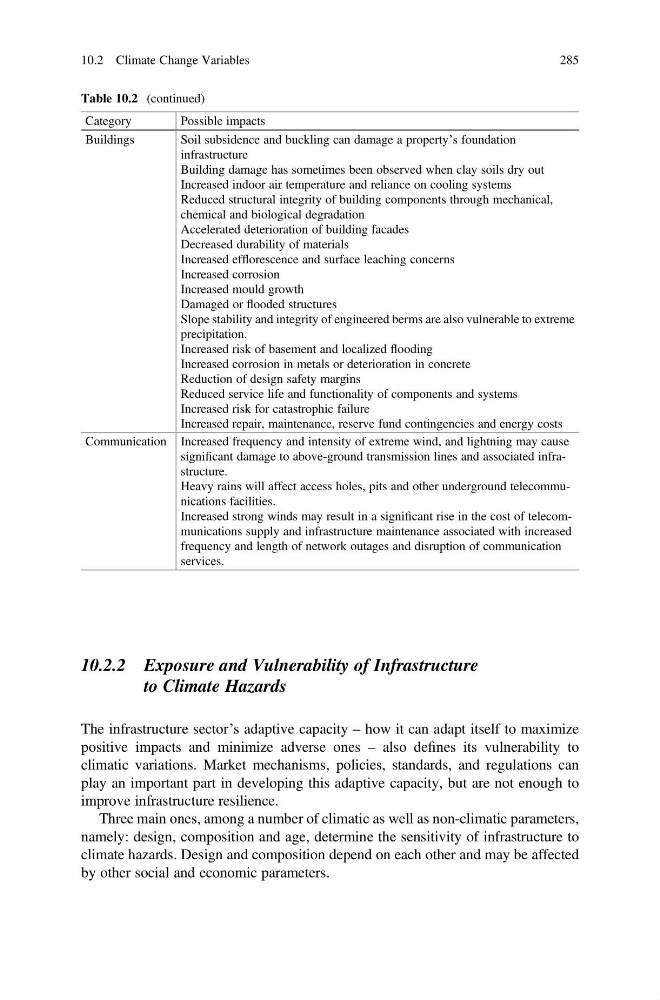
Table 10.2 (continued)
Category
Possible impacts
Buildings
Soil subsidence and buckling can damage a property’s foundation
infrastructure
Building damage has sometimes been observed when clay soils dry out
Increased indoor air temperature and reliance on cooling systems
Reduced structural integrity of building components through mechanical,
chemical and biological degradation
Accelerated deterioration of building facades
Decreased durability of materials
Increased efflorescence and surface leaching concerns
Increased corrosion
Increased mould growth
Damaged or flooded structures
Slope stability and integrity of engineered berms are also vulnerable to extreme
precipitation.
Increased risk of basement and localized flooding
Increased corrosion in metals or deterioration in concrete
Reduction of design safety margins
Reduced service life and functionality of components and systems
Increased risk for catastrophic failure
Increased repair, maintenance, reserve fund contingencies and energy costs
Communication Increased frequency and intensity of extreme wind, and lightning may cause
significant damage to above-ground transmission lines and associated infrastructure.
Heavy rains will affect access holes, pits and other underground telecommunications facilities.
Increased strong winds may result in a significant rise in the cost of telecommunications supply and infrastructure maintenance associated with increased
frequency and length of network outages and disruption of communication
services.
10.2 Climate Change Variables
285
to Climate Hazards
The infrastructure sector’s adaptive capacity – how it can adapt itself to maximize
positive impacts and minimize adverse ones – also defines its vulnerability to
climatic variations. Market mechanisms, policies, standards, and regulations can
play an important part in developing this adaptive capacity, but are not enough to
improve infrastructure resilience.
Three main ones, among a number of climatic as well as non-climatic parameters,
namely: design, composition and age, determine the sensitivity of infrastructure to
climate hazards. Design and composition depend on each other and may be affected
by other social and economic parameters.
Table 10.2 (continued)
Category
Possible impacts
Buildings
Soil subsidence and buckling can damage a property’s foundation
infrastructure
Building damage has sometimes been observed when clay soils dry out
Increased indoor air temperature and reliance on cooling systems
Reduced structural integrity of building components through mechanical,
chemical and biological degradation
Accelerated deterioration of building facades
Decreased durability of materials
Increased efflorescence and surface leaching concerns
Increased corrosion
Increased mould growth
Damaged or flooded structures
Slope stability and integrity of engineered berms are also vulnerable to extreme
precipitation.
Increased risk of basement and localized flooding
Increased corrosion in metals or deterioration in concrete
Reduction of design safety margins
Reduced service life and functionality of components and systems
Increased risk for catastrophic failure
Increased repair, maintenance, reserve fund contingencies and energy costs
Communication Increased frequency and intensity of extreme wind, and lightning may cause
significant damage to above-ground transmission lines and associated infrastructure.
Heavy rains will affect access holes, pits and other underground telecommunications facilities.
Increased strong winds may result in a significant rise in the cost of telecommunications supply and infrastructure maintenance associated with increased
frequency and length of network outages and disruption of communication
services.
10.2 Climate Change Variables
285