

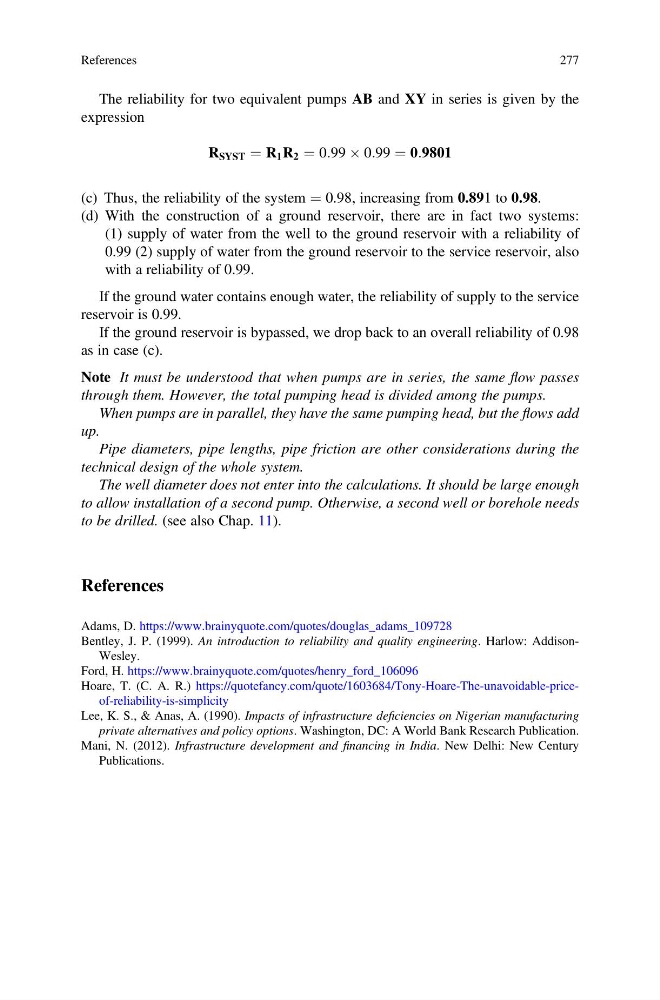
The reliability for two equivalent pumps AB and XY in series is given by the
expression
R SYST ¼ R 1 R 2 ¼ 0:99 Â 0:99 ¼ 0:9801
(c) Thus, the reliability of the system ¼ 0.98, increasing from 0.891 to 0.98.
(d) With the construction of a ground reservoir, there are in fact two systems:
(1) supply of water from the well to the ground reservoir with a reliability of
0.99 (2) supply of water from the ground reservoir to the service reservoir, also
with a reliability of 0.99.
If the ground water contains enough water, the reliability of supply to the service
reservoir is 0.99.
If the ground reservoir is bypassed, we drop back to an overall reliability of 0.98
as in case (c).
Note It must be understood that when pumps are in series, the same flow passes
through them. However, the total pumping head is divided among the pumps.
When pumps are in parallel, they have the same pumping head, but the flows add
up.
Pipe diameters, pipe lengths, pipe friction are other considerations during the
technical design of the whole system.
The well diameter does not enter into the calculations. It should be large enough
to allow installation of a second pump. Otherwise, a second well or borehole needs
to be drilled. (see also Chap. 11).
References
Adams, D. https://www.brainyquote.com/quotes/douglas_adams_109728
Bentley, J. P. (1999). An introduction to reliability and quality engineering. Harlow: AddisonWesley.
Ford, H. https://www.brainyquote.com/quotes/henry_ford_106096
Hoare, T. (C. A. R.) https://quotefancy.com/quote/1603684/Tony-Hoare-The-unavoidable-priceof-reliability-is-simplicity
Lee, K. S., & Anas, A. (1990). Impacts of infrastructure deficiencies on Nigerian manufacturing
private alternatives and policy options. Washington, DC: A World Bank Research Publication.
Mani, N. (2012). Infrastructure development and financing in India. New Delhi: New Century
Publications.
References
277
expression
R SYST ¼ R 1 R 2 ¼ 0:99 Â 0:99 ¼ 0:9801
(c) Thus, the reliability of the system ¼ 0.98, increasing from 0.891 to 0.98.
(d) With the construction of a ground reservoir, there are in fact two systems:
(1) supply of water from the well to the ground reservoir with a reliability of
0.99 (2) supply of water from the ground reservoir to the service reservoir, also
with a reliability of 0.99.
If the ground water contains enough water, the reliability of supply to the service
reservoir is 0.99.
If the ground reservoir is bypassed, we drop back to an overall reliability of 0.98
as in case (c).
Note It must be understood that when pumps are in series, the same flow passes
through them. However, the total pumping head is divided among the pumps.
When pumps are in parallel, they have the same pumping head, but the flows add
up.
Pipe diameters, pipe lengths, pipe friction are other considerations during the
technical design of the whole system.
The well diameter does not enter into the calculations. It should be large enough
to allow installation of a second pump. Otherwise, a second well or borehole needs
to be drilled. (see also Chap. 11).
References
Adams, D. https://www.brainyquote.com/quotes/douglas_adams_109728
Bentley, J. P. (1999). An introduction to reliability and quality engineering. Harlow: AddisonWesley.
Ford, H. https://www.brainyquote.com/quotes/henry_ford_106096
Hoare, T. (C. A. R.) https://quotefancy.com/quote/1603684/Tony-Hoare-The-unavoidable-priceof-reliability-is-simplicity
Lee, K. S., & Anas, A. (1990). Impacts of infrastructure deficiencies on Nigerian manufacturing
private alternatives and policy options. Washington, DC: A World Bank Research Publication.
Mani, N. (2012). Infrastructure development and financing in India. New Delhi: New Century
Publications.
References
277