

R t
ð Þ ¼ exp Àλt
ð
Þ
X nÀ1
k¼0
λt
ð Þ
k
k!
ð9:10Þ
Thus for n ¼ 1, this yields, as expected,
R t
ð Þ ¼ exp Àλt
ð
Þ
For n ¼ 2, R(t) increases to:
R t
ð Þ ¼ exp Àλt
ð
Þ 1 þ λt
½
ð9:11Þ
The term λt.exp(2λt) gives the increase in reliability resulting from one additional standby unit.
When n ¼ 3, there is a further increase in R(t):
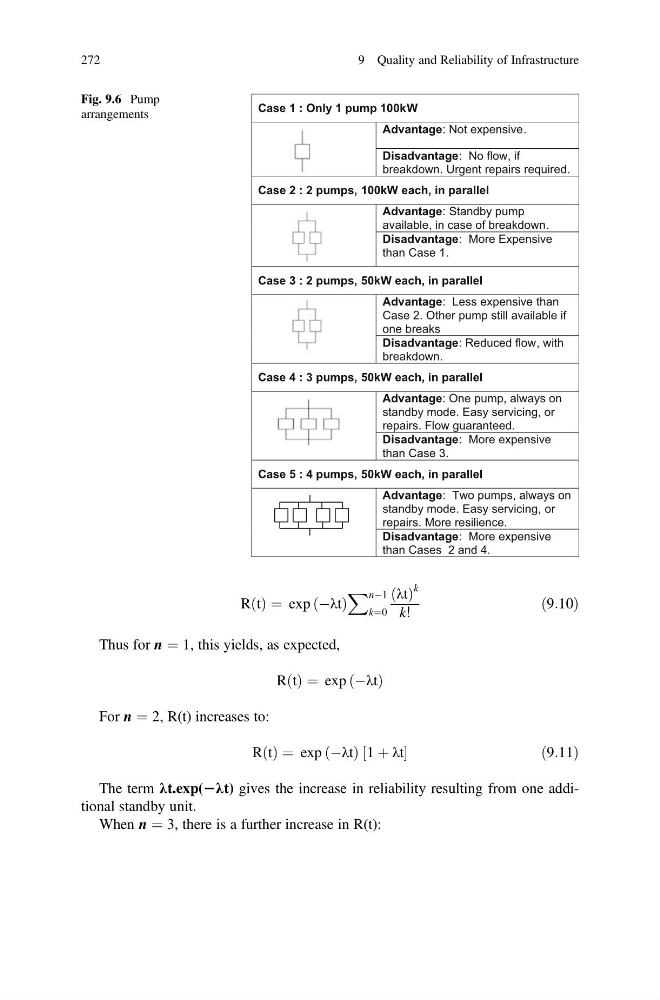
Case 1 : Only 1 pump 100kW
Advantage: Not expensive.
Disadvantage: No flow, if
breakdown. Urgent repairs required.
Case 2 : 2 pumps, 100kW each, in parallel
Advantage: Standby pump
available, in case of breakdown.
Disadvantage: More Expensive
than Case 1.
Case 3 : 2 pumps, 50kW each, in parallel
Advantage: Less expensive than
Case 2. Other pump still available if
one breaks
Disadvantage: Reduced flow, with
breakdown.
Case 4 : 3 pumps, 50kW each, in parallel
Advantage: One pump, always on
standby mode. Easy servicing, or
repairs. Flow guaranteed.
Disadvantage: More expensive
than Case 3.
Case 5 : 4 pumps, 50kW each, in parallel
Advantage: Two pumps, always on
standby mode. Easy servicing, or
repairs. More resilience.
Disadvantage: More expensive
than Cases 2 and 4.
Fig. 9.6 Pump
arrangements
272
9 Quality and Reliability of Infrastructure
ð Þ ¼ exp Àλt
ð
Þ
X nÀ1
k¼0
λt
ð Þ
k
k!
ð9:10Þ
Thus for n ¼ 1, this yields, as expected,
R t
ð Þ ¼ exp Àλt
ð
Þ
For n ¼ 2, R(t) increases to:
R t
ð Þ ¼ exp Àλt
ð
Þ 1 þ λt
½
ð9:11Þ
The term λt.exp(2λt) gives the increase in reliability resulting from one additional standby unit.
When n ¼ 3, there is a further increase in R(t):
Case 1 : Only 1 pump 100kW
Advantage: Not expensive.
Disadvantage: No flow, if
breakdown. Urgent repairs required.
Case 2 : 2 pumps, 100kW each, in parallel
Advantage: Standby pump
available, in case of breakdown.
Disadvantage: More Expensive
than Case 1.
Case 3 : 2 pumps, 50kW each, in parallel
Advantage: Less expensive than
Case 2. Other pump still available if
one breaks
Disadvantage: Reduced flow, with
breakdown.
Case 4 : 3 pumps, 50kW each, in parallel
Advantage: One pump, always on
standby mode. Easy servicing, or
repairs. Flow guaranteed.
Disadvantage: More expensive
than Case 3.
Case 5 : 4 pumps, 50kW each, in parallel
Advantage: Two pumps, always on
standby mode. Easy servicing, or
repairs. More resilience.
Disadvantage: More expensive
than Cases 2 and 4.
Fig. 9.6 Pump
arrangements
272
9 Quality and Reliability of Infrastructure