

particularly when the benefits assume the forms of reduced disability and longer
anticipated life spans. The basic issue is to estimate social costs triggered by any
disease under different assumed conditions.
If we consider an individual who is exposed to a particular disease, labelled k,
under any one proposed disease-control project, he may be spending different time
periods in one state of disability or more, each of which signifies a different cost per
time unit to him. A possible stratification of such incapacities might be into m ¼ 6
states:
1. minor disability - no restrictions on normal activities
2. restricted activity
3. limited activity
4. limited mobility
5. confined – therefore immobile
6. death.
Historical data and professional opinions can be used in assessing the expected
time E(t ki ) that the individual will spend in disability state i, where i ¼ 1, 2,..., m,
given that he was subjected to disease k. The expected time spent as disabled person
until state m, death, is.
E t km :
ð Þ ¼ expected life span in the absence of disease k
ð
Þ
À expected life span, given disease k
ð
Þ
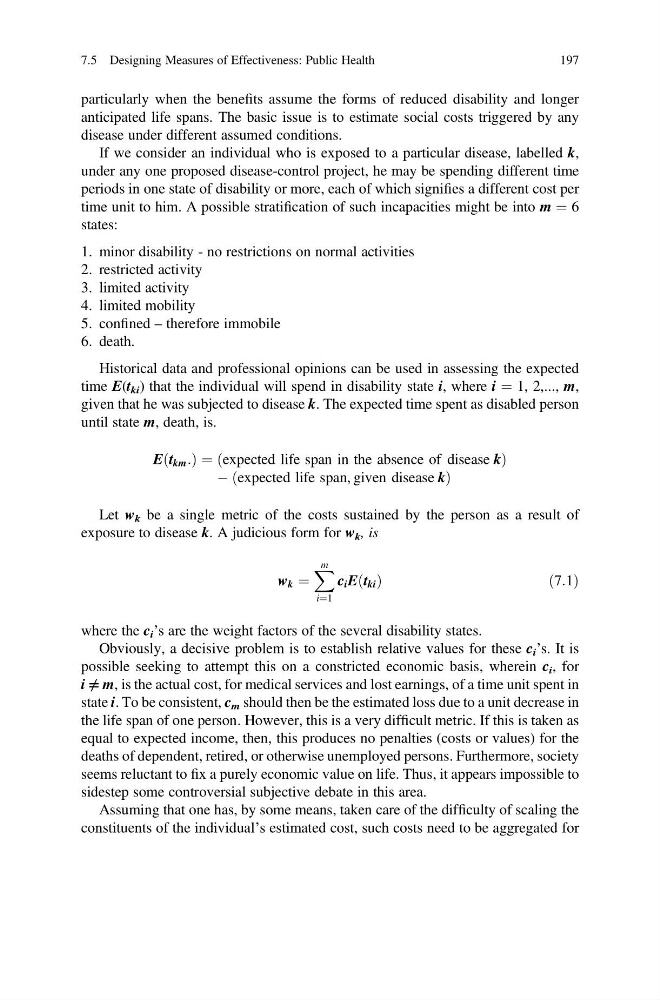
Let w k be a single metric of the costs sustained by the person as a result of
exposure to disease k. A judicious form for w k , is
w k ¼
X m
i¼1
c i E t ki
ð Þ
ð7:1Þ
where the c i ’s are the weight factors of the several disability states.
Obviously, a decisive problem is to establish relative values for these c i ’s. It is
possible seeking to attempt this on a constricted economic basis, wherein c i , for
i ≠ m, is the actual cost, for medical services and lost earnings, of a time unit spent in
state i. To be consistent, c m should then be the estimated loss due to a unit decrease in
the life span of one person. However, this is a very difficult metric. If this is taken as
equal to expected income, then, this produces no penalties (costs or values) for the
deaths of dependent, retired, or otherwise unemployed persons. Furthermore, society
seems reluctant to fix a purely economic value on life. Thus, it appears impossible to
sidestep some controversial subjective debate in this area.
Assuming that one has, by some means, taken care of the difficulty of scaling the
constituents of the individual’s estimated cost, such costs need to be aggregated for
7.5 Designing Measures of Effectiveness: Public Health
197
anticipated life spans. The basic issue is to estimate social costs triggered by any
disease under different assumed conditions.
If we consider an individual who is exposed to a particular disease, labelled k,
under any one proposed disease-control project, he may be spending different time
periods in one state of disability or more, each of which signifies a different cost per
time unit to him. A possible stratification of such incapacities might be into m ¼ 6
states:
1. minor disability - no restrictions on normal activities
2. restricted activity
3. limited activity
4. limited mobility
5. confined – therefore immobile
6. death.
Historical data and professional opinions can be used in assessing the expected
time E(t ki ) that the individual will spend in disability state i, where i ¼ 1, 2,..., m,
given that he was subjected to disease k. The expected time spent as disabled person
until state m, death, is.
E t km :
ð Þ ¼ expected life span in the absence of disease k
ð
Þ
À expected life span, given disease k
ð
Þ
Let w k be a single metric of the costs sustained by the person as a result of
exposure to disease k. A judicious form for w k , is
w k ¼
X m
i¼1
c i E t ki
ð Þ
ð7:1Þ
where the c i ’s are the weight factors of the several disability states.
Obviously, a decisive problem is to establish relative values for these c i ’s. It is
possible seeking to attempt this on a constricted economic basis, wherein c i , for
i ≠ m, is the actual cost, for medical services and lost earnings, of a time unit spent in
state i. To be consistent, c m should then be the estimated loss due to a unit decrease in
the life span of one person. However, this is a very difficult metric. If this is taken as
equal to expected income, then, this produces no penalties (costs or values) for the
deaths of dependent, retired, or otherwise unemployed persons. Furthermore, society
seems reluctant to fix a purely economic value on life. Thus, it appears impossible to
sidestep some controversial subjective debate in this area.
Assuming that one has, by some means, taken care of the difficulty of scaling the
constituents of the individual’s estimated cost, such costs need to be aggregated for
7.5 Designing Measures of Effectiveness: Public Health
197