

6.3.2 System Characteristics
Systems have some major characteristics, which apply very well to infrastructure
networks or systems:
(1) An infrastructure system constitutes a complex grouping of equipment and
persons.
(2) An infrastructure system comprises sub-systems. While drawing the flow diagrams of the subsystems, the level of detail required will depend on the problem
being studied.
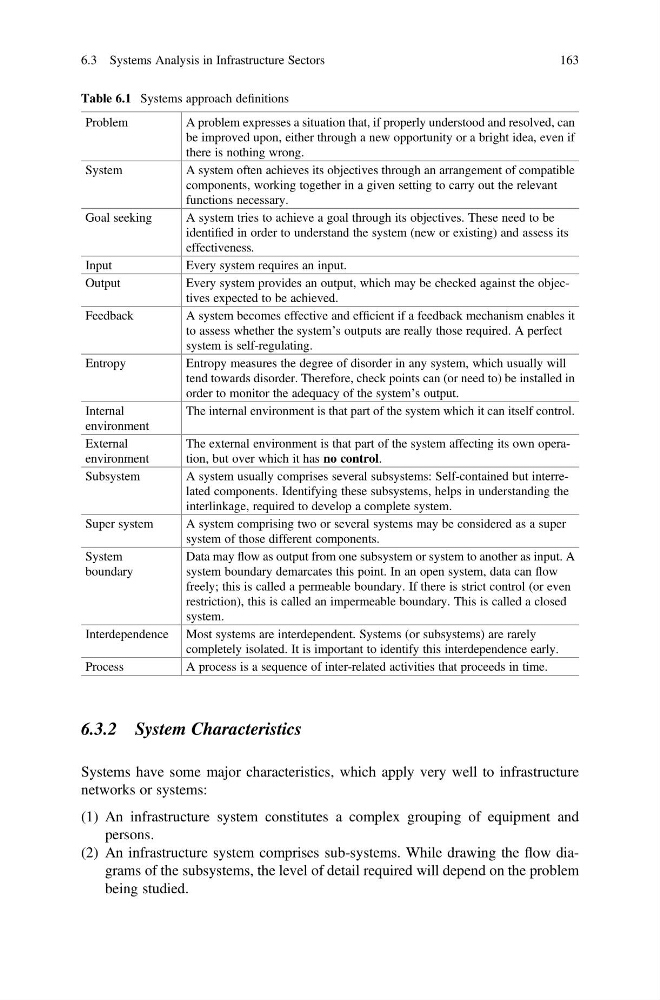
Table 6.1 Systems approach definitions
Problem
A problem expresses a situation that, if properly understood and resolved, can
be improved upon, either through a new opportunity or a bright idea, even if
there is nothing wrong.
System
A system often achieves its objectives through an arrangement of compatible
components, working together in a given setting to carry out the relevant
functions necessary.
Goal seeking
A system tries to achieve a goal through its objectives. These need to be
identified in order to understand the system (new or existing) and assess its
effectiveness.
Input
Every system requires an input.
Output
Every system provides an output, which may be checked against the objectives expected to be achieved.
Feedback
A system becomes effective and efficient if a feedback mechanism enables it
to assess whether the system’s outputs are really those required. A perfect
system is self-regulating.
Entropy
Entropy measures the degree of disorder in any system, which usually will
tend towards disorder. Therefore, check points can (or need to) be installed in
order to monitor the adequacy of the system’s output.
Internal
environment
The internal environment is that part of the system which it can itself control.
External
environment
The external environment is that part of the system affecting its own operation, but over which it has no control.
Subsystem
A system usually comprises several subsystems: Self-contained but interrelated components. Identifying these subsystems, helps in understanding the
interlinkage, required to develop a complete system.
Super system
A system comprising two or several systems may be considered as a super
system of those different components.
System
boundary
Data may flow as output from one subsystem or system to another as input. A
system boundary demarcates this point. In an open system, data can flow
freely; this is called a permeable boundary. If there is strict control (or even
restriction), this is called an impermeable boundary. This is called a closed
system.
Interdependence Most systems are interdependent. Systems (or subsystems) are rarely
completely isolated. It is important to identify this interdependence early.
Process
A process is a sequence of inter-related activities that proceeds in time.
6.3 Systems Analysis in Infrastructure Sectors
163
Systems have some major characteristics, which apply very well to infrastructure
networks or systems:
(1) An infrastructure system constitutes a complex grouping of equipment and
persons.
(2) An infrastructure system comprises sub-systems. While drawing the flow diagrams of the subsystems, the level of detail required will depend on the problem
being studied.
Table 6.1 Systems approach definitions
Problem
A problem expresses a situation that, if properly understood and resolved, can
be improved upon, either through a new opportunity or a bright idea, even if
there is nothing wrong.
System
A system often achieves its objectives through an arrangement of compatible
components, working together in a given setting to carry out the relevant
functions necessary.
Goal seeking
A system tries to achieve a goal through its objectives. These need to be
identified in order to understand the system (new or existing) and assess its
effectiveness.
Input
Every system requires an input.
Output
Every system provides an output, which may be checked against the objectives expected to be achieved.
Feedback
A system becomes effective and efficient if a feedback mechanism enables it
to assess whether the system’s outputs are really those required. A perfect
system is self-regulating.
Entropy
Entropy measures the degree of disorder in any system, which usually will
tend towards disorder. Therefore, check points can (or need to) be installed in
order to monitor the adequacy of the system’s output.
Internal
environment
The internal environment is that part of the system which it can itself control.
External
environment
The external environment is that part of the system affecting its own operation, but over which it has no control.
Subsystem
A system usually comprises several subsystems: Self-contained but interrelated components. Identifying these subsystems, helps in understanding the
interlinkage, required to develop a complete system.
Super system
A system comprising two or several systems may be considered as a super
system of those different components.
System
boundary
Data may flow as output from one subsystem or system to another as input. A
system boundary demarcates this point. In an open system, data can flow
freely; this is called a permeable boundary. If there is strict control (or even
restriction), this is called an impermeable boundary. This is called a closed
system.
Interdependence Most systems are interdependent. Systems (or subsystems) are rarely
completely isolated. It is important to identify this interdependence early.
Process
A process is a sequence of inter-related activities that proceeds in time.
6.3 Systems Analysis in Infrastructure Sectors
163